ความวิตกกังวล ความเครียด และความหวังที่มีความสัมพันธ์กับภาวะซึมเศร้า ในผู้หญิงที่มีภาวะมีบุตรยาก: การทบทวนวรรณกรรมอย่างเป็นระบบ
คำสำคัญ:
ภาวะมีบุตรยาก, ความวิตกกังวล, ความเครียด, ความหวัง, ภาวะซึมเศร้าบทคัดย่อ
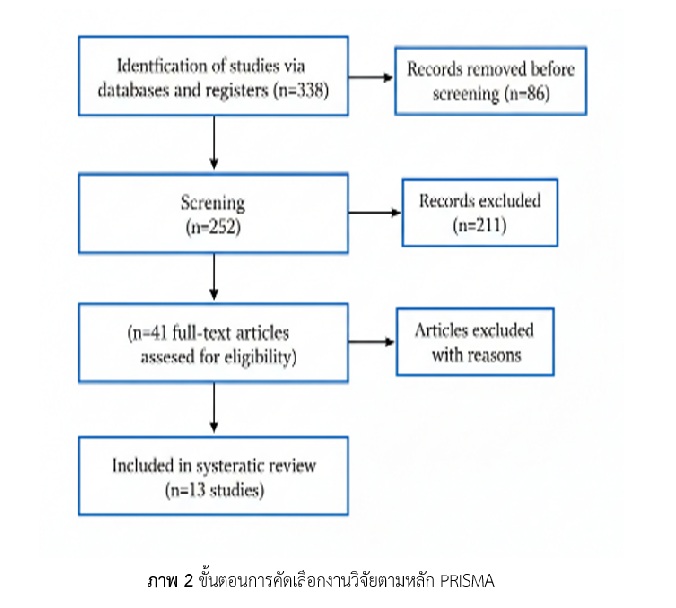
การวิจัยครั้งนี้มีวัตถุประสงค์เพื่อทบทวนและสังเคราะห์หลักฐานเชิงประจักษ์เกี่ยวกับความวิตกกังวล ความเครียด และความหวังที่มีความสัมพันธ์กับภาวะซึมเศร้าในผู้หญิงที่มีภาวะมีบุตรยาก โดยใช้ระเบียบวิธีการทบทวนวรรณกรรมอย่างเป็นระบบตามแนวคิดของสถาบันโจแอนนาบริกส์ (Joanna Briggs Institute: JBI) และรายงานผลตามแนวทาง PRISMA 2020 งานวิจัยที่นำมาทบทวนเป็นงานวิจัยปฐมภูมิทั้งเชิงปริมาณ และเชิงคุณภาพ ภาษาไทยและภาษาอังกฤษที่ตีพิมพ์ในช่วงปี พ.ศ. 2558 – 2568 การสืบค้นดำเนินการจากฐานข้อมูลอิเล็กทรอนิกส์ ได้แก่ CINAHL, Scopus, PubMed ,Thai Journals Online (ThaiJO) และ Google Scholar รวมถึงการสืบค้นด้วยมือจากวารสารและวิทยานิพนธ์ การกำหนดคำถามการวิจัยใช้กรอบ PEO (Population–Exposure–Outcome) กระบวนการคัดเลือก การประเมินคุณภาพ และการสกัดข้อมูลดำเนินการโดยผู้วิจัยอย่างเป็นอิสระตามแบบประเมินของ JBI จากการสืบค้นพบงานวิจัยจำนวน 338 เรื่อง หลังการตัดซ้ำและคัดกรองตามเกณฑ์เหลืองานวิจัยที่ผ่านการประเมินคุณภาพในระดับปานกลางถึงสูงและนำมาสังเคราะห์ผลจำนวน 13 เรื่อง สรุปเชิงเนื้อหาเพื่อบรรยายความวิตกกังวล ความเครียด และความหวังที่มีความสัมพันธ์กับภาวะซึมเศร้าในผู้หญิงที่มีภาวะมีบุตรยาก
ผลการวิจัย พบว่า 1) ผู้หญิงที่มีภาวะมีบุตรยากมีระดับความวิตกกังวลและความเครียดตั้งแต่ระดับปานกลางถึงสูง ในช่วงการรักษาด้วยเทคโนโลยีช่วยการเจริญพันธุ์ 2) ความวิตกกังวลและความเครียดมีความสัมพันธ์เชิงบวกกับภาวะซึมเศร้าอย่างมีนัยสำคัญทางสถิติ และ 3) ความหวังมีความสัมพันธ์เชิงลบกับภาวะซึมเศร้า โดย ความหวังมีบทบาทเป็นปัจจัยปกป้องและเป็นตัวแปรตัวกลางที่ช่วยลดทอนผลกระทบของความวิตกกังวลและความเครียดต่อภาวะซึมเศร้า
ผลการศึกษานี้ ชี้ให้เห็นว่า ภาวะซึมเศร้าในสตรีที่มีภาวะมีบุตรยากเป็นผลจากปฏิสัมพันธ์ของปัจจัยทางจิตสังคมหลายมิติ ดังนั้น การดูแลที่มีประสิทธิผลควรบูรณาการการรักษาทางการแพทย์กับการส่งเสริมสุขภาพจิตอย่างเป็นระบบเพื่อมุ่งสู่การดูแลแบบองค์รวม ที่ตอบสนองทั้งการรักษาและคุณภาพชีวิตของผู้รับบริการ
เอกสารอ้างอิง
Arhin, S. K., Mensah, F. O., & Boateng, L. A. (2025). Psychological distress, hope, and coping among women experiencing infertility in Ghana: A qualitative study. BMC Women’s Health, 25(1), 118. https://doi.org/10.1186/s12905-025-X
Beyene, G. M., Tesfaye, M., & Alemu, T. (2025). Perceived social stigma, anxiety, stress, and depression among infertile women attending fertility clinics in Ethiopia. Journal of Psychosomatic Obstetrics & Gynecology, 46(1), 34–42. https://doi.org/10.1080/0167482X.2024.x
Boivin, J., Griffiths, E., & Venetis, C. A. (2020). Emotional distress in infertility: Women’s and men’s expectations and the reality of treatment. Human Reproduction, 35(1), 122–133.
Chin, K., Somsakul, P., & Tan, L. (2021). Socio-cultural pressures and psychological distress among infertile women in Asian contexts. Journal of Psychosomatic Obstetrics & Gynecology, 42(3), 189–198.
Khalesi, Z., & Kenarsari, M. (2024). Hope as a mediator between infertility-related stress and depression in infertile women. Journal of Affective Disorders, 340, 327–334.
Kiani, A., Ghasemi, M., & Rahimian, H. (2022). The mediating role of hope in the relationship between anxiety and depression among infertile women. Health and Quality of Life Outcomes, 20(1), 45–54.
Lei, Y., Wang, J., Zhang, L., & Li, X. (2021). Infertility-related stress, marital relationship, and depression among infertile women. Journal of Reproductive and Infant Psychology, 39(5), 493–505. https://doi.org/10.1080/02646838.2020.1856372
Lockwood, C., Porritt, K., Munn, Z., Rittenmeyer, L., Salmond, S., Bjerrum, M., Loveday, H., Carrier, J., & Stannard, D. (2017). Chapter 2: Systematic reviews of qualitative evidence. In E. Aromataris & Z. Munn (Eds.), JBI manual for evidence synthesis. Adelaide, Australia: Joanna Briggs Institute.
Omani-Samani, R., Marouf Zadeh, S., Ghaderi, A., & Navid, B. (2017). Hope and its relationship with depression, anxiety, and stress in infertile women. Iranian Journal of Reproductive Medicine, 15(10), 591–598.
Page, M. J., McKenzie, J. E., Bossuyt, P. M., Boutron, I., Hoffmann, T. C., Mulrow, C. D., … Moher, D. (2021). The PRISMA 2020 statement: An updated guideline for reporting systematic reviews. BMJ, 372, n71. doi:10.1136/bmj.n71
Pangzup, P., Nilmanat, K., & Kongsuwan, W. (2021). Living with infertility: Women lived experiences and meaning-making in the Thai cultural context. Nursing & Health Sciences, 23(4), 948–956. (in Thai)
Sakulsaengprapha, A., Chontawan, R., & Songwathana, P. (2019). Psychological experiences of Thai women with infertility: A qualitative meta-synthesis. Thai Journal of Nursing Research, 23(2), 85–98. (in Thai)
Song, Y., Chen, J., Wang, Y., & Liu, H. (2024). Psychological distress and depression among women with infertility: The role of maladaptive coping styles. Frontiers in Psychiatry, 15, 1298457. https://doi.org/10.3389/fpsyt.2024.1298457
Terzioglu, F., Turk, R., Yucel, C., & Dilbaz, B. (2016). Stress, depression, and marital adjustment in infertile women undergoing assisted reproductive treatment. European Journal of Obstetrics & Gynecology and Reproductive Biology, 206, 9–14. https://doi.org/10.1016/j.ejogrb.2016.08.021
World Health Organization. (2023). Infertility prevalence estimates, 1990–2021. Geneva, Switzerland: World Health Organization.
Wu, H. L., Lin, C. L., & Huang, M. C. (2021). Personal and social stress, hope, and quality of life in women receiving infertility treatment. Journal of Nursing Research, 29(4), e165. https://doi.org/10.1097/jnr.0000000000000456
Yokota, R. T. C., Matsuyama, Y., & Fujiwara, T. (2022). Social stigma, anxiety, and depressive symptoms among women with infertility in Japan. Social Science & Medicine, 302, 114987. https://doi.org/10.1016/j.socscimed.2022.114987
ดาวน์โหลด
เผยแพร่แล้ว
รูปแบบการอ้างอิง
ฉบับ
ประเภทบทความ
สัญญาอนุญาต
ลิขสิทธิ์ (c) 2026 วิทยาลัยพยาบาลบรมราชชนนี นครศรีธรรมราช

อนุญาตภายใต้เงื่อนไข Creative Commons Attribution-NonCommercial-NoDerivatives 4.0 International License.
บทความที่ได้รับการตีพิมพ์เป็นลิขสิทธิ์ของ วิทยาลัยพยาบาลบรมราชชนนี นครศรีธรรมราช
ข้อความที่ปรากฏในบทความแต่ละเรื่องในวารสารวิชาการเล่มนี้เป็นความคิดเห็นส่วนตัวของผู้เขียนแต่ละท่านไม่เกี่ยวข้องกับวิทยาลัยพยาบาลบรมราชชนนี นครศรีธรรมราช และบุคคลากรท่านอื่น ๆ ในวิทยาลัยฯ แต่อย่างใด ความรับผิดชอบองค์ประกอบทั้งหมดของบทความแต่ละเรื่องเป็นของผู้เขียนแต่ละท่าน หากมีความผิดพลาดใดๆ ผู้เขียนแต่ละท่านจะรับผิดชอบบทความของตนเองแต่ผู้เดียว