Anxiety, Stress, Hope, and Depression among Women with Infertility: A Systematic Review
Keywords:
Infertility, Anxiety, Stress, Hope, DepressionAbstract
This study aimed to systematically review and synthesize empirical evidence on
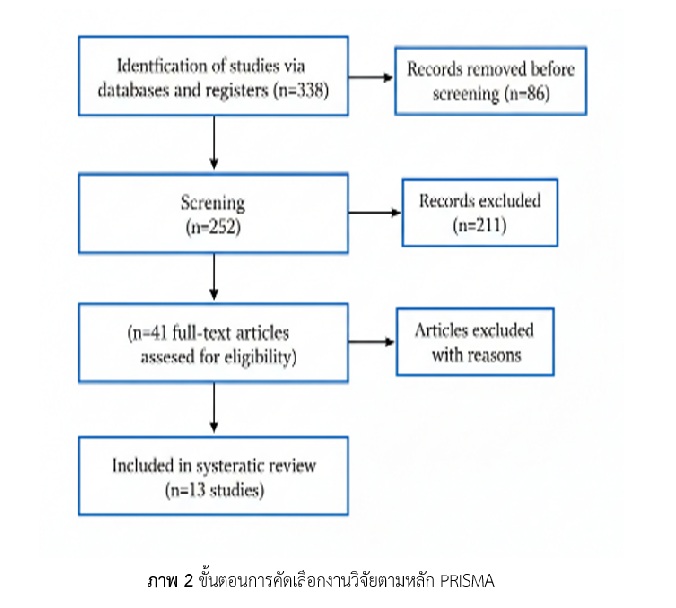
anxiety, stress, and hope in relation to depression among women with infertility. The review was conducted following the systematic review methodology of the Joanna Briggs Institute (JBI) and reported in accordance with the PRISMA 2020 guidelines. Primary quantitative and qualitative studies published in Thai and English between 2015 and 2025 were included. Literature searches were conducted using electronic databases, including CINAHL, Scopus, Thai Journals Online (Thai JO), and Google Scholar, supplemented by manual searches of relevant journals and theses. The research questions were formulated using the Population–Exposure–Outcome (PEO) framework. Study selection, quality appraisal, and data extraction were independently performed using JBI appraisal tools. A total of 338 records were identified. After removing duplicates and screening according to the eligibility criteria, 13 studies of moderate to high methodological quality were included in the final synthesis. Narrative synthesis was used to describe anxiety, stress, and hope in relation to depression among women with infertility.
The findings revealed that: (1) women with infertility consistently experienced moderate to high levels of anxiety and stress, particularly during assisted reproductive technology (ART) treatment; (2) anxiety and stress were significantly and positively associated with depression; and (3) hope was negatively associated with depression and functioned as a protective factor, as well as a mediating variable that reduced the effects of anxiety and stress on depression.
This systematic review highlights the critical role of psychosocial factors—anxiety, stress, and hope in depression among women with infertility. The findings provide essential evidence to inform the development of mental health care, counseling services, and structured hope-enhancement programs aimed at reducing the level and severity of depression in this population.
References
Arhin, S. K., Mensah, F. O., & Boateng, L. A. (2025). Psychological distress, hope, and coping among women experiencing infertility in Ghana: A qualitative study. BMC Women’s Health, 25(1), 118. https://doi.org/10.1186/s12905-025-X
Beyene, G. M., Tesfaye, M., & Alemu, T. (2025). Perceived social stigma, anxiety, stress, and depression among infertile women attending fertility clinics in Ethiopia. Journal of Psychosomatic Obstetrics & Gynecology, 46(1), 34–42. https://doi.org/10.1080/0167482X.2024.x
Boivin, J., Griffiths, E., & Venetis, C. A. (2020). Emotional distress in infertility: Women’s and men’s expectations and the reality of treatment. Human Reproduction, 35(1), 122–133.
Chin, K., Somsakul, P., & Tan, L. (2021). Socio-cultural pressures and psychological distress among infertile women in Asian contexts. Journal of Psychosomatic Obstetrics & Gynecology, 42(3), 189–198.
Khalesi, Z., & Kenarsari, M. (2024). Hope as a mediator between infertility-related stress and depression in infertile women. Journal of Affective Disorders, 340, 327–334.
Kiani, A., Ghasemi, M., & Rahimian, H. (2022). The mediating role of hope in the relationship between anxiety and depression among infertile women. Health and Quality of Life Outcomes, 20(1), 45–54.
Lei, Y., Wang, J., Zhang, L., & Li, X. (2021). Infertility-related stress, marital relationship, and depression among infertile women. Journal of Reproductive and Infant Psychology, 39(5), 493–505. https://doi.org/10.1080/02646838.2020.1856372
Lockwood, C., Porritt, K., Munn, Z., Rittenmeyer, L., Salmond, S., Bjerrum, M., Loveday, H., Carrier, J., & Stannard, D. (2017). Chapter 2: Systematic reviews of qualitative evidence. In E. Aromataris & Z. Munn (Eds.), JBI manual for evidence synthesis. Adelaide, Australia: Joanna Briggs Institute.
Omani-Samani, R., Marouf Zadeh, S., Ghaderi, A., & Navid, B. (2017). Hope and its relationship with depression, anxiety, and stress in infertile women. Iranian Journal of Reproductive Medicine, 15(10), 591–598.
Page, M. J., McKenzie, J. E., Bossuyt, P. M., Boutron, I., Hoffmann, T. C., Mulrow, C. D., … Moher, D. (2021). The PRISMA 2020 statement: An updated guideline for reporting systematic reviews. BMJ, 372, n71. doi:10.1136/bmj.n71
Pangzup, P., Nilmanat, K., & Kongsuwan, W. (2021). Living with infertility: Women lived experiences and meaning-making in the Thai cultural context. Nursing & Health Sciences, 23(4), 948–956. (in Thai)
Sakulsaengprapha, A., Chontawan, R., & Songwathana, P. (2019). Psychological experiences of Thai women with infertility: A qualitative meta-synthesis. Thai Journal of Nursing Research, 23(2), 85–98. (in Thai)
Song, Y., Chen, J., Wang, Y., & Liu, H. (2024). Psychological distress and depression among women with infertility: The role of maladaptive coping styles. Frontiers in Psychiatry, 15, 1298457. https://doi.org/10.3389/fpsyt.2024.1298457
Terzioglu, F., Turk, R., Yucel, C., & Dilbaz, B. (2016). Stress, depression, and marital adjustment in infertile women undergoing assisted reproductive treatment. European Journal of Obstetrics & Gynecology and Reproductive Biology, 206, 9–14. https://doi.org/10.1016/j.ejogrb.2016.08.021
World Health Organization. (2023). Infertility prevalence estimates, 1990–2021. Geneva, Switzerland: World Health Organization.
Wu, H. L., Lin, C. L., & Huang, M. C. (2021). Personal and social stress, hope, and quality of life in women receiving infertility treatment. Journal of Nursing Research, 29(4), e165. https://doi.org/10.1097/jnr.0000000000000456
Yokota, R. T. C., Matsuyama, Y., & Fujiwara, T. (2022). Social stigma, anxiety, and depressive symptoms among women with infertility in Japan. Social Science & Medicine, 302, 114987. https://doi.org/10.1016/j.socscimed.2022.114987
Downloads
Published
How to Cite
Issue
Section
License
Copyright (c) 2026 Boromarajonani College of Nursing, Nakhon Si Thammarat

This work is licensed under a Creative Commons Attribution-NonCommercial-NoDerivatives 4.0 International License.
บทความที่ได้รับการตีพิมพ์เป็นลิขสิทธิ์ของ วิทยาลัยพยาบาลบรมราชชนนี นครศรีธรรมราช
ข้อความที่ปรากฏในบทความแต่ละเรื่องในวารสารวิชาการเล่มนี้เป็นความคิดเห็นส่วนตัวของผู้เขียนแต่ละท่านไม่เกี่ยวข้องกับวิทยาลัยพยาบาลบรมราชชนนี นครศรีธรรมราช และบุคคลากรท่านอื่น ๆ ในวิทยาลัยฯ แต่อย่างใด ความรับผิดชอบองค์ประกอบทั้งหมดของบทความแต่ละเรื่องเป็นของผู้เขียนแต่ละท่าน หากมีความผิดพลาดใดๆ ผู้เขียนแต่ละท่านจะรับผิดชอบบทความของตนเองแต่ผู้เดียว