Factors Related to Covid -19 Stigma among People in Thasala District of Nakhon Si Thammarat Province
Keywords:
Social Stigma, Covid-19 Patients, Fear of Covid-19Abstract
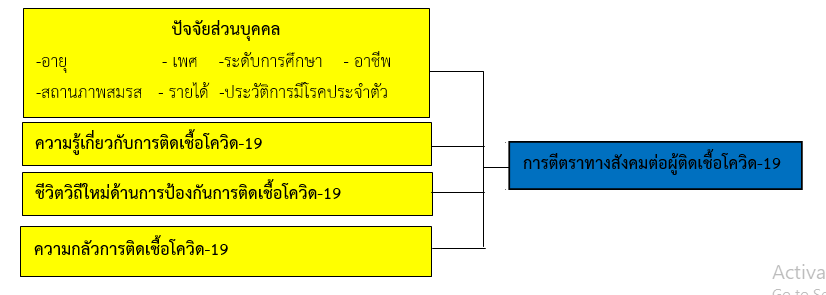
This cross-sectional survey aimed to identify factors related to Coronavirus Disease 2019 (COVID-19) stigma among people living in Thasala District of Nakhon Si Thammarat Province. Sample was 303 residents of 18 years old or over. Data were collected from August 2020 to January 2021. Research tool was a questionnaire with five parts including general information, knowledge about COVID-19, new normal under COVID-19, fear of COVID -19, and COVID-19 stigma. Content validity of questionnaire was validated by three experts. Its reliability was tested obtaining a value of .91. Data were analyzed using frequency, percentage, mean, standard deviation, Pearson’s product moment correlation, point biserial correlation coefficient, Spearman rank-order correlation coefficient, and stepwise multiple regression analysis.
Results revealed that most of respondents had knowledge and New Normal for Covid-19 at a very high level, whereas Fear of Covid-19, and Covid-19 Stigma were at a high level. Fear of Covid-19 was moderately and significantly correlated with Covid-19 Stigma (r= .617,
p < .01). Education level and knowledge about Covid-19 were lowly but significantly correlated with Covid-19 Stigma (r= -.265 and rsp= -.174, respectively, p < .01). Fear of Covid-19 and knowledge about Covid-19 could significantly predict the Covid-19 stigma.
Per findings, healthcare providers can set an educational training program to reduce fear of Covid -19 among people in order to prevent social stigma towards Covid -19 patients.
References
Abdelhafiz, A. S & Alorabi, M. (2020). Social stigma: the hidden threat of COVID-19. Frontiers in Public Health, 8, 1-4.
Ahmad T. H., Baig, M, & Hui, J. (2020). Coronavirus disease 2019 (COVID-19) pandemic and economic impact. Pakistan Journal Medical Sciences, 36(COVID19-S4), S1-S6.
Ahorsu, D. K., Lin, C. Y, Imani, V., Saffari, M., Griffiths, M. D., & Pakpour, A. H. (2022) The fear of COVID-19 scale: Development and initial validation. International Journal of Mental Health and Addiction, 20(3), 1537-1545. https://doi.org/10.1007/s11469-020-00270-8.
Aimnarat, N. (2021). No bias no stigmatization Covid 19 patient does not a sin person. Rangsitsarn online. Retrieved April 8, 2020 from https://www.2.rsu.ac.th/ sarnrangsit- online-detail/CommArts-Article05.
Blaine, B. E & McClure Brenchley, K. J. (2018). Understanding the psychology of diversity. (3rd ed). Thousand Oaks, Calif: Sage.
Corrigan, P.W. & Watson, A. C. (2002). Understanding the impact of stigma on people with mental illness. Paper presented at the forum-stigma and mental illness. World Psychiatry.
Department of Disease Control, Ministry of Public Health. (2021). COVID-19 situation report. Retrieved July 20, 2021 from https://www.covid19.ddc.moph.go.th/ (in Thai)
Department of Health, Ministry of Public Health. (2020). New normal in daily living during Covid-19 epidemic. Retrieved April 19, 2020 from https://www.anamai.moph.go.th/ main.php?filename=index.
Department of Mental Health, Ministry of Public Health. (2020). COVID-19 and mental health. Retrieved December 15, 2020 from https://www.dmh.go.th/covid19. (in Thai)
Dong, L., Hu, S., & Gao, J. (2020). Discovering drugs to treat coronavirus disease 2019 (COVID-19). Drug Discoveries & Therapeutics, 14(1), 58–60.
Dwinantoaji, H & Sumarni, D. W. (2020). Human security, social stigma and global health: the COVID-19 pandemic in Indonesia. Journal of the Medical Sciences, 52(3), 74-81.
Hair, F. J., Black, C. W., Babin, J. B., & Anderson, E. R. (2010). Multivariate data analysis. (7th ed). New Jersey: Pearson Education.
Health Education Division, Department of Health Service Support. (2020). New normal model: Covid 19. Retrieved April 19, 2020 from https://www.healthydee.go.th/view_media.php?id=961.
IFRC, Unicef, & World Health Organization. (2020). Social stigma associated with COVID19. Retrieved July 11, 2020 from https://www.unicef.org/sites/default/files/2020-03/Social 20stigma20associated%20with%20the%20coronavirus%20disease%202019%20%28COVID- 19%29.pdf.
Jirawatkul, A. (2015). Statistics in research: Appropriate selection (2nd ed). Bangkok: Wityapat Publicaion. (in Thai)
Nakhon Si Thammarat Provincial Public Health Office. (2021). Situation corona virus (COVID-19). Nakhon Si Thammarat. Retrieved April 15, 2021 from https://61.19202.217/ covid-19/?cat=3. National
Institute of Development Administration (NIDA). (2020). Nida Poll' conducted a survey of COVID-19, more than 32% wear a mask every time when outside the house. Most frustrated, people from high-risk countries do not self-quarantine Retrieved December 19, 2020 from https://www.matichon.co.th/local/quality-life/news_2057073.
Polit, D. F & Beck, C. T. (2012). Nursing research: Generating and assessing evidence for nursing practice (9 ed). Philadelphia: Wolters Kluwer Health/Lippincott Williams & Wilkins.
Riiser, K., Helseth, S., Haraldstad, K., Torbjornsen, A., & Richardsen, K. R. (2020). Adolescents' health literacy, health protective measures and healthrelated quality of life during the Covid-19 pandemic. PLoS ONE, 15(8), 1-13.
Sermrittirong, S., Rodchan, S., Thanyakittikul, P., Srikhumbor, N., Kolkang, N., & Suksomket, R., et al. (2019). Stigma and social distance of people towards people affected by leprosy in a community. Journal of Bamrasnaradura Infectious Diseases Institute, 3(2), 66-77.
Silanoi, L. & Chindaprasert, K. (2019). The use of rating scale in quantitative research on social sciences, humanities, hotel and tourism study. Journal of Management Science, Ubon Ratchathani University, 8(5), 112-126.
Tangkratoke, P. (2020). Health literacy for Covid 19 prevention. Retrieved April 11, 2020 from https://www.hfocus.org/content/2020/04/18851.
Thanirat, S., Radabut, M. Wichianrat, S., & Opasawatchai, S. (2020). Strategies to relieve a social stigma on COVID-19. Kuakarun Journal of Nursing, 27(2), 64-174.
Worapongthorn, T. & Worapongthorn, S. (2021). Sample size calculation for research project with G*Power program. Journal of Health Promotion and Environmental Health, 41(1), 11-21.
World Health Organization. (2020). Coronavirus disease (COVID-19) situation report-171. Retrieved December 28, 2020 from https://www.who.int/docs/default-source/ coronaviruse/situation-reports/20200709-covid-19-sitrep-171.pdf?sfvrsn=9aba7ec7_2
Wudhiwong, K. (2020). Preventative measures to reduce social stigma in Universities in Thailand during the COVID-19 pandemic. Payap University Journal, 30(2), 1-14.
Downloads
Published
How to Cite
Issue
Section
License
Copyright (c) 2021 Boromarajonani College of Nursing, Nakhon Si Thammarat

This work is licensed under a Creative Commons Attribution-NonCommercial-NoDerivatives 4.0 International License.
บทความที่ได้รับการตีพิมพ์เป็นลิขสิทธิ์ของ วิทยาลัยพยาบาลบรมราชชนนี นครศรีธรรมราช
ข้อความที่ปรากฏในบทความแต่ละเรื่องในวารสารวิชาการเล่มนี้เป็นความคิดเห็นส่วนตัวของผู้เขียนแต่ละท่านไม่เกี่ยวข้องกับวิทยาลัยพยาบาลบรมราชชนนี นครศรีธรรมราช และบุคคลากรท่านอื่น ๆ ในวิทยาลัยฯ แต่อย่างใด ความรับผิดชอบองค์ประกอบทั้งหมดของบทความแต่ละเรื่องเป็นของผู้เขียนแต่ละท่าน หากมีความผิดพลาดใดๆ ผู้เขียนแต่ละท่านจะรับผิดชอบบทความของตนเองแต่ผู้เดียว