Development of a Breastfeeding Assessment Tool and Evaluation of its Use in Postpartum Ward of Maharaj Nakorn Si Thammarat Hospital
Keywords:
SPEC.N, Breastfeeding Assessment Tool, Postpartum WardAbstract
This research aimed to develop a breastfeeding assessment tool for using in the postpartum ward and to examine its quality after being applied in routine work. The study was divided into 2 phases: the instrument development and the instrument quality check. The data were collected from 40 postpartum mothers in their first phase, from 10 registered nurses, and from 450 medical records of mothers in their second phase. The research instruments used in the study were the breastfeeding assessment tool, a registered nurse’s satisfaction questionnaire after applying the instrument in the routine work, and the recording data forms concerning breastfeeding of postpartum mothers. The data were analyzed by using the descriptive statistic of numbers, percentages, mean and standard deviation.
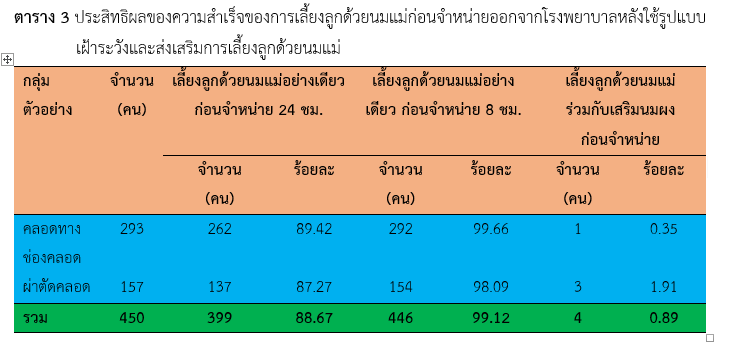
The developed breastfeeding assessment tool was named “SPEC.N Breastfeeding Assessment Tool”. It has 3 columns: assessment methods, passing criteria, and promoting guidelines. There were 4 assessment topics, namely suckling, positioning, adequate breastfeeding, as well as the comfort of nipple and breast. The instrument was assessed by using open-ended questions. The passing criteria and responses were rated in numbers. The tool was validated by 3 experts, obtaining the IOC of 0.94. The values of objectivity (95%), sensitivity (90.91%), and specificity (93.10%) reached the acceptance criteria. Regarding the registered nurses’ satisfaction assessment, it was found that the satisfaction level was very high with a mean between 4.70 - 4.90, and with a standard deviation between .316 - .422. The success of breastfeeding before discharging was at the 88.67% level.
The SPEC.N is a new breastfeeding assessment tool for using in the postpartum ward. This newly developed instrument still requires retesting for sensitivity and specificity before clinical use.
References
Alden, K.R. (2006). Newborn nutrition and feeding. In D. L. Lowdermilk & L. E. perry (eds), Maternity nursing (7th ed).
St. Louis, Missouri: Mosby Elsevier.
Bangsaynoi, K. (2010). Feeding at the breast & Breastfeeding Assessment. In Woramongkon, N. (Eds.), Breastfeeding
Specialist Training Manual, Office of Health Promotion (pp. 92-115). Nonthaburi. (in Thai).
Burns, N., & Grove, S.K. (2005). The practice of nursing research: conduct, critique, & utilization (5th ed). St. Louis:
Elsevier Saunders.
Chantana, K. (2011). Neonatal nursing. (5th ed.). Samut Prakan: Chamchuree Products. (in Thai).
Chusil, K. (2012). Breastfeeding assessment. In Muttamara, S., Chusil, K., Suthatworawut, A., Sangthawee, W., &
Hangchowanit. (Eds.), Textbook of breastfeeding mothers (pp. 163-174). Bangkok, Aiyarabook. (in Thai)
Davidson, M. R.,London, M. L., & Ladewig, P. A. W. (2012). Olds’ Maternity- Newborn nursing & women health care.
(9th ed.). New Jersey: Person education.
Dennis, C. (2020). Breastfeeding initiation and duration: A 1990-2000 literature review. Journal of Obstetrics
Gynecologic and Neonatal Nursing, 31, 12-32.
Department of Health. (2015). Maternal and child health standards assessment 2015 in Hospital, Health Promotion
Hospital & Tambon Nom Mae. Retrieved from https://www. chiangmaihealth.go.th/cmpho_web/detail_article2.
php?info_id=623.
Faculty of Nursing, Mahidol University. (2011). Breastfeeding. In Wijitsukon, K., Sangpaem, P., Watnayu, N.,
Reangchirattean, S. & Phayakreang, S. (Eds.). Breastfeeding. Bangkok. (in Thai).
Fisk, C.M., Crozier, S.R., Inskip, H.M., Godfrey, K.M., Cooper, C., Roberts, G.C., et al. (2011). Breastfeeding and reported
morbidity during infancy: Findings from the Southampton women’s survey. Maternal and child Nutrition, 7, 61-
Mclnnes, R.J., & Chambers, J.A. (2008). Supporting breastfeeding mothers: Qualitative synthesis. Journal of Advanced
Nursing; 62(4), 407-427.
Phanit, W. (2006). KM word a day, “From KM Practitioner to KM Practitioner”. Bangkok: Tathata Publication Company
Limited. (in Thai).
Saengpheng, L. & Wittayapun, Y. (2018). A Comparison between flat nipple and normal nipple mothers in
breastfeeding success at Maharaj Nakhon Si Thammarat Hospital. Maharaj Nakhon Si Thammarat Hospital
Medical Journal, 2(1),8-18.
Sowjanya, S.V.M.S. & Venugopalan, L. (2018). LATCH Score as a predictor of exclusive Breastfeeding at 6 weeks
postpartum: Aprospective Cohort Study. Breastfeed Med. PMID:29957025.
Wongwanit, S. (2006). Assessment checklist: Methodology and assessment tools. In Wongwanit, S. (Eds.). Meta-
Assessment: Methodology and application. (pp. 49-76). Bangkok: Chulalongkorn University Press. (in Thai).
World Health Organization. (2018). Ten steps to successful breastfeeding (Revised 2018). Retrieved April, 30, 2018,
from www.who.int/nutrition/bfhi/ten-steps/en/.
Downloads
Published
How to Cite
Issue
Section
License
Copyright (c) 2021 Boromarajonani College of Nursing, Nakhon Si Thammarat

This work is licensed under a Creative Commons Attribution-NonCommercial-NoDerivatives 4.0 International License.
บทความที่ได้รับการตีพิมพ์เป็นลิขสิทธิ์ของ วิทยาลัยพยาบาลบรมราชชนนี นครศรีธรรมราช
ข้อความที่ปรากฏในบทความแต่ละเรื่องในวารสารวิชาการเล่มนี้เป็นความคิดเห็นส่วนตัวของผู้เขียนแต่ละท่านไม่เกี่ยวข้องกับวิทยาลัยพยาบาลบรมราชชนนี นครศรีธรรมราช และบุคคลากรท่านอื่น ๆ ในวิทยาลัยฯ แต่อย่างใด ความรับผิดชอบองค์ประกอบทั้งหมดของบทความแต่ละเรื่องเป็นของผู้เขียนแต่ละท่าน หากมีความผิดพลาดใดๆ ผู้เขียนแต่ละท่านจะรับผิดชอบบทความของตนเองแต่ผู้เดียว