Evaluation of an HIV Prevention and Medical Practice Program for Prisoners: A Case Study of Pakphanang District Prison, Nakhon Si Thammarat Province
Keywords:
HIV Prevention, Prison, Program Evaluation, Medical PracticeAbstract
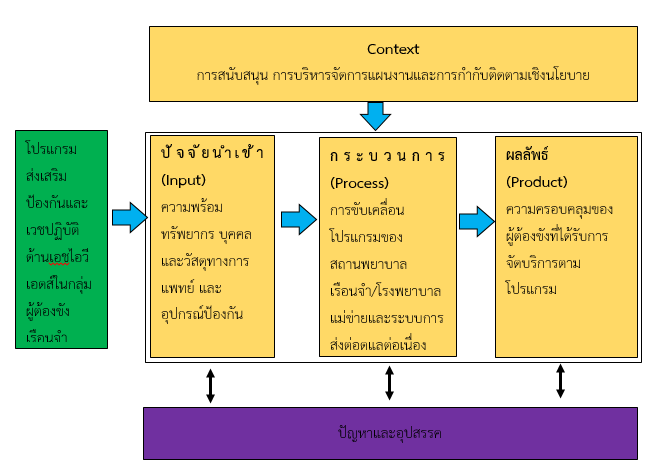
This evaluation research aimed to assess the context, inputs, processes, and effectiveness of an HIV prevention and medical practice program for prisoners. The sample was 166 participants including workers from Pak Phanang Hospital and Pak Phanang Prison of Nakhon Si Thammarat Province. Both quantitative and qualitative data were collected using questionnaires and in-depth interviews developed by the researcher. The reliability of the questionnaire regarding knowledge was tested using K-R 20, obtaining a value of 0.86. The other parts of the questionnaire were tested using Cronbach’s alpha coefficient, obtaining a value of 0.85. Data were collected in May 2022 and analyzed using descriptive percentages, mean, standard deviations, and content analysis.
Results revealed that in terms of context, the satisfaction towards management support and policy monitoring was at a high level (M= 4.23, S.D.= 0.11). For inputs, the resource sufficiency was at the highest level (M= 4.45, S.D.= 0.06). And the knowledge was also at a high level (84.95%). The HIV AIDS prevention behaviors were at a high level (M= 4.10, S.D.= 0.60).
In terms of process, the coverage pertaining to the activities was at a medium level (M=3.41, S.D.= 0.06). All inmates were initially screened for HIV AIDS. From 2017 to 2020, new HIV-infected inmates were 1.3, 0.80, 0.47, and 1.40, respectively. All inmates diagnosed with HIV have been registered in the antiretroviral therapy (ART) system. The overall problems of the operation were: 1) the annual screening of old inmates who had not yet passed the criteria, and 2) organizing a referral system for the continuation of treatment when prisoners were released.
Per findings, this case study suggests: 1) a systematic referral into the regular health system is necessary for the continuation of treatment when prisoners are released, 2)the provision of television service would support inmates’ care, and 3)connecting treatment is necessary when prisoners are released and must continue to receive antiretroviral therapy (ART).
References
Best, J. W. (1977). Research in education. (3nded). Englewod Cliffs: Prentice-Hall.
Crabtree, B. F., & Miller, W. L. (1992). Doing qualitative research: multiple strategies. Thousand Oaks, CA: Sage Publications.
Chamniyom, A., Krungkraipetch, N., & Junprasert, S. (2017). Factors predicting intention to voluntary HIV screening test among male prisoners in prison seventh territory. The Journal of Faculty of Nursing Burapha University, 25(2), 57-68.
Chonlapan, A. (2019). The development of the integrated system for diseases prevalent among prisoner-inmates: first admitted, transferred and discharged screening. Department of Disease Control. [Online]; (Cited 2017 September, 21). Retrieved January 14, 2022 from; https://ddc.moph.go.th. (in Thai)
Department of Disease Control. (2017). National strategy on ending AIDS problems 2017-2030. Ministry of Public Health. Nonthaburi: N.C. Concept Co. Ltd., Bangkok. (in Thai)
Jantarathaneewat, K., Chanakaew, P., Udon, T., & Thariyain, A. (2019). A formative assessment to develop HIV/STD prevention and care program for young prisoners at the central correctional institution for young offenders, Pathumthani. Thai AIDS Journal, 24(1), 1-8.
Health Administration Division. (2019). Guide of health service system development for prisoners. Bangkok: Born to Publishing, Ltd. (in Thai)
Legislative Institutional Repository of Thailand. (2020). Academic focus. Bangkok. (in Thai)
Phuengsanthia, T. & Tongkum, S. (2018). Prison: the area of punishment and the return of good inmates to society. Veridian E-Journal, Silpakorn University, 11(3), 737-748.
Royal Thai Government Gazette. (2017). Constitution of the kingdom of Thailand. [Online]; (Cited 2017 September, 21). Retrieved from http://www.ratchakitcha.soc.go.th/. (in Thai)
Sa-ardeam, S. & Sukhontapirom Na Pattalung, A. (2015). A study of self-esteem and risk behaviors to HIV of inmates in prison with therapeutic community program in Northeastern Region of Thailand. Chulalongkorn Medical Journal, 59(1), 75-89.
Samama, C. & Na-Ranong, L. (2017). The crux of prisoners toward the project of return good people to the society. Veridian E-Journal, Silpakorn University, 10(2), 1105-1114.
Silapichit, C. & Vorapart, T. (2016). Legal measures for prevent and control the epidemic of AIDS in Prison. A Thesis submitted in partial fulfillment for the degree of master of laws. Department of Low Dhurakij Pundit University. (in Thai).
Sunanta, M. (2019). An application of RRTTR measure for HIV prevention among prisoners in a province prison in Northern Thailand Office of Disease Prevention & Control Region 11 Chiangmai. Lanna Public Health Journal, 15(2), 34.
Sunanta, M. (2021). A study of prevalence and risk factors of HIV infection among male prisoners in Chiang Mai Province. Lanna Public Health Journal, 17(2), 26-36.
Taro Yamane. (1973). Statistics: an introductory analysis. 3rded. New York. Harper and Row Publications. The National AIDS Management Center Bureau of AIDS, TB, and STIs Department of Disease Control, Ministry of Public Health. (2017).
Thailand aational strategy to end AIDS 2017 – 2030. N.C. Concept Co. Ltd., Bangkok. (in Thai) Woraphat, T. (2021). Immates overflow. Kamlungjai Journal, 6(2), 36-42.
Downloads
Published
How to Cite
Issue
Section
License
Copyright (c) 2022 Boromarajonani College of Nursing, Nakhon Si Thammarat

This work is licensed under a Creative Commons Attribution-NonCommercial-NoDerivatives 4.0 International License.
บทความที่ได้รับการตีพิมพ์เป็นลิขสิทธิ์ของ วิทยาลัยพยาบาลบรมราชชนนี นครศรีธรรมราช
ข้อความที่ปรากฏในบทความแต่ละเรื่องในวารสารวิชาการเล่มนี้เป็นความคิดเห็นส่วนตัวของผู้เขียนแต่ละท่านไม่เกี่ยวข้องกับวิทยาลัยพยาบาลบรมราชชนนี นครศรีธรรมราช และบุคคลากรท่านอื่น ๆ ในวิทยาลัยฯ แต่อย่างใด ความรับผิดชอบองค์ประกอบทั้งหมดของบทความแต่ละเรื่องเป็นของผู้เขียนแต่ละท่าน หากมีความผิดพลาดใดๆ ผู้เขียนแต่ละท่านจะรับผิดชอบบทความของตนเองแต่ผู้เดียว