The Effectiveness of an Online Educational Video about Infant Cues on Knowledge and Behavior of Mothers of Preterm Infants of QR Code
Keywords:
Infant Cues, Pre-term Infants, Video Online, Knowledge, Desirable health behaviors, health status, elderlyAbstract
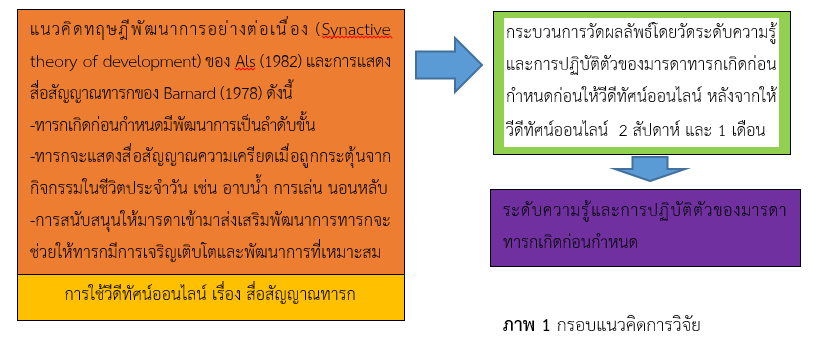
This one-group quasi-experimental interrupted time design research aimed to compare the knowledge and behavior of mothers of preterm infants before and after watching an educational video on infant cues. The sample was 36 mothers of premature babies. Simple random sampling was applied. The research tools were: 1) an online educational video on infant cues, presenting forms of communication of infants for expressing their needs, such as being hungry, being full, feeling pain, being happy or unhappy, being wide awake and ready to play, being tired, as well as mother's adequate response, 2) the demographic data of mothers and infants, 3) a knowledge and behavior questionnaire, and 4) a satisfaction questionnaire. All instruments were validated by 3 experts with a CVI of 0.80. The reliability of the questionnaires was tested using Cronbach's alpha, obtaining values of 0.80 and 0.82, respectively. Data were analyzed using percentage, mean, standard deviation, Fisher exact test, and one-way repeated ANOVA statistic.
The results showed that, after watching the video on infant cues, the mothers of preterm infants had knowledge at a higher level (M=13.1, S.D.= 2.26) than before with statistical significance (p < 0.001). The behaviors of the mothers in response to infant cues were also at a higher level (M= 4.2, S.D.= 1.03) than before watching the video with a statistical significance
(p < 0.001). The mothers’ satisfaction with the video was at a high level (M=4.16, S.D.= 0.65).
Per findings, this online video on infant cues could help mothers respond to pre-term infants’ needs appropriately.
References
Abdeyazdan, Z., Shahkolahi, Z., Mehrabi, T., & Hajiheidari, M. (2014). A family support intervention to reduce stress among parents of preterm infants in neonatal intensive care unit. Iranian Journal of Nursing Midwifery Research, 19(4), 349-353.
Als, H. (1982). Toward a synactive theory of development: Promise for the assessment and support of infant individuality. Infant Mental Health Journal, 3(4), 229-243.
Als, H. (1986). A synactive model of neonatal behavioral organization: Framework for the assessment of neurobehavioral development in the premature infant and for support of infants and parents in the neonatal intensive care environment. Physical & Occupational Therapy in Pediatrics, 6(3-4), 3-53.
Association of Peri Operative Registered Nurses (AORN). (2013). Perioperative standards and recommended practices for inpatient and ambulatory settings. Denver (CO): 302-322.
Ballweg, D. (2008). Neonatal and pediatric pain management: Standards and application. Paediatrics and Child Health, 18, S61–S66.
Barnard, K. E. (1978). Nursing child assessment teaching scale manual. Seattle, WA: Nursing Child Assessment Satellite Training, University of Washington.
Blackburn, S. & Patteson, D. (1991). Effects of cycled light on activity state and cardiorespiratory function in preterm infants. The Journal of Perinatal & Neonatal Nursing, 4(4), 47–54.
Blackburn, S. (1998). Environmental impact of the NICU on developmental outcomes. Journal of Pediatric Nursing, 13(5), 279–289.
Blackburn, S. (2007). Surgical Stress. The Journal of Perinatal & Neonatal Nursing, 21(1), 9–10.
Bloom, B. S. (1971). Handbook on formative and summative evaluation of student learning. New York : McGraw–Hill.
Epstein, E. (2005). Toward a new conceptualization for stress response in newborn infants. Newborn and Infant Nursing Review, 5(2), 97–103.
Hadley, L. B. & West, D. (1999). Developmental and behavioral characteristics of preterm infant. California: NICU Ink.
Holsti, L., Grunau, R. E., Oberlander, T. F., & Whitfield, M. F. (2005). Prior pain induces heightened motor responses during clustered care in preterm infants in the NICU. Early Human Development, 81(3), 293–302.
Khanthong, K. (2020). Using QR code for the 5E inquiry-based learning management on social literacy among Prathom Suksa 5 students. Journal of Teacher Professional Development, 1(3), 44-53.
Klaikerd, C., Akarathambodi, C., Hongpuek, Y., Plaengyot, N., Jardon, J., & Saengsila, J., et al. (2019, July 11-12). Effectiveness of postpartum maternal education model using information technology. In the 11th NPRU National Academic Conference Nakhon Pathom Rajabhat University. Nakhon Pathom. (in Thai)
Limperopoulos, C., Gauvreau, K. K., O’Leary, H., Moore., M., Bassan, H., & Eichenwald, E. C, et al. (2008). Cerebral hemodynamic changed during intensive care of preterm infants. Pediatrics, 122(5), 1006-1013. https://doi:10.1542/peds.2008-0768
Laohavich, C. (2021). Development of educational information with Rama bronchoscopy QR code. Thai Journal of Cardio-Thoracic Nursing, 32(2), 247-259.
Mishel, M. H. (1983). Parent’s perception of uncertainty concerning their hospitalization child. Nursing Research, 32(6), 324-330.
Nunchai, J. & Saengnual, S. (2018). Developing simulation model for fetal position assessment training skill. Nursing Journal, 45(4), 37-46.
Phumeechanya, N. & Jeerungsuwan, N. (2013). Development of self directed learning system and learning activities in ubiquitous learning environment by using tablet and QR code to access online learning resources. Research and Development Journal, Loei Rajabhat University, 8(26), 13-24.
Polhan, B., Watanakijkrilert, D., & Pongthavornkamol, K. (2019). The effects of education and inhaler skills program through line application on symptom control among asthmatic patient. The Journal of The Royal Thai Army Nurses, 20(3), 93-103.
Poompan, P., Tilokskulchai, F., Prasopkittikun, T., & Limprayoon, K. (2013). Factors influencing parents’ uncertainty in chronically ill children with intubation during critical period. Journal of Nursing Science, 30(3), 15-24.
Strategy and Planning Division, Office of the Permanent Secretary of MOPH. (2020). Public Health Statistics A.D. Retrieved March 11, 2021 from https://www.bps.moph.go.th/new_bps/sites/default/files/2563_0.pdf. (in Thai)
Teerarungsikul, N. (2002). Nursing care for premature infants. (3rd ed.). Bangkok: Press. (in Thai)
Urharmnuay, M., Namprom, N., & Soontornchai, P. (2010). Neonatal nursing at risk. In Urharmnuay, M., Lamchang, S., & Yenbut, J. Pediatric nursing, 1, (pp. 79-104). Chiang Mai: Faculty of Nursing Chiang Mai University. (in Thai)
World Health Organization. (2020). Infant Mortality. Retrieved March 11, 2021 from https://www.who.int/news-room/fact-sheets/detail/levels-and-trends-in-child-mortality- report-2020
Downloads
Published
How to Cite
Issue
Section
License
Copyright (c) 2022 Boromarajonani College of Nursing, Nakhon Si Thammarat

This work is licensed under a Creative Commons Attribution-NonCommercial-NoDerivatives 4.0 International License.
บทความที่ได้รับการตีพิมพ์เป็นลิขสิทธิ์ของ วิทยาลัยพยาบาลบรมราชชนนี นครศรีธรรมราช
ข้อความที่ปรากฏในบทความแต่ละเรื่องในวารสารวิชาการเล่มนี้เป็นความคิดเห็นส่วนตัวของผู้เขียนแต่ละท่านไม่เกี่ยวข้องกับวิทยาลัยพยาบาลบรมราชชนนี นครศรีธรรมราช และบุคคลากรท่านอื่น ๆ ในวิทยาลัยฯ แต่อย่างใด ความรับผิดชอบองค์ประกอบทั้งหมดของบทความแต่ละเรื่องเป็นของผู้เขียนแต่ละท่าน หากมีความผิดพลาดใดๆ ผู้เขียนแต่ละท่านจะรับผิดชอบบทความของตนเองแต่ผู้เดียว