The Development of a Nursing Model for Colon Cancer Patients in the Female Surgery Unit, Lampang Hospital
Keywords:
Development, Nursing Model, Colon Cancer Patients, Female Surgery WardAbstract
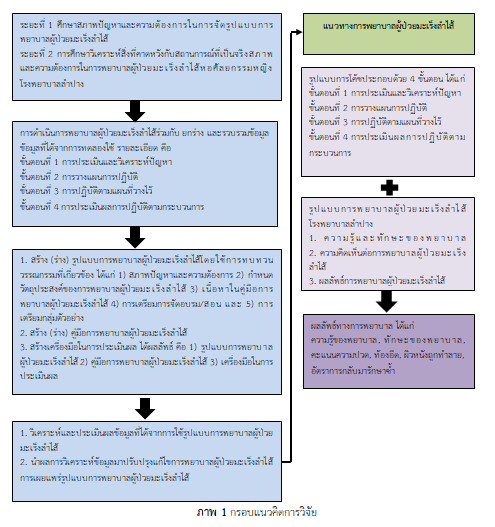
The objective of this research and development was to develop a nursing model for colon cancer patients in the female surgery unit at Lampang Hospital by coaching and measuring the effectiveness of the nursing model for colon cancer patients. The researchers used the Hass (1992) concept of coaching, which consists of four steps: 1) assessing and analyzing problems; 2) operational planning; 3) implementing the plan; and 4) evaluating performance. Participants were 17 professional nurses working in the female surgery ward at Lampang Hospital and 60 colon cancer patients admitted to the female surgery ward. Data was collected between March 2021 and March 2023. The research instruments in each phase were: Phase 1 was an in-depth interview regarding the nursing care model for colon cancer patients. Phase 2 was a form for recording the opinions of experts on the developed model, and Phase 3 was: 1) a nursing model for colon cancer patients in the female surgical ward developed; 2) an evaluation form of the effectiveness of the nursing model for colon cancer patients, including the occurrence of skin damage readmission rate; and 3) an evaluation form of nurses' knowledge and skills regarding giving nursing care to patients with colon cancer, which has a CVI value of 0.82. Data were analyzed by descriptive statistics, paired t-test, independent t-test and linear mixed model.
The results showed that a nursing care model for colon cancer patients in the female surgery ward in all three phases, including the preoperative period, during surgery, and after surgery, was supported for safe surgery in all three phases by a developed coaching model. It consisted of three components: 1) main principles and objectives; 2) process, which consists of four steps: evaluation and analysis, planning, implementation of the plan, and evaluation of coaching results; and 3) conditions for using the model, including support systems, coaching skills, supervision of personnel to be experts, providing knowledge and training, preparing a nursing manual, educating patients about behavior before and after surgery, and rehabilitation after surgery. The results of using the model found that 1) nurses in the female surgery ward had more knowledge and practice in nursing colon cancer patients after using the model than before using the model, which was statistically significant (p < 0.001); and 2) nurses in the female surgery ward were satisfied with a nursing model for colon cancer patients at a high level of 76.47%. In terms of effectiveness, it was found that skin damage was reduced by 0.1 points, and there were no re-admits.
It can be suggested that a nursing model for colon cancer patients in the female surgery ward can be applied to nursing departments that provide care for patients with other types of cancer in order to further improve the quality of nursing care for cancer patients and enhance their quality of life.
References
Chongsakul, A., Yoosomboon, N., & Karuncharernpanit, S. (2020). Development of comprehensive care model for one day surgery of Phaholpolpayuhasaena Hospital, Thailand. Region 4-5 Medical Journal, 39(1), 109-125.
Female Surgery Statistics Lampang Hospital. (2021). Lampang Hospital information center Lampang Provincial Public Health Office: Lampang. (in Thai)
Ghana, S., Hakimi, S., Mirghafourvand, M., Abbasalizadeh, F., & Behnampour, N. (2017). Randomized controlled trial of abdominal binders for postoperative pain, distress, and blood loss after cesarean delivery. International Journal of Gynecology & Obstetrics, 137(3), 271-276.
Haas, S. A. (1992). Coaching: Developing key players. JONA: The Journal of Nursing Administration, 22(6), 54-58.
Databased of Cancer Patients Unit. (2022). Hospital-based cancer registry 2021. Bangkok: National Cancer Institute.
Howharn, C., & Inthongparn, O. (2015). A research and development of coaching model to enhance health care service skills. Nursing Journal of the Ministry of Public Health, 25(1), 167–177.
Law, H., & Aquilina, R. (2013). Developing a healthcare leadership coaching model using action research and system approaches-a case study: Implementing an executive coaching program to support nurse managers in achieving organizational objectives in Malta. International Coaching Psychology Review. 8(1), 54-71.
Paengsook, T., Urharmnuay, M., & Chotibang, J. (2017). Effects of coaching on nurses’ practices regarding positioning in preterm infants with endotracheal tube. Nursing Journal, 44(3), 1-8.
Redshaw, B. (2000). Do we really understand coaching? How can we make it work better. Industrial and Commercial Training, 32(3), 106 – 108.
Satchukon, S. (2004). Teaching techniques. Bangkok: Sarathan Printing House. (in Thai)
Spross, J. A. (2009). Expert coaching and guidance. In: Hamric, A. B.; Spross, J. A.; Hanson, C. M., editors. Advanced nursing practice: An integrative approach. Saunders Elsevier; St. Louis.
Wongngam, B., Urharmnuay, M., & Klunkin, P. (2016). Effect of coaching on practices of nurses in responding to stress cues of preterm infants during invasive procedures. Nursing Journal, 43(1), 12-22.
World Health Organization. (2021). Cancer [Internet]. Geneva, Switzerland: World Health Organization; [cited 2023 April 30]. Available from: https://www.who.int/news-room/fact- sheets/ detail/cancer.
Zeus, P., Skiffington, S., & Trade, M-H. (2002). The coaching at work took it: A complete guide to techniques and practices. The Journal for Quality and Participation; Spring, 26(1), 49 – 51.
Downloads
Published
How to Cite
Issue
Section
License
Copyright (c) 2023 Boromarajonani College of Nursing, Nakhon Si Thammarat

This work is licensed under a Creative Commons Attribution-NonCommercial-NoDerivatives 4.0 International License.
บทความที่ได้รับการตีพิมพ์เป็นลิขสิทธิ์ของ วิทยาลัยพยาบาลบรมราชชนนี นครศรีธรรมราช
ข้อความที่ปรากฏในบทความแต่ละเรื่องในวารสารวิชาการเล่มนี้เป็นความคิดเห็นส่วนตัวของผู้เขียนแต่ละท่านไม่เกี่ยวข้องกับวิทยาลัยพยาบาลบรมราชชนนี นครศรีธรรมราช และบุคคลากรท่านอื่น ๆ ในวิทยาลัยฯ แต่อย่างใด ความรับผิดชอบองค์ประกอบทั้งหมดของบทความแต่ละเรื่องเป็นของผู้เขียนแต่ละท่าน หากมีความผิดพลาดใดๆ ผู้เขียนแต่ละท่านจะรับผิดชอบบทความของตนเองแต่ผู้เดียว