A Self-management Guideline of People at Risk of Diabetes in Tambon Ban Lamnao, Nakhon Si Thammarat Province
Keywords:
A self-management Guideline, Risk Factors, People at Risk of DiabetesAbstract
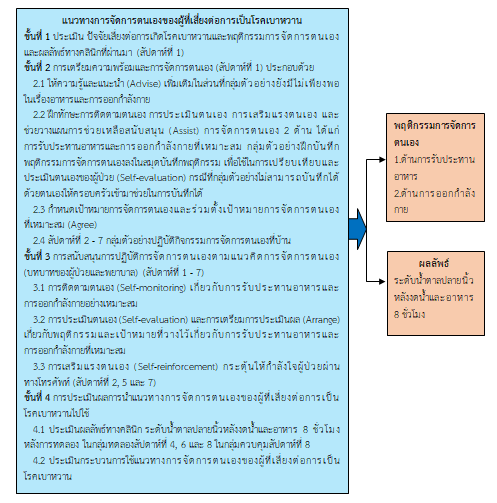
This quasi-experimental study aimed to determine the effects of self-management guidelines on the reduction of diabetes risk factors. Participants in the study were 60 people at risk of diabetes, as calculated by the G*power program. Participants were randomly selected and assigned to the experimental group and the control group, with 30 people in each group. Data collection was conducted during March-May 2023. The intervention group received a self-management guideline for people at risk of diabetes consisting of four steps: 1) assessment of risk factors for diabetes and knowledge of diet and exercise; 2) education about diabetes self-management to reduce risk factors for diabetes and self-management skills training to reduce diabetes risk factors; 3) self-management support; and 4) behavior modification evaluation. Whereas the control group received the usual health services. The intervention group was assessed for fingertip stick blood glucose after fasting for 8 hours at the pre-experimental and post-experimental stages at 4, 6, and 8 weeks. Data were analyzed by frequency, percentage, mean, and standard deviation. The difference in Blood glucose levels between the experimental group and the control group was analyzed using an independent t-test. The differences in blood glucose levels between pre- and post-experimental at weeks 4, 6, and 8 were tested using the Repeated Measure ANOVA.
The results revealed that after the 8th week of the experiment, the mean finger stick blood glucose level after fasting for eight hours in the intervention group was significantly lower than that in the control group (p< 0.01). The mean blood glucose levels of the intervention group at week 8 were significantly lower than those at week 6, week 4, and before the experiment (p<0.01).
The results demonstrated the effectiveness of self-management guidelines for people at risk of diabetes. Primary care nurses can apply this guideline to those who are at risk of diabetes.
References
Aekplakorn, W., Bunnag, P., Woodward, M., Sritara, P., Cheepudomwit, S., Yamwong, S., et al. (2006). A risk score for predicting incident diabetes in the Thai population. Diabetes Care, 29, 1872-1877.
Akeplakorn, W., Puckcharern, H., & Satheannoppakao, W. (2021). Diabetes. In Akeplakorn, W. (Editor), The 6th Survey of Thai Public Health by Physical Examination, 2019-2020. Bangkok: Aksorn Grphic and Design Publishing Limited Partnership. (in Thai)
American Diabetes Association. (2017). Classification and diagnosis of diabetes. Diabetes Care, 40(1), S11-24.
American Diabetes Association. (2018). Classification and Diagnosis of Diabetes: Standards of Medical Care in Diabetes-2018. Diabetes Care. 41(1), S13-S27.
Balk, E. M., Earley, A., Raman, G., Avendano, E. A., Pittas, A. G., & Remington, P. L. (2015). Combined diet and physical activity promotion programs to prevent type 2 diabetes among persons at increased risk: a systematic review for the community preventive services task force. Annals of Internal Medicine, 163(6), 437-451.
Bloom, B. S. (1971). Handbook on formative and summative evaluation of student learning. New York : McGraw-Hill.
Boontein, P., Poungkaew, A., Praphasil, O., & Kuakool, P. (2021). Factors predicting self- management behavior in patients with type II diabetes. Nursing Science Thailand, 39(1), 13-23.
Chulaporn, S. & Sattanako, C. (2017). Effects of self management program on glycemic control in patients with type 2 diabetes. Journal of Nursing and Education, 10(4), 32-46.
Cohen, J. (1998). Statistical power analysis for the behavioral sciences (2nd ed). New Jersey: Lawrence Erlbaum Associates, Incorporated.
Glasgow, R. E., Emont, S., & Miller, D. C. (2006). Assessing delivery of five ‘As’ for patient- centered counseling. Health Promotion International, 21(3), 245-255.
Grady, P. A. & Gough, L. L. (2014). Self-management: a comprehensive approach to management of chronic conditions. American Journal of Public Health, 104(1), 25-31.
Jangwang, S., Pittayapinune, T., & Chutipattana, N. (2016). Factors related to self-care behavior for prevention of diabetes mellitus and hypertension among population groups at risk. The Southern College Network Journal of Nursing and Public Health, 3(1), 110-128.
Kanfer, F. H. & Gaelick-Bays, L. (1991). Self management medthod. In Kanfer, F. H., Goldsteinn, A. (Eds.), Helping people change: a text book at medthods. (305-360). New York: Pergamon press.
Milenkovi, T., Gavrilovic, S., Percan, V., & Petrovski, G. (2004). Influence of diabetic education on patient well-being and metabolic control. Diabetologia Croatica, 33(3), 91-96.
Ministry of Public Health. (2017). eHealth strategy, Ministry of Public Health (2017 – 2026). Retrieved May 24, 2023 from https://www.ict.moph.go.th/upload_file/files/eHealth_Strategy_ENG_141117.pdf.
Moucheraud, C., Lenz, C., Latkovic, M., & Wirtz, V. J. (2019). The costs of diabetes treatment in low-and middle-income countries: a systematic review. The British Medical Journal Global Health, 4(1), 1-12.
Munsrakeat, K., Rawiworrakul, T., & Lagampan, S. (2019). Effects of self-management program for glycemic control among insulin depen-dent type 2 diabetes patients. The Journal of Baromarajonani College of Nusing, Nakhonratchasima, 25(2), 87-103.
Nakhon Si Thammarat Provincial Health Office. (2022). The report system sends 43 files (HDC). Retrieved December 15, 2022 from https://nrt.hdc.moph.go.th/hdc/main/index_pk.php. (in Thai)
Polit, D. F. & Hungler, B. P. (1995). Nursing research: principles and medthods (5th ed.). New York: Lippincott company.
Saeedi, P., Petersohn, I., Salpea, P., Malanda, B., Karuranga, S., Unwin, N., et al. (2019). Global and regional diabetes prevalence estimates for 2019 and projections for 2030 and 2045: Results from the international diabetes federation diabetes atlas, 9th edition. Diabetes Research and Clinical Practice, 157, 107843. Retrieved December 15, 2022 from https://www.doi.org/10.1016/j.diabres.2019.107843
Sanee, A. (2014). Self-management program in chronic diseases. Journal of The Royal Thai Army Nurses, 15(2), 129-134.
Senaphan, S. & Sitthiban, S. (2018). Self-management guideline for reduction of diabetes risk factors in Ban Pakthon community, Chawang district, Nakhon Si Thammarat province. Region 11 Medical Journal, 32(1), 805-812.
Sontimuang, W. (2022). Factors related to self-care behavior of diabetic patients among the Urak Lawois, Koh Lanta district Krabi province. Maharaj Nakhon Si Thammarat Medical Journal, 5(2), 68-78.
Terathongkum, S., Kraithaworn, P., Poolsukkho, P., & Poolsawat, S. (2018). Effects of health behavior change program with arm swing exercise on body mass index and capillary blood sugar in pre-diabetes group. Thai Journal of Nursing and Midwifery Practice, 5(1), 19-31.
Wandao, Y., Chinnawong, T., Chalothorn, U., & Tipwong, A. (2018). The experience of self- management in patients with uncontrolled type 2 diabetes, Sadao hospital, Sadao, Songkhla. Songklanagarind Journal of Nursing, 38(3), 54-64.
WatcharapornNatkamyoung. (2023). The effects of developing a self-Management model in patients with uncontrolled type 2 diabetes, Banthi hospital, Lamphun province. Journal of Nursing and Public Health Research, 3(2), 78-95.
Wongpanarak, N. (2014). The therapeutic relationship: application in nursing process. Journal of The Royal Thai Army Nurses, 15(2), 84-91.
Wongsin, U. & Wannasri, A. (2018). Unit cost of diabetes care: a case study of a general hospital in Thailand. Journal of the Department of Medical Services, 43(6), 45-49.
Downloads
Published
How to Cite
Issue
Section
License
Copyright (c) 2023 Boromarajonani College of Nursing, Nakhon Si Thammarat

This work is licensed under a Creative Commons Attribution-NonCommercial-NoDerivatives 4.0 International License.
บทความที่ได้รับการตีพิมพ์เป็นลิขสิทธิ์ของ วิทยาลัยพยาบาลบรมราชชนนี นครศรีธรรมราช
ข้อความที่ปรากฏในบทความแต่ละเรื่องในวารสารวิชาการเล่มนี้เป็นความคิดเห็นส่วนตัวของผู้เขียนแต่ละท่านไม่เกี่ยวข้องกับวิทยาลัยพยาบาลบรมราชชนนี นครศรีธรรมราช และบุคคลากรท่านอื่น ๆ ในวิทยาลัยฯ แต่อย่างใด ความรับผิดชอบองค์ประกอบทั้งหมดของบทความแต่ละเรื่องเป็นของผู้เขียนแต่ละท่าน หากมีความผิดพลาดใดๆ ผู้เขียนแต่ละท่านจะรับผิดชอบบทความของตนเองแต่ผู้เดียว