A Comparative Study of the Results from the Development of the New Normal Healthy Market: A Case Study in the Public Health Region 11
Keywords:
Management Factors of the New Normal Healthy Market, Public Health Region 11, New Normal Healthy MarketAbstract
The objectives of this mixed-methods study were to 1) examine the results from the development of the new normal healthy market based on healthy market standards; 2) compare the management factors of fresh markets that met the criteria for the new normal healthy market and those that didn't; and 3) make recommendations for the development of the new normal healthy market in Public Health Region 11. Participants in the quantitative method were market operators, market managers, or traders in fresh markets that participated in the new normal healthy market project between October 2022 and March 2023, qualified and unqualified markets from Phuket province and Surat Thani province. The sample size was determined using the G*Power program to get 60 participants per group. A multistage random sampling method was conducted. The research tool was a questionnaire with a confidence value of 0.92. The data were analyzed using descriptive statistics and an independent t-test. Participants in a qualitative method included eight people involved in the operation of the new normal healthy market, who were chosen through a purposive sampling strategy. Data was collected using semi-structured interviews. The data were analyzed using content analysis.
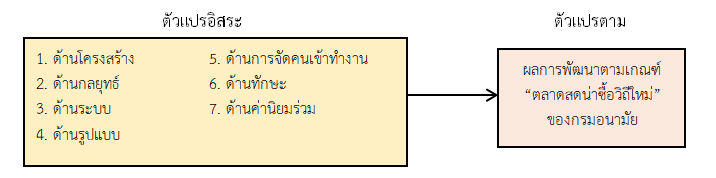
The results showed that 55.17% of the 29 fresh markets participating in the development of the new normal healthy market project met the criteria, while 44.83% failed. The fresh markets that met the criteria for the new normal healthy market performed highest in terms of environmental sanitation, with 100%. Non-qualified fresh markets had the most operations in the fields of environmental sanitation and personal hygiene, representing 76.92%. The results of comparing management factors with the concept of the McKinsey 7-S Framework found that there were statistically significant differences in aspects of strategy, style, skills, shared values, and overall (p < 0.05). Development suggestions discovered that responsible organizations should have a budget allocation policy, support the use of the Food Handler system, organize training for entrepreneurs, and develop digital media in order to develop the new normal healthy market.
It can be suggested that the local government should promote the development of environmental sanitation in fresh markets and the personal hygiene of the seller/sales assistant by considering the management factors of the fresh market in developing the new normal healthy market and receiving policy and operational support from the Ministry of Public Health.
References
Bureau of Food and Water Sanitation, Department of Health. (2021). Guide to new normal healthy market. Kaew Chao Chom Media and Publishing Center. Suan Sunandha Rajabhat University. (in Thai)
Boontham, R. & Ruangsom, W. (2019, January 19). 7s framework management model with local government organizations. In Academic conference the 2nd national research presentation of humanities and social sciences students, Faculty of humanities and social sciences Suan Sunandha Rajabhat University. (in Thai)
Chantawibul, A., Kingkaewcharoenchai, C., Pholwong, P., Limparangsee, S., & Kaewruang, N. (2021). Development of new normal market model. Thailand Journal of Health Promotion and Environmental Health, 44(3), 90-102.
Cohen, J. M. & Uphoff, N. T. ( 1981). Rural development participation: concept and measures for project design implementation and evaluation. Rural Development Committee Center for International Studies, Cornell: Cornell University.
Damrongpingsakul, R. (2009). Situation survey and participation in the attractive market type 1 project of healthy market a case study of a market that has not been certified as a healthy market. Department of Health of Bureau of Food and Water Sanitation, Department of Health: Nonthaburi. (in Thai)
Faul, F., Erdfelder, E., Lang, A. G., & Buchner, A. (2007). G*Power 3: A flexible statistical power analysis program for the social, behavioral, and biomedical sciences. Behavior Research Methods, 39(2), 175–191.
Panyayuttasuk, T. (2021). The factor according 7S framework model for effective Sattahip municipality’s management. Journal of the Dual Degree Program in Public Administration and Business, 13(1), 104–116. Retrieved May 1, 2023 from http://www.mpamba.ru.ac.th/images/Project/treatise_bangkok13_06102020/6117950013.pdf. (in Thai)
Pornleartkochakorn, N., Limsiritong, K., & Santisarn, B. (2022). Factors of McKinsey's 7S model affecting learning organization of hotel business in Thailand. Journal of Humanities and Social Sciences Thonburi University, 16(2), 112–124.
Regional Health Promotion Center 11 Nakhon Si Thammarat. (2022). Annual report, 2022. Regional Health Promotion Center 11: Nakhon Si Thammarat. (in Thai)
Ruangpraphan, C. (2000). Basic statistics with examples of minitab SPSS and SAS analysis. Khon Kaen. Khon Kaen University. (in Thai)
Sidajit, J. & Inmong, U. (2013). A comparison of management practices between fresh food markets that meet and failing to meet the healthy market standard: a case study of the fresh food markets in Loei province. Research and Development Journal Loei Rajabhat University, 8(3), 110-119.
Thongtae, L. (2017). Factors affecting personal sanitation and hygiene practices of food handlers in rangsit city municipality, thailand. (Master’s thesis). Pathum Thani: Thammasat University. (in Thai)
Oranam, N. (2013). McKinsey 7s management factors affecting for being the attractive market of Maha Sarakham Municipality. (Master’s thesis). Maha Sarakham: Maha Sarakham Rajabhat University. (in Thai)
Downloads
Published
How to Cite
Issue
Section
License
Copyright (c) 2023 Boromarajonani College of Nursing, Nakhon Si Thammarat

This work is licensed under a Creative Commons Attribution-NonCommercial-NoDerivatives 4.0 International License.
บทความที่ได้รับการตีพิมพ์เป็นลิขสิทธิ์ของ วิทยาลัยพยาบาลบรมราชชนนี นครศรีธรรมราช
ข้อความที่ปรากฏในบทความแต่ละเรื่องในวารสารวิชาการเล่มนี้เป็นความคิดเห็นส่วนตัวของผู้เขียนแต่ละท่านไม่เกี่ยวข้องกับวิทยาลัยพยาบาลบรมราชชนนี นครศรีธรรมราช และบุคคลากรท่านอื่น ๆ ในวิทยาลัยฯ แต่อย่างใด ความรับผิดชอบองค์ประกอบทั้งหมดของบทความแต่ละเรื่องเป็นของผู้เขียนแต่ละท่าน หากมีความผิดพลาดใดๆ ผู้เขียนแต่ละท่านจะรับผิดชอบบทความของตนเองแต่ผู้เดียว