Factors Influencing Parents’ Behaviors in the Prevention of COVID-19 Among Preschool Children
Keywords:
COVID-19 , preschool, parents’ behaviorsAbstract
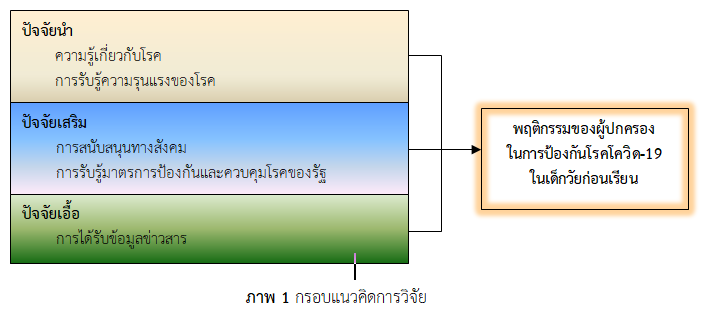
The objective of this predictive correlational research was to examine factors influencing parents’ behaviors in the prevention of COVID-19 among preschool children receiving service in child development centers under the municipality in the Mueang District, Ubon Ratchathani Province. Participants were 108 parents of preschool children, aged between 3-5 years, selected by simple random sampling without replacement. Data collection instruments were a general information questionnaire, a perception of the severity of COVID-19 disease questionnaire, a social support questionnaire, and a questionnaire on parents’ behavior in preventing COVID-19, which had a Cronbach alpha coefficient of 0.80, 0.93, 0.87, 0.84, and 0.85, respectively. The COVID-19 knowledge questionnaire had a KR-20 value of 0.86. Data were analyzed using descriptive statistics, Pearson's correlation coefficient, and stepwise multiple regression. The results showed that social support was the best predictor factor that could predict parents' behavior in preventing COVID-19 disease in preschool children, which was 45.3%. The second-best predictor was the perceived severity of COVID-19, which accounted for 16.1%. The third most predictable factor was knowledge about disease, which increased by 3.8%. The last predictor was access to information, which increased by 2%. These four significant predictors could explain 67.3% of the variation in parents’ behavior in the prevention of COVID-19 among preschool children (R2 =.673, p <.05).
The results suggest that nurses and health care providers should provide intervention programs that focus on increasing family social support. perception of disease severity, provide knowledge and information about COVID-19 adequately for parents in order to encourage parents to have protective behaviors against COVID-19 in preschool children that lead to healthy children.
References
Alsulaiman, S. A., & Rentner, T. L. (2018). The health belief model and preventive measures: A study of the ministry of health campaign on coronavirus in Saudi Arabia. Journal of International Crisis and Risk Communication Research, 1(1), 27–56.
Amin, U. A. & Parveen, A. P. (2022). Impact of COVID-19 on children. Middle East Current Psychiatry, 29(9). 1-10.
Bureau of Information Office of The Permanent Secretary of Ministry of Public Health. (2022). The ministry of public health announces that "COVID" spreads more among young children. Retrieved August 28, 2023 from https://www.pr.moph.go.th/?url=pr/detail/2/04/ 172727/. (in Thai)
Department of Health. (2022). Institute of child health development suggest ways to take care and prevent early childhood infection with COVID-19. Retrieved August 28, 2023 From https://www.workpointtoday.com/covid19-369/. (in Thai)
Department of medical service. (2023). Clinical practice guidelines for diagnosis, treatment, and prevention of infection in hospitals Case of Coronavirus Disease 2019 (COVID-19). Retrieved April 18, 2023 from https://www.covid19.dms.go.th/backend///Content/ Content FIle/Bandner_(Big)/Attach/25660418150440PM_CPG_COVID- 19_v.27_n_18042023.pdf. (in Thai)
Green, L. W. & Kreuter, M. W. (2005). Health program planning: An educational and ecological Approach. (4th ed.). New York: McGraw-Hill Higher Education.
Jaide, C., Santati, S., & Kongsaktrakul, C. (2013). Factors related to child care workers’ behavior in prevention of acute respiratory infection in child care centers. Ramathibodi Nursing Journal, 18(3), 389–403.
Jirojkul, P. (2013). Concepts, theories, health promotion and their use. Bangkok: Project Welfare, Praboromarajchanok Institute. (in Thai)
Kaewsuk, C., Pongjaturawit, Y., & Chaimongkol, N. (2016). Factors Associated with Maternal Behavior in Prevention of Acute Respiratory Infection in Preschool Children. The Journal of Faculty of Nursing Burapha University, 24( 4), 54-64.
Kaewsuk., Pongjaturawit, Y., & Chaimongkol, N. (2015). Predictors of maternal behavior in prevention of acute respiratory infection in preschool children. Academic conference report and presentation of research results National and International Level 6 National Group science, 1(6), 130-140. (in Thai)
Kanjanapradub, T. (2023). Children infected with COVID must be careful not to have severe symptoms. Retrieved January 11, 2023 from https://www.paolohospital. com/th-TH/chokchai4/Article/Details/Covid infection in children - to be careful not to have severe symptoms. (in Thai)
Kongkun, P., Kaewsuksai, R., Waedueramae, R., Tongkoop, B., & Salaeh, M. (2021). Prevention of Coronavirus Disease (COVID-19) among food vendors in Narathiwat province: Relationships Between Perception, Social Support and “New Normal Behaviors”. The Southern College Network Journal of Nursing and Public Health, 8(3), 133-146.
LaMorte, W., (2022). The health belief model. Retrieved November 3, 2022 form https://www.sphweb.bumc.bu.edu/otlt/mph-modules/sb/behavioralchangetheories/ behavioralchangetheories2.html
Lohmae, U., Yeepaloh, M., & Kajornkittiya, K. (2022). Factors predicting preventive behaviors of COVID–19 among guardians of preschool aged children. Journal of Prachomklao College of Nursing, Phetchaburi Province, 5(1), 12-25.
Maikhaothong, T. (2012). Searching and assessment of health information sources on the web: issues and chapters analysis from research. Journal of Information Science, 23(3), 31-41.
Ministry of Public Health. (2021). Practical manual for early childhood development institutions in preventing the spread of COVID-19. (2nd ed). Bureau of Health Promotion and the National Institute of Child Health Development, Department of Health. (in Thai)
Ounsaneha, W., Laosee, O., Suksaroj, T. T., & Rattanapan, C. (2023). Preventive behaviors and influencing factors among thai residents in endemic areas during the highest epidemic peak of the COVID-19 outbreak. International Journal of Environmental Research and Public Fealth, 20(3). https//www.doi:10.3390/ijerph20032525.
Phansuma, D. & Boonruksa, P. (2021). Knowledge, attitudes, and preventive behaviors of COVID-19 among residents in Pru Yai sub-district, Muang district, Nakhon Ratchasima province. Srinagarind Medical Journal, 36(5). 597-604.
Polit, D. F. & Beck, C. T. (2004). Nursing research: principles and methods. (7thed.). Philadelphia: Lippincott Williams & Wilkins.
Pothisa, T., Ong-Artborirak, P., Seangpraw, K., Tonchoy, P., Kantow, S., Auttama, N., & et al. (2022). Knowledge of COVID-19 and its relationship with preventive behaviors and vaccination among adults in Northern Thailand's community. International Journal of Environmental Research and Public Health, 19(3), 1-14.
Queen Sirikit National Institute of Child Health. (2023). MIS-C (Miss C) and long COVID (Long COVID) conditions in children. Retrieved February 25, 2022 from https://www.children hospital.go.th/15293/our services/press release/state-mis-c-miss-and-long-covid-try- covid-in-children/.
Royal Thai Government. (2023). Announcements and orders. Retrieved August 20, 2022 from https://www.thaigov.go.th/news/contents/details/27963.
Srisuwan, S. (2022). Factors affecting surveillance operations, prevention, and control of COVID-19 at Sai Thong Watthana district. Phichit Public Health Research And Academic Journal, 3(2), 98-107.
Tabachnick, B. G., & Fidell, L. S. (2007). Using multivariate statistics. (5thed.). Boston: Pearson/ Allyn & Bacon.
Ubon Ratchathani Municipality. (2021). Announcement of schools and child development centers under Ubon Ratchathani Municipality. Retrieved July 1, 2022 from https://www.cityub.go.th/New2017/index.php/2017-04-10-03-11-24/25-2017-05- 25-09-29-30/3732-5-9-2564 (in Thai)
Udumrati, V. (2022). Academic papers knowledge development to promote and restore early childhood development after the situation Coronavirus Disease 2019 (COVID-19) pandemic. Retrieved December 30, 2022 from https://www.ecd-covidrecovery.rlgef. com/download/Download Academic Documents/.
Umeta, B., Mulugeta, T., Mamo, G., Alemu, S., Berhanu, N., Milkessa, G., & et.al. (2022). An analysis of COVID-19 information sources. Journal of Pharmaceutical Policy and Practice, 15(1), 49. doi:10.1186/s40545-022-00446-8.
Wongrattana, C. (2010). Writing a Research Outline: Guidelines for Success (2nd ed). Nonthaburi: Thai Niramit Kit Inter Progressive. (in Thai)
World Health Organization. (2023). WHO coronavirus (COVID-19) dashboard. Retrieved August 28, 2023 from https://www.covid19.who.int/.
Witoonsakul, P., Chaisuwan, C., & Rungamornrat, S. (2021). Factors influencing behaviors in preventing COVID-19 of teachers and caregivers in child care centers. Nursing Science Journal of Thailand, 39(4), 41-54.
Downloads
Published
How to Cite
Issue
Section
License
Copyright (c) 2023 Boromarajonani College of Nursing, Nakhon Si Thammarat

This work is licensed under a Creative Commons Attribution-NonCommercial-NoDerivatives 4.0 International License.
บทความที่ได้รับการตีพิมพ์เป็นลิขสิทธิ์ของ วิทยาลัยพยาบาลบรมราชชนนี นครศรีธรรมราช
ข้อความที่ปรากฏในบทความแต่ละเรื่องในวารสารวิชาการเล่มนี้เป็นความคิดเห็นส่วนตัวของผู้เขียนแต่ละท่านไม่เกี่ยวข้องกับวิทยาลัยพยาบาลบรมราชชนนี นครศรีธรรมราช และบุคคลากรท่านอื่น ๆ ในวิทยาลัยฯ แต่อย่างใด ความรับผิดชอบองค์ประกอบทั้งหมดของบทความแต่ละเรื่องเป็นของผู้เขียนแต่ละท่าน หากมีความผิดพลาดใดๆ ผู้เขียนแต่ละท่านจะรับผิดชอบบทความของตนเองแต่ผู้เดียว