Developing a Care Model for High-risk Schizophrenia Patients to Prevent Severe Violence Occurrences, Pattani Hospital
Keywords:
schizophrenia, Recurrent symptoms, high riskAbstract
This research and development study aimed to: 1) investigate the condition of recurrent relapse problems among high-risk schizophrenia patients prone to severe violence, 2) develop a care model for high-risk schizophrenia patients to prevent severe violence occurrences, and 3) evaluate the effectiveness of the care model for high-risk schizophrenia patients prone to severe violence at Pattani Hospital, divided into three phases. Phase 1 involved reviewing 5-year retrospective statistics on relapse rates and examining the problems faced by high-risk schizophrenia patients prone to severe violence through group interviews with 25 key informants. Phase 2 involved using the quantitative and qualitative data obtained from Phase 1 to develop a model through brainstorming sessions and assessing the model's benefits with 17 stakeholders. The research tool used was a questionnaire on the benefits developed by the researchers, with a content validity index ranging from 0.67 to 1.00. Data analysis included mean and standard deviation. Phase 3 involved evaluating the effectiveness of the model by assessing the psychiatric symptoms of schizophrenia patients before and after using the model. The sample group consists of 14 high-risk schizophrenia patients meeting the inclusion criteria. The assessment tool used was the psychiatric symptom assessment form developed by the Department of Mental Health. Data analysis was performed using the Wilcoxon signed-rank test.
The research findings were as follows:
1. The problems identified were: 1) inability of relatives to manage the violent behavior of patients and their relatives, 2) unclear assistance guidelines for patients, 3) high risk of recurrence both within the family and the community, 4) lack of readiness of patients and relatives, as well as ineffective referral systems, and 5) insufficient continuous treatment.
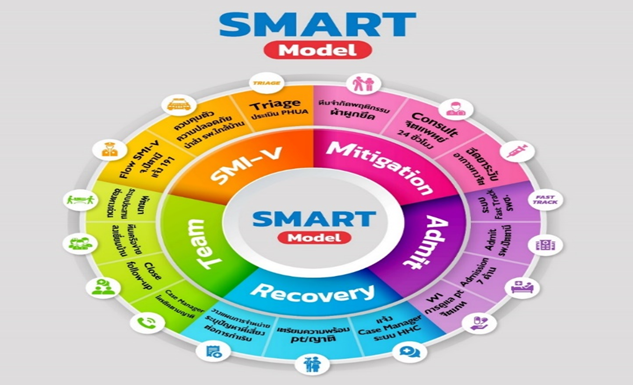
2. The care model for high-risk psychiatric patients prone to severe violence was the SMART Model, consisting of: S: SMI-V; M: Mitigation; A: Admit; R: Recovery; and T: Team.
3. The effectiveness of the SMART Model, when comparing the difference in scores of psychiatric symptom assessments before and after implementation, showed a statistically significant difference at the .05 level.
The SMART Model is a comprehensive care model for high-risk psychiatric patients prone to severe violence that can integrate all aspects of teamwork effectively.
References
Charoensri, K. (2023). Development of care model for psychiatric patients with high risk of violence by network partners participation: A case study Ban Na Tham - Huay Sai, Pa Rai subdistrict, Don Tan district, Mukdahan province. Journal of Environmental Health and Community Health, 8(2), 286-296.
Chudpimai, R. (2023). Development of a care model for chronic psychiatric patients At-risk groups in the community through the participation process of network partners, Lamplaimat district, Buriram province. Regional Health Promotion Center 9 Journal, 16(3), 851-867.
Klungka, S., Piyabanditkul, L., & Jaitieng, A. (2022). Analysis of Caring Pattern for Persons with Schizophrenia in One Tumbon of Khon Kaen Province. Nursing Science Journal of Thailand. 40(3), 31-41.
Jansam, S. (2020). Development of a seamless psychiatric care service system in the service area, Yasothon province. Journal of Health Science, 31(1), 1-9.
Laongsri, S., Srichaikul, B., & Pimchan, N. (2017). The development of care model for psychiatric patients in the communityTambon Phai, Rattanaburi district, Surin province. The Journal of Baromarajonani College of Nusing, Nakhonratchasima, 23(2), 1-9.
Lohacheewa, S. (2022). Recurrence of psychiatric patient hospitalization: The nursing role in continuing care. Thai Red Cross Nursing Journal, 14(1), 1-9.
Pattani Hospital. (2022). Annual report 2022. Pattani Hospital. Pattani Province. The Department of Mental Health. (2020). Manual for the care system for psychiatric patients at high risk of act of violence for institutions/hospitals Under the Department of Mental Health. Bangkok: Prosperus Plus. (in Thai)
Sriharaksa, P. (2022). Caring for schizophrenic patients at risk of violence through the use of participatory case management in the community Muang district, Sakon Nakhon province: A case study of Khamin subdistrict, Mueang district, Sakon Nakhon province. Journal of Health and Environmental Education, 8(1), 436-447.
Walaisri, K. (2023). Development of a care model for serious mental illness with high risk to violence in the community through the participation process of network partners, Selaphum district, Roi-et province. Journal of Environmental and Community Health, 8(3), 909-917.
Downloads
Published
How to Cite
Issue
Section
License
Copyright (c) 2024 Boromarajonani College of Nursing, Nakhon Si Thammarat

This work is licensed under a Creative Commons Attribution-NonCommercial-NoDerivatives 4.0 International License.
บทความที่ได้รับการตีพิมพ์เป็นลิขสิทธิ์ของ วิทยาลัยพยาบาลบรมราชชนนี นครศรีธรรมราช
ข้อความที่ปรากฏในบทความแต่ละเรื่องในวารสารวิชาการเล่มนี้เป็นความคิดเห็นส่วนตัวของผู้เขียนแต่ละท่านไม่เกี่ยวข้องกับวิทยาลัยพยาบาลบรมราชชนนี นครศรีธรรมราช และบุคคลากรท่านอื่น ๆ ในวิทยาลัยฯ แต่อย่างใด ความรับผิดชอบองค์ประกอบทั้งหมดของบทความแต่ละเรื่องเป็นของผู้เขียนแต่ละท่าน หากมีความผิดพลาดใดๆ ผู้เขียนแต่ละท่านจะรับผิดชอบบทความของตนเองแต่ผู้เดียว