The Effects of Utilizing the SPEC.N Breastfeeding Assessment Tool on the Success of Breastfeeding Before Discharge in Postpartum Cesarean Section Mothers, Maharaj Nakhon Si Thammarat Hospital
Keywords:
Special Needs Children, , Stress, Parenting EffectivenessAbstract
This quasi-experimental research aimed to investigate the effects of utilizing the SPEC.N Breastfeeding Assessment tool on the success of breastfeeding before discharge. The sample group consisted of mothers undergoing postpartum cesarean section who received preoperative and postoperative care at the Special Patient Ward, Maharaj Nakhonsrithammarat Hospital, totaling 30 individuals in December 2023. Participants were selected using purposive sampling based on specific criteria. The SPEC.N Breastfeeding Assessment tool and the LATCH score were used for evaluation. Data analysis was conducted using statistical analysis methods.
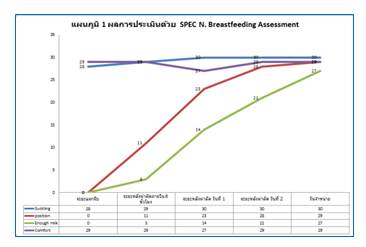
The study found that mothers who utilized the SPEC.N Breastfeeding Assessment tool during the early postpartum period, within 8 hours after surgery, on the first and second postoperative days, and on the day of discharge, achieved breastfeeding success rates of 93.33%, 96.67%, 100.00%, 100.00%, and 100.00%, respectively. The assessment of breastfeeding initiation or positioning showed success rates of 0.00%, 36.67%, 76.67%, 93.33%, and 96.67%, respectively. Adequate breastmilk intake assessments showed success rates of 0.00%, 10.00%, 46.67%, 70.00%, and 90.00%, respectively. Evaluation of nipple and breast comfort yielded success rates of 96.67%, 96.67%, 90.00%, 96.67%, and 96.67%, respectively. The mean scores for breastfeeding effectiveness assessment during the early postoperative and discharge periods were 5.30 (S.D.=1.09) and 8.93 (S.D.=1.34), respectively, with a 90.00% success rate for mothers after cesarean delivery. It can be observed that the mean score for breastfeeding effectiveness on the day of discharge was higher than that during the early postoperative period, indicating higher success rates for mothers after cesarean delivery in breastfeeding before discharge. This suggests that mothers after cesarean delivery can breastfeed correctly, infants receive adequate breastmilk, and mothers do not experience nipple discomfort or pain. This is attributed to the tool's ability to assess breastfeeding accurately from the initiation stage and the continuous follow-up assessments, allowing prompt assistance and problem resolution according to appropriate nursing guidelines.
Therefore, it is recommended to use the SPEC.N Breastfeeding Assessment tool to promote breastfeeding success for mothers after cesarean delivery, thus enhancing breastfeeding success before discharge.
References
Baimonta, L., Nirattharadorn, M., & Kamolwarin, S. (2015). The effect of promoting breastfeeding program on maternal breastfeeding and milk flow among women experiencing cesarean section. Nursing Journal, 42(4), 65-75.
Baiya, N., Ketsuwan, S., Pachaiyapoom, N., & Puapornpong, P. (2013). Mother’s knowledge, latch score and satisfaction after development support service in HRH Princess Maha Chakri Sirindhorn Medical Center. Journal of Medicine and Health Sciences, 20(2), 17-23.
Budsaengdee, B. (2014). Self-efficacy promotion on success in exclusive breastfeeding among cesarean section mothers. Thai Red Cross Nursing Journal, 7(1), 1-9.
Budsaengdee, B., Kantaruksa, K., & Chareonsanti, J. (2013). Effects of self-efficacy promotion on success in exclusive breastfeeding among cesarean section mother. Nursing Journal, 40(3), 1-10.
Evans, K. C., Evans, R. G., Royal, R., Esterman, A. J., & James, S. L. (2003). Effect of cesarean section on breast milk transfer to the normal term newborn over the first week of life. Archives of Disease in Childhoo Fetal and Neonatal Edition, 88(5), 380-382.
Jinpol, P. (2023). Applied Statistic for Research. Nakhonsrithammarat: K. pulprinting. (in Thai)
Pérez-Rios, N., Rimos-Valencia, G., & Ortiz, A. P. (2008). Cesarean delivery as a barrier for breastfeeding initiation: the Puerto Rican experience. Journal of Human Lactation: Official Journal of International Lactation Consultant Association, 24(3), 293–302.
Puapornpong, P., Raungrongmorakot, K., Hamontri, S., Ketsuwan, S. & Wongin,S. (2016). Latch score and exclusive breastfeeding during first six months postpartum. Journal of Medicine and Health Sciences. 23(1), 9-14.
Rowe-Murray, H. J., & Fisher, J. R. (2002). Baby friendly hospital practices: cesarean section is a persistent barrier to early initiation of breastfeeding. Birth (Berkeley, Calif.), 29(2), 124-131.
Saengpheng, L. (2022). Development of a breastfeeding assessment tool and evaluation of its use in postpartum ward of Maharaj Nakorn Si Thammarat Hospital. Journal of Health Sciences and Pedagogy, 2(1), 55-66.
Techamuanwaiwit, S., Keereewichian, P., & Suvithayasiri, K. (2021). Promotion of breastfeeding after cesarean section: literature review. Journal of Health and Nursing Research, 37(3), 23-35.
Tharana, N. (2020). Promoting and supporting breastfeeding in postpartum mothers with cesarean section. Nursing Journal, 48(4), 324-335.
Wijitsukon, K., Sangpaum, P., Wattayu, N., Roungjiraschear, S., & Payackroung, S. (2012). Breastfeeding (2nd ed.) Bangkok: Faculty of nursing, Mahidol University. (in Thai)
Wongphinit, U. (2015). Nurse’s role in promoting exclusive breastfeeding at hospital discharge. Thai Red Cross Nursing Journal, 8(1), 24-32.
Downloads
Published
How to Cite
Issue
Section
License
Copyright (c) 2024 Boromarajonani College of Nursing, Nakhon Si Thammarat

This work is licensed under a Creative Commons Attribution-NonCommercial-NoDerivatives 4.0 International License.
บทความที่ได้รับการตีพิมพ์เป็นลิขสิทธิ์ของ วิทยาลัยพยาบาลบรมราชชนนี นครศรีธรรมราช
ข้อความที่ปรากฏในบทความแต่ละเรื่องในวารสารวิชาการเล่มนี้เป็นความคิดเห็นส่วนตัวของผู้เขียนแต่ละท่านไม่เกี่ยวข้องกับวิทยาลัยพยาบาลบรมราชชนนี นครศรีธรรมราช และบุคคลากรท่านอื่น ๆ ในวิทยาลัยฯ แต่อย่างใด ความรับผิดชอบองค์ประกอบทั้งหมดของบทความแต่ละเรื่องเป็นของผู้เขียนแต่ละท่าน หากมีความผิดพลาดใดๆ ผู้เขียนแต่ละท่านจะรับผิดชอบบทความของตนเองแต่ผู้เดียว