ปัจจัยทำนายความเข้มแข็งทางใจของผู้สูงอายุ อำเภอน้ำโสม จังหวัดอุดรธานี
คำสำคัญ:
ความเข้มแข็งทางใจ, การเผชิญปัญหาและการจัดการปัญหา, การสนับสนุนทางสังคม, การเห็นคุณค่าในตนเอง, ผู้สูงอายุบทคัดย่อ
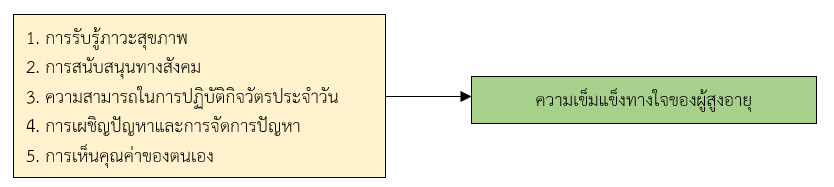
การวิจัยเชิงพรรณนานี้เพื่อศึกษาความเข็มแข็งทางใจและปัจจัยทำนายความเข็มแข็งทางใจของผู้สูงอายุ อำเภอน้ำโสม จังหวัดอุดรธานี จำนวน 129 คน ใช้วิธีการสุ่มแบบชั้นภูมิ เครื่องมือที่ใช้เป็นแบบสอบถามการรับรู้ภาวะสุขภาพ การสนับสนุนทางสังคม ความสามารถในการปฏิบัติกิจวัตรประจำวัน การเผชิญปัญหาและการจัดการปัญหา การเห็นคุณค่าของตนเองและความเข้มแข็งทางใจ ได้ค่าความสอดคล้องระหว่างข้อคำถามกับวัตถุประสงค์ระหว่าง 0.67 - 1.00 ค่าความเชื่อมั่นสัมประสิทธิ์แอลฟ่าของครอนบาคได้เท่ากับ 0.96, 0.92, 0.72, 0.84, 0.71 และ 0.96 ตามลำดับ วิเคราะห์ข้อมูลโดยใช้สถิติเชิงพรรณนา และสถิติถดถอยเชิงพหุแบบขั้นตอน
ผลการศึกษาพบว่า ความเข็มแข็งทางใจของผู้สูงอายุ อำเภอน้ำโสม จังหวัดอุดรธานี ในภาพรวม ส่วนใหญ่อยู่ในระดับปานกลาง (ร้อยละ 66.67) โดยปัจจัยการเผชิญปัญหาและการจัดการปัญหา (Beta= .420) การสนับสนุนทางสังคม (Beta= .351) และการเห็นคุณค่าในตนเอง (Beta=.193) สามารถทำนายความเข้มแข็งทางใจของผู้สูงอายุ อำเภอน้ำโสม จังหวัดอุดรธานี อย่างมีนัยสำคัญทางสถิติที่ระดับ .001 โดยอธิบายความแปรปรวนได้ร้อยละ 41.20 (adjR2 = .412)
ดังนั้น โรงพยาบาลชุมชนควรส่งเสริมการจัดกิจกรรมเพื่อให้ผู้สูงอายุสามารถเผชิญปัญหาและการจัดการปัญหา เห็นในคุณค่าตนเอง ตลอดจนการสนับทางสังคมด้านอารมณ์ ให้ข้อมูลข่าวสาร สนับสนุนวัตถุสิ่งของ การเงิน การสนับสนุนอาชีพ ตลอดจนยกย่องเชิดชูจากสังคม
เอกสารอ้างอิง
Boonsawad, P., Petchlorlian, A., Tongboonchoo, C., Rattanavicha, W., Duangduen, Y. (2020). Resilience in older adults at wellness center. Journal of The Royal Thai Army Nurses, 21(3), 481–490. (in Thai)
Chaosuansreecharoen, K. R., Chaosaunsreecharoen, P., & Khongsanit, S. (2019). Predicting factors of resilience among the elderly residents of nursing home in Southern Thailand. Journal of Mental Health of Thailand, 27(2), 65–79. (in Thai)
Choowattanapakorn, T., Alex, L., Lundman, B., Norberg, A., & Nygren, B. (2010). Resilience among women and men aged 60 years and over in Sweden and in Thailand. Nursing & Health Sciences, 12(3), 329–335.
Chunsorn, N., Kangchai, W., & Rattanajarana, S. (2018). Predictive factors of resilience among elderly with diabetes. Journal of Nursing and Health Sciences, 12(2), 12–24. (in Thai)
Cohen, J. (1988). Statistical power analysis for the behavioral sciences (2nd ed.). Hillsdale, NJ: Lawrence Erlbaum Associates.
Connor, K. M., & Davidson, J. R. T. (2003). Development of a new resilience scale: the connor-davidson resilience scale (CD-RISC). Depression and Anxiety, 18(2), 76–82.
Department of Medical Services, Ministry of Public Health. (2021). Guidelines for screening and health assessment of the elderly (B.E. 2564). Bangkok: Najanta Creation Co., Ltd. (in Thai)
Department of Mental Health, Ministry of Public Health. (2019). Guidelines for home visits under the caregiver support program for the elderly. Bangkok: Prosperous plus Co., Ltd. (in Thai)
Department of Older Persons. (2024). Elderly action plan, phase 3 (B.E. 2566–2580). Retrieved September 13, 2024, from https://www.dop.go.th/th/laws/1/28/843 (in Thai)
Faul, F., Erdfelder, E., Lang, A. G., & Buchner, A. (2007). G*Power 3: A flexible statistical power analysis program for the social, behavioral, and biomedical sciences. Behavior Research Methods, 39(2), 175–191.
Hair Jr, J. F., Black, W. C., Babin, B. J., & Anderson, R. E. (2009). Multivariate Data Analysis (7th Edition). New Jersey: Pearson Education.
House, J. S. (1981). Work stress and social support. Reading, MA: Addison-Wesley.
Jalowiec, A. (1988). “Confirmatory factor analysis of the Jalowiec coping scale. In
Waltz, C.F. & Strickland, O. L.” Measurements of nursing outcomes: measuring client outcomes. (pp. 236–308). New York: Springer.
Jermthaisong, S., Chaisena-Dallas, J., & Hengudomsub, P. (2019). Predictive Factors on Resilience Among Older Adults with Depression Bang Nam Priao District, Chachoengsao Province. Vajira Nursing Journal, 21(2), 51–66. (in Thai)
Khongphaisansophon, A. & Soonthornchaiya, R. (2016). Factors related to resilience among older persons with major depressive disorder. The Journal of Psychiatric Nursing and Mental Health, 30(2), 127–142. (in Thai)
Mekkhachorn, N. (2021). Resilience: a new approach of mental empowerment for dealing with current life crises. Journal of Psychology Kasem Bundit University, 11(2), 1–9. (in Thai)
Musich, S., Wang, S. S., Schaeffer, J. A. , Kraemer, S., Wicker, E., Yeh, C. S. (2022). he association of increasing resilience with positive health outcomes among older adults. Geriatric Nursing, 44, 97–104. (in Thai)
National Statistical Office. (2024). Summary of key findings on the employment of older persons in Thailand 2023. Bangkok: National Statistical Office. (in Thai)
Osman Ali, S. A., Alenezi, A., Kamel, F., Mostafa, M. H. (2024). Health locus of control, resilience and self-efficacy among elderly patients with psychiatric disorders. International Journal of Mental Health Nursing, 33(3), 616–623.
Osofsky, H. J., Osofsky, J. D., & Hansel, T. C. (2011). Deepwater horizon oil spill: Mental health effects on residents in heavily affected areas. Disaster Med Public Health Prep, 5(4), 280–286.
Ounlam, T. & Panpoklang, S. (2022). Predictive Factors of Resilience among Elderly with Non-Communicable Disease in Bang Phun 2 of Tambon Health Promoting Hospital, Muang Pathum Thani District, Pathum Thani Province. Journal of Health and Nursing Research, 38(2), 111–122. (in Thai)
Parayat, C., Kangchai, W., & Somanusorn, S. (2016). Predictive Factors of Resilience among Elderly. The Journal of Faculty of Nursing Burapha University, 24(2), 97–106. (in Thai)
Punyavachirachai, P. & Kanchanajirangkura, P. (2022). The study of thai people resilience quotient during the covid-19 outbreak. Research and Development Health System Journal, 15(1), 318–333. (in Thai)
Saengniam, W. & Jitpanya, C. (2018). The relationships between resilience, coping, injury severity score and the health-related quality of life in patients with multiple trauma. Thai Red Cross Nursing Journal, 11(2), 132–152. (in Thai)
Sophonpanichkul, P. & Malakul, P. (2022). Psychological factors affecting resilience quotient of cardiovascular patients. Apheit Journal Science Technology, 11(2), 1–13. (in Thai)
Sornkla, K., Kangchai, W., & Rattanayarana, S. (2019). Predictive factors of resilience among elderly living in home for the aged. Journal of Health and Nursing Research, 35(2), 163–173. (in Thai)
Speake, D. L., Cowart, M. E., & Pellet, K. (1989). Health perceptions and lifestyles of the elderly. Research in Nursing & Health, 12(2), 93–100.
Stewart, D. E., Yuen, T. (2011). A systematic review of resilience in the physically ill. Psychosomatics, 52(3), 199–209.
Sunthornchai, R. (2019). Psychosocial therapy for the elderly. Pathum Thani: Thammasat University Press. (in Thai)
Tabtim, D., Intarakamhang, U., & Choochom, O. (2020). Problem and cause of resilience, resilience enhancement method and caring behavior to elderly diabetes mellitus patient in family caregivers. Journal of Social Science and Buddhistic Anthropology, 5(10), 463–482. (in Thai)
Vorapongsathorn, S. (2015). Research in health education. Bangkok: Without Printing House. (in Thai) Wagnlid, G. (2003). Resilience and successful aging. Comparison among low and high income older adults. Journal of Gerontological Nursing, 29(12), 42–49.
Wells, M. (2010), Resilience in older adults living in rural, suburban, and urban areas. Journal of Rural Nursing and Health Care, 10(2), 45–54.
Wongpakaran, T. & Wongpakaran, N. (2011). Confirmatory factor analysis of Rosenberg self esteem scale: A study of Thai student sample. Journal of the Psychiatric Association of Thailand, 56(1), 59-70. (in Thai)
World Health Organization. (2023). Thailand’s Leadership and Innovations towards Healthy Ageing. Retrieved September 13, 2024 from https://www.who.int/southeastasia/news/feature-stories/detail/thailands-leadership-and-innovation-towards-healthy-ageing
ดาวน์โหลด
เผยแพร่แล้ว
รูปแบบการอ้างอิง
ฉบับ
ประเภทบทความ
สัญญาอนุญาต
ลิขสิทธิ์ (c) 2024 วิทยาลัยพยาบาลบรมราชชนนี นครศรีธรรมราช

อนุญาตภายใต้เงื่อนไข Creative Commons Attribution-NonCommercial-NoDerivatives 4.0 International License.
บทความที่ได้รับการตีพิมพ์เป็นลิขสิทธิ์ของ วิทยาลัยพยาบาลบรมราชชนนี นครศรีธรรมราช
ข้อความที่ปรากฏในบทความแต่ละเรื่องในวารสารวิชาการเล่มนี้เป็นความคิดเห็นส่วนตัวของผู้เขียนแต่ละท่านไม่เกี่ยวข้องกับวิทยาลัยพยาบาลบรมราชชนนี นครศรีธรรมราช และบุคคลากรท่านอื่น ๆ ในวิทยาลัยฯ แต่อย่างใด ความรับผิดชอบองค์ประกอบทั้งหมดของบทความแต่ละเรื่องเป็นของผู้เขียนแต่ละท่าน หากมีความผิดพลาดใดๆ ผู้เขียนแต่ละท่านจะรับผิดชอบบทความของตนเองแต่ผู้เดียว