Counseling to Reduce the Incidence of Bullying in Schools and Its Impact on Students
Keywords:
Counseling, Bullying, StudentsAbstract
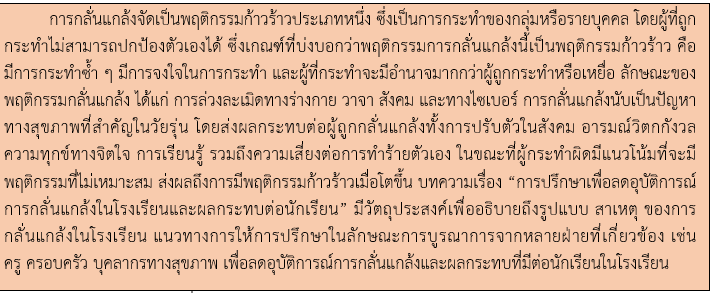
Bullying is a form of aggressive behavior that involves individuals or groups, where the victim is unable to defend themselves. The criteria that indicate bullying as an aggressive behavior include repetitive actions, intentionality, and the perpetrator having more power than the victim. Types of bullying behaviors include physical, verbal, social, and cyberbullying. Bullying is a significant health problem among adolescents, impacting victims' social adjustment, anxiety, emotional distress, learning, and increasing the risk of self-harm. Perpetrators, on the other hand, tend to exhibit inappropriate behaviors, leading to aggressive conduct as they grow older.
The article "Counseling to Reduce the Incidence of Bullying in Schools and Its Impact on Students" aims to explain the forms and causes of bullying in schools, as well as counseling approaches that integrate efforts from multiple stakeholders, such as teachers, families, and healthcare professionals, to reduce the incidence of bullying and its impact on students in schools.
References
Alex-Hart, B. A., Okagua, J., & Opara, P. I. (2015). Prevalence of bullying in secondary schools in Port Har court. International Journal of Adolescent Medicine and Health, 27(4), 391–396. www.http://dx.doi.org/10.1515/ijamh-2014-0038.
Arslan, G., Allen, K. A., & Tanhan, A. (2021). School bullying, mental health, and wellbeing in adolescents: Mediating impact of positive psychological orientations. Child Indicators Research, 14, 1007-1026.
Bandura, A. (1986). Social foundations of thought and action: A social cognitive theory. New Jersey: Prentice-Hall.
Betts, L. R., Spenser, K. A., & Gardner, S. E. (2017). Adolescents’ involvement in cyber bullying and perceptions of school: The importance of perceived peer acceptance for female adolescents. Sex roles, 77, 471-481.
Bronfenbrenner, U. (1994). Ecological models of human development. In T. Husen & T. N. Postlethwaite (Eds.), International Encyclopedia of Education. (2nd ed.). Oxford: Elsevier Science.
Cecen-Celik, H., & Keith, S. (2019). Analyzing predictors of bullying victimization with routine activity and social bond perspectives. Journal of Interpersonal Violence, 34(18), 3807-3832.
Cornell, D., & Limber, S. P. (2015). Law and policy on the concept of bullying at school. American Psychologist, 70(4), 333–343.
Department of Mental Health (2020). Thailand ranks 2nd for “Children bullying in schools” with 600,000 victims per year. Retrieved September 3, 2024 from www.https://dmh.go.th/news-dmh/view.asp?id=27485 (in Thai)
Espelage, D. L., & Holt, M. K. (2013). Suicidal ideation and school bullying experiences after controlling for depression and delinquency. Journal of Adolescent Health, 53(1), S27-S31.
Hewitt, J. P., & Shulman, D. (2011). Self and society: A symbolic interactionist social psychology. (11th ed.). Boston, MA: Pearson. Hymel, S., & Swearer, S. M. (2015). Four decades of research on school bullying: an introduction. American Psychologist, 293–299. www.http://dx doi:10.1037/a0038928.
Jia, M., & Mikami, A. Y. (2014). Peer preference and friendship quantity in children with externalizing behavior: Distinct in fluences on bully status and victim status. Journal of Abnormal Child Psychology, 43(5), 957–969. www.http://dx.doi.org/10.1007/s10802-014- 9956-8.
Juvonen, J., Wang, Y., & Espinoza, G. (2011). Bullying experiences and compromised academic performance across middle school grades. The Journal of Early Adolescence, 31(1), 152–173. www.http://dx.doi.org/10.1177/0272431610379415.
Källmén, H., & Hallgren, M. (2021). Bullying at school and mental health problems among adolescents: a repeated cross-sectional study. Child and adolescent psychiatry and mental health, 15, 1-7.
Lemstra, M. E., Nielsen, G., Rogers, M. R., Thompson, A. T., & Moraros, J. S. (2012). Risk indicators and outcomes associated with bullying in youth aged 9–15 years. Canadian Journal of Public Health, 103, 9-13.
Menesini, E., & Salmivalli, C. (2017). Bullying in schools: The state of knowledge and effective interventions. Psychology, Health & Medicine, 22(sup1), 240-253. www.https://doi.org/10.1080/13548506.2017.1279740.
Mucherah, W., Finch, H., White, T., & Thomas, K. (2018). The relationship of school climate, teacher defending and friends on students' perceptions of bullying in high school. Journal of adolescence, 62, 128-139.
Olthof, T., & Goossens, F. A. (2008). Bullying and the need to belong: Early adolescents' bullying-related behavior and the acceptance they desire and receive from particular classmates. Social Development, 17(1), 24–46. www.http://dx.doi.org/10.1111/j.1467- 9507.2007.00413.x.
Olweus, D. (1997). Bully/victim problems in school: Facts and intervention. European journal of psychology of education, 12, 495-510.
Olweus, D. (2013). School bullying: development and some important challenges. Annual Review of Clinical Psychology, 9, 751–780.
Olweus, D., & Limber, S. P. (2018). Bullying in school: Evaluation and dissemination of the Olweus Bullying Prevention Program. American Journal of Orthopsychiatry, 88(4), 423– 432. https://doi.org/10.1037/ort0000301
Rose, C. A., Espelage, D. L., Monda-Amaya, L. E., Shogren, K. A., & Aragon, S. R. (2015). Bullying and middle school students with and without specific learning disabilities: An examination of social-ecological predictors. Journal of learning disabilities, 48(3), 239- 254.
Seals, D., & Young, J. (2003). Bullying and victimization: prevalence and relationship to gender, grade level, ethnicity, self-esteem, and depression. Adolescence, 38(152).
Steinmayr, R., Crede, J., McElvany, N., & Wirthwein, L. (2016). Subjective well-being, test anxiety, academic achievement: Testing for reciprocal effects. Frontiers in Psychology, 6, 1994.
Swearer, S., & Espelage, D. (2011). A social-ecological framework of bullying among youth in North American schools.NewYork: Routledge.
Thornberg, R., & Delby, H. (2019). How do secondary school students explain bullying. Educational Research, 61(2), 142-160.
United Nations Children’s Fund. (2018). UNICEF Annual Report 2017. Retrieved August 1, 2024 from https://www.unicef.org/reports/unicef-annual-report-2017.
United Nations Educational Scientific and Cultural Organization. (2019). Behind the numbers: Ending school violence and bullying. Retrieved September 3, 2024 from www.https://unesdoc.unesco.org/ark:/ 48223/pf0000366483.
Wachs, S., Bilz, L., Fischer, S. M., Schubarth, W., & Wright, M. F. (2018). Students’ willingness to intervene in bullying: Direct and indirect associations with classroom cohesion and self- efficacy. International Journal of Environmental Research and Public Health, 15(11), 2577.
World Health Organization. (2002). World Report on Violence and Health. Geneva. Retrieved September 3, 2024 from www.https://www.who.int/publications/i/item/9241545615.
Zych, I., Ttofi, M. M., & Farrington, D. P. (2019). Protective factors against bullying and cyberbullying: A systematic review of meta-analyses. Aggression and Violent Behavior, 45, 4-19. https://doi.org/10.1016/j.avb.2018.06.008.
Downloads
Published
How to Cite
Issue
Section
License
Copyright (c) 2024 Boromarajonani College of Nursing, Nakhon Si Thammarat

This work is licensed under a Creative Commons Attribution-NonCommercial-NoDerivatives 4.0 International License.
บทความที่ได้รับการตีพิมพ์เป็นลิขสิทธิ์ของ วิทยาลัยพยาบาลบรมราชชนนี นครศรีธรรมราช
ข้อความที่ปรากฏในบทความแต่ละเรื่องในวารสารวิชาการเล่มนี้เป็นความคิดเห็นส่วนตัวของผู้เขียนแต่ละท่านไม่เกี่ยวข้องกับวิทยาลัยพยาบาลบรมราชชนนี นครศรีธรรมราช และบุคคลากรท่านอื่น ๆ ในวิทยาลัยฯ แต่อย่างใด ความรับผิดชอบองค์ประกอบทั้งหมดของบทความแต่ละเรื่องเป็นของผู้เขียนแต่ละท่าน หากมีความผิดพลาดใดๆ ผู้เขียนแต่ละท่านจะรับผิดชอบบทความของตนเองแต่ผู้เดียว