Development of Learning Using an Electronic Book Combined with Simulation-Based Learning on Nursing Care for Patients Receiving High-Flow Nasal Cannula Therapy on Learning Achievement, Satisfaction, and Self-Confidence Among Nursing Students
Keywords:
Electronic Book, Simulation-Based Learning, Learning Achievement, Satisfaction, Self-ConfidenceAbstract
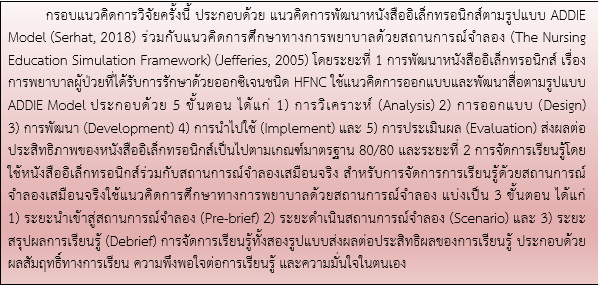
This research and development study aimed to develop and examine the effectiveness of an electronic book, as well as to evaluate the learning outcomes of using the electronic book combined with virtual simulation on nursing care for patients receiving high-flow oxygen therapy. The sample consisted of 76 fourth-year nursing students from Rangsit University. The study was conducted from September 2024 to January 2025 and was divided into two phases. Phase 1 involved developing and testing the effectiveness of the electronic book with 42 nursing students. Phase 2 examined the effectiveness of learning using the electronic book combined with virtual simulation on learning achievement, satisfaction, and self-confidence among 34 nursing students. Data were collected using a learning achievement test, a satisfaction questionnaire, and a self-confidence questionnaire administered before the learning session, after the session, and after the practice. The effectiveness of the electronic book was assessed using the E1/E2 efficiency index, and the effectiveness of the learning method was analyzed using descriptive statistics, Friedman Two-Way Analysis of Variance by Ranks, and the Wilcoxon Signed Ranks Test.
The results of Phase 1 showed that the electronic book, which consisted of 5 chapters and corresponding end-of-chapter exercises, achieved an effectiveness score of 82.66/86.22, exceeding the standard criterion of 80/80. In Phase 2, it was found that after learning using the electronic book combined with virtual simulation, the nursing students' learning achievement differed significantly (p < 0.05); the highest average scores were observed after clinical practice, followed by after class and before class, respectively. The students reported a high level of satisfaction with the learning experience, and self-confidence was significantly higher after clinical practice than after class (p < 0.05).
Therefore, the learning approach using the electronic book combined with virtual simulation is deemed appropriate for preparing nursing students prior to actual practice in caring for patients with oxygen deficiency who are receiving high-flow oxygen therapy.
References
Cohen, J. (1977). Statistical power analysis for the behavioral sciences (revised edition), New York: Academic Press
Hu, M., Zhou, Q., Zheng, R., Li, X., Ling, J., Chen, Y. et al. (2020). Application of high-flow nasal cannula in hypoxemic patients with COVID-19: a retrospective cohort study. BMC Pulmonary Medicine, 20, 1–7.
Jamjang, S., Atthamatakul, W., Nilliaum, R., & Wongyara, N. (2021). The effects of simulation-based learning on problem solving ability and self-confidence in nursing care for patients with health problems among nursing students. Journal of Prachomklao College of Nursing, Phetchaburi Province, 4(3), 178–194. (in Thai)
Jeffries, P. R. (2005). A framework for designing, implementing, and evaluating simulations used as teaching strategies in nursing. Nursing Education Perspectives, 26(2), 96–103.
Khamman, S., Surimuang, M., & Assawapalanggool, S. (2020). Effectiveness of high-flow nasal cannula oxygen therapy among adult patients: A Study at Mae Sot Hospital (Research report). Tak: Mae Sot Hospital. (in Thai)
Komonwipast, N., & Ucharattana, P. (2022). The effectiveness of an electronic book entitled “Male indwelling urinary catheterization” for sophomore nursing students in fundamentals of nursing course. Songklanagarind Journal of Nursing, 42(2), 62–72. (in Thai)
Kurt, S. (2018). ADDIE model: Instructional design. Retrieved June 25, 2024, from https://educationaltechnology.net/the-addie-model-instructional-design/
Lee, S. Y., Wang, T. J., Hwang, G. J., & Chang, S. C. (2019). Effects of the use of interactive E-books by intensive care unit patients' family members: Anxiety, learning performances and perceptions. British Journal of Educational Technology, 50(2), 888–901.
Manapattanasatien, T., Chitreecheur, J., & Kasatpibal, N. (2018). Development of an electronic book on prevention of multidrug resistance organisms transmission for registered nurses. Nursing Journal, 45(1), 146–158. (in Thai)
Promwong C. (2013). Developmental Testing of Media and Instructional Package. Journal of Education, Silpakorn University, 5(1), 7–20. (in Thai)
Sinthuchai, S., Ubolwan, K., & Boonsin S. (2017). Effects of high-fidelity simulation based learning on knowledge, satisfaction, and self-confidence among the fourth year nursing students in comprehensive nursing care practicum. Ramathibodi nursing journal, 23(1), 113–127. (in Thai)
Tiyawisutsri, C., & Limkamontip, S. (2024). The development of multimedia electronic book (E-book) on basic 7 principles of newborn care for nursing students. The Journal of Boromarajonani College of Nursing, Suphanburi, 7(1), 82–94. (in Thai)
Thammakijpirote, K., Maneewong, J., & Sanongyard, J. (2023). Simulation-based learning on critical thinking of nursing students in Thailand: A systematic review. The Journal of Boromarajonani College of Nursing, Suphanburi, 6(1), 5–28. (in Thai)
Ucharattana, P., Komonwipast, N., & Chaotthong, S. (2022). The development and effectiveness of an interactive electronic book entitled “Female indwelling catheterization” for sophomore nursing students at Rangsit University. Journal of Nursing and Health Care, 40(2), 45–54. (in Thai)
Uppor, W., Klunklin, A., Viseskul, N., Skulphan, S., & Turale, S. (2023). Designing simulation scenarios to enhance nursing students’ clinical judgment: A qualitative study. Pacific Rim International Journal of Nursing Research, 27(3), 445–456.
Wu, T. T., Huang, Y. M., Su, C. Y., Chang, L., & Lu, Y. C. (2018). Application and analysis of a mobile e-book system based on project-based learning in community health nursing practice courses. Educational Technology & Society, 21(4), 143–156.
Downloads
Published
How to Cite
Issue
Section
License
Copyright (c) 2025 Boromarajonani College of Nursing, Nakhon Si Thammarat

This work is licensed under a Creative Commons Attribution-NonCommercial-NoDerivatives 4.0 International License.
บทความที่ได้รับการตีพิมพ์เป็นลิขสิทธิ์ของ วิทยาลัยพยาบาลบรมราชชนนี นครศรีธรรมราช
ข้อความที่ปรากฏในบทความแต่ละเรื่องในวารสารวิชาการเล่มนี้เป็นความคิดเห็นส่วนตัวของผู้เขียนแต่ละท่านไม่เกี่ยวข้องกับวิทยาลัยพยาบาลบรมราชชนนี นครศรีธรรมราช และบุคคลากรท่านอื่น ๆ ในวิทยาลัยฯ แต่อย่างใด ความรับผิดชอบองค์ประกอบทั้งหมดของบทความแต่ละเรื่องเป็นของผู้เขียนแต่ละท่าน หากมีความผิดพลาดใดๆ ผู้เขียนแต่ละท่านจะรับผิดชอบบทความของตนเองแต่ผู้เดียว