A Literature Review on the Components of a Toxic Work Environment
Keywords:
Components, Toxic Work Environment, Toxic SocietyAbstract
Toxic work environments remain a relatively new issue in Thai society; however, ongoing discussions on social media have increasingly highlighted the prevalence of toxicity, often referred to as a “toxic society.” In this article, the term “toxic work environment” is used to describe such conditions, as working within a toxic social setting inevitably affects the psychological well-being of those involved. While the term “toxic society” lacks a universally accepted definition, numerous studies have identified various elements that may serve as indicators of toxicity. A review of relevant international research synthesized 13 components of toxic work environments, with seven components appearing in more than 30% of the studies, including bullying or excessive workload, harassment or threats, exclusion or ostracism, disrespect or rudeness, negative leadership including narcissism or authoritarianism, hostile or demeaning communication, and discrimination or inequality.
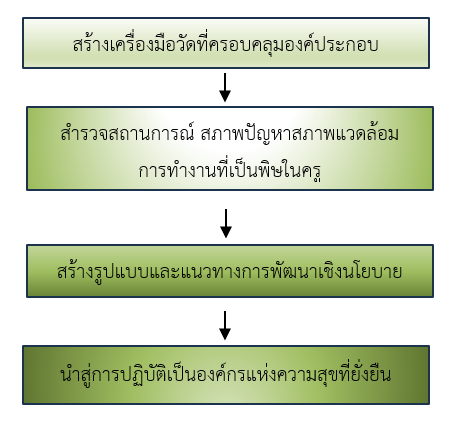
A recommendation for future research is to investigate the components of a toxic society in order to develop a standardized assessment tool. This tool could then be used to survey organizations, helping to screen for issues and measure the severity of toxicity that requires intervention. In the next phase, frameworks or models should be created and developed to reduce toxicity within organizations, both at the policy and operational levels. Continuous development efforts are also essential to foster and sustain a positive organizational culture built on well-being.
References
American Psychological Association (APA). (2024). Toxic workplaces leave employees sick, scared, and looking for an exit. Here's how to combat unhealthy conditions. Retrieved December 15, 2024, from https://www.apa.org/topics/healthy-workplaces/toxic-workplace.
Anjum, A., & Ming, X. (2018). Combating toxic workplace environment: An empirical study in the context of Pakistan. Journal of Modelling in Management, 13(3), 675-697.
Anjum, A., Ming, X., Siddiqi A. F., & Rasool, S. F. (2018). An empirical study analyzing job productivity in toxic workplace environments. International Journal of Environmental Research and Public Health, 15(5), 1035.
Aumporn, S. & Prachongchit, S. (2012). Research report in causal factors on administration affecting private school teacher turnover. Suddhiparitad, 26, 185-198.
Badri, S. K. Z. & Chieng, S. L. (2023). Prevalence of toxic work environments and their impact on wellbeing: preliminary findings among the millennial population. KnE Social Sciences, 393-408.
Balachandar, A., A., Ramasundaram, G., Lantose, A. M., Aishvarya, N., & Harini, A. R. (2024). Assessing the influence of employee eudaimonic and well-being on resilience in contemporary work environment: An investigation amidst toxic work culture. Retrieved January 4, 2025, from http://dx.doi.org/10.2139/ssrn.4963952.
Beng, L. S., & Mahadevan, A. (2023). Impact of toxic work environment on employee turnover intention in pharmaceutical industry, Klang Valley, Malaysia. International Journal of Recent Advances in Multidisciplinary Research, 10(8), 8709-8715.
Cannon, J. (2022). Toxic cultures at work: the eight drivers of a toxic culture and a process forcChange. Taylor & Francis Press.
Catherine, S. M., Markelz, A., Taylor, J. C., Deshpande, D. S., & Wolfe, P. (2022). Teacher workplace bullying: how pervasive is the Problem? TESE, 45(2), 123-140.
Christian, A. (2023). How every workplace became toxic. Retrieved December 15, 2024, from https://www.bbc.com/worklife/article/20231012-how-every-workplace-became-toxic.
Ciby, M., & Raya, R. P. (2015). Workplace bullying: a review of the defining features, measurement methods and prevalence across continents. IIM Kozhikode Society & Management Review, 4(1), 38-47.
Coldren, A. A. (2024). Quantitative insights into the psychological impact of toxic work environments (Doctoral dissertation, South College).
De Silva, K. B. N. (2022). Workplace harassment and its impact on society: a qualitative evidence synthesis. Retrieved January 9, 2024, from https://ssrn.com/abstract=4399466.
Eisner, D. C. (2020). Identifying and eliminating the toxic work environment in the clinical setting: a narrative review. Journal of Health Ethics Administration, 10(2), 1-14.
General, S. (2023). Workplace well-being. US department of health and human services. Retrieved December 17, 2024, from https://www.hhs.gov/surgeongeneral/priorities/workplace-well-being/index.html.
Hongsa, T., & Polyong, P. C. (2024a). Risk factors affecting stress and burnout among teachers: a cross-sectional study from Chonburi, Thailand. The Journal of University of Occupational and Environmental Health, 46(2), 203-213.
Hongsa, T. & Polyong, P. C. (2024b). Prevalence and factors associated with sickness presenteeism among Thai and Foreign teachers following the end of COVID-19 public health emergency of international concern. Korean Journal of Family Medicine, 45, 1-9.
Internet Marketing Company. (2019). Being an assistant teacher but unable to have his own thoughts. Retrieved January 20, 2025, from https://pantip.com/topic/38503246. (in Thai)
Iqbal, J., Hashmi, Z. F., Asghar M. Z., Rehman A. U., & Järvenoja, H. (2024). Impact of petty tyranny on employee turnover intentions: the mediating roles of toxic workplace environment and emotional exhaustion in academia. Behavioral Sciences, 14(12), 1218.
Japanese Society of Toxicology. (2024). The 51st annual meeting of the Japanese society of toxicology. Retrieved December 15, 2024, from https://www.jsot2024.jp/index.html.
Jolly, P. M., Kong, D. T., & Kim, K. Y. (2021). Social support at work: an integrative review. In Journal of Organizational Behavior, 42(2), 229–251.
Kamaruzaman, N. H., Izhar, F. M. N., Ruslan, N. F. N., Khairuefendy, N. N., Nasir, N. S. N., Anuar, A., et al. (2024). Navigating toxicity: how social support, age discrimination, and workplace spirituality shape mental health wellness. Journal of Education, 9(55), 403-421.
Khomchadluek. (2024). A young pharmacist caused a tragic Incident by gassing himself to death in his car, leaving behind a sad note. His boss did not listen to him and used pressure to force him to resign. Retrieved December 17, 2024, from https://www.komchadluek.net/news/crime/590532. (in Thai)
Knop, K. & Mielczarek, K. (2015). The improvement on the basis of PDCA and SDCA cycles. Zeszyty Naukowe, 2(3), 60-71.
Lam, C. K., Walter, F., & Huang, X. (2017). Supervisors’ emotional exhaustion and abusive supervision: the moderating roles of perceived subordinate performance and supervisor self-monitoring. Journal of Organizational Behavior, 38, 1151–1166.
LaMontagne, A. D., Åberg, M., Blomqvist, S., Glozier, N., Greiner, B. A., Gullestrup, J., et al. (2024). Work-related suicide: evolving understandings of etiology & intervention. American Journal of Industrial Medicine, 67(8), 679-695.
Liengsakul, K., Lakkanasirorat, M., & Arab, V. (2021). The prevalence and affected factors of workplace violence against staff working in a public secondary care hospital in southern Thailand. Thai Journal of Public Health and Health Sciences, 4(1), 117-133.
Lockhart, L. (2018). What to do if your workplace is toxic. Nursing made incredibly easy, 16(6), 54-55. Matichon. (2019). Teachers come out to expose being forced to sign for the receipt of the scandalous school lunches and parents urge legal action against the director. Retrieved December 20, 2024, from https://www.matichon.co.th/region/news_1641763. (in Thai)
McKinsey Company (2022). Women in the workplace 2020. Retrieved January 9, 2025, from https://wiw-report.s3.amazonaws.com/Women_in_the_Workplace_2022.pdf.
Nimitniwat, S., Pawchit, C., Meesan, N. (2022). Scrutinize the bullying in school and workplaces. Liberal Arts Review, 17(1), 138-151.
Office of Basic Education Policy and Planning, Ministry of Education. (2023). Statistics on the number of teachers and educational personnel for the Year 2021-2023. Retrieved January 22, 2025, from http://www.bopp.go.th/?page_id=3860. (in Thai)
Owens, A. T. (2023). Racial discrimination and toxic cultures at work: professional black employees and the great resignation (Doctoral dissertation, Walden University).
Ozamiz-Etxebarria, N., Idoiaga M. N., Bueno-Notivol, J., Pérez-Moreno, M., & Santabárbara, J. (2021). Prevalence of anxiety depression and stress among teachers during the COVID-19 pandemic: a rapid systematic review with meta-analysis. Brain Sciences, 11(9),1172.
Rasool, S. F., Maqbool, R., Samma, M., & Anjum, A. (2019). Positioning depression as a critical factor in creating a toxic workplace environment for diminishing worker productivity. Sustainability, 11(9), 2589.
Rasool, S. F., Wang, M., Tang, M., Saeed, A., & Iqbal, J. (2021). How toxic workplace environment effects the employee engagement: the mediating role of organizational support and employee wellbeing. International Journal of Environmental Research and Public Health, 18(5), 2294.
Robert, B. (2011). Using effective leadership strategies in the workplace. Retrieved January 26, 2025, from https://www.robertbitting.com.
Samanchit, P. (2023). Motivation development as related to work performance for staff in faculty of pharmacy, Mahasarakham university. Interdisciplinary Academic and Research Journal, 3(5), 955–976.
Sansone, R. A., & Sansone, L. A. (2015). Workplace bullying: a tale of adverse consequences. Innovations in Clinical Neuroscience, 12(1-2), 32-37.
Seligman, M. (2018). PERMA and the building blocks of well-being. The Journal of Positive Psychology, 13(4), 333-335.
Shkëmbi, F., Melonashi, E., & Fanaj, N. (2015). Workplace stress among teachers in Kosovo. SAGE Open, 5(4), 2158244015614610.
Sleek, S. (2023). Toxic workplaces leave employees sick, scared, and looking for an exit; how to combat unhealthy conditions. Retrieved January 12, 2025, from https://www.apa.org/topics/healthy-workplaces/toxic-workplace.
Sull, D. & Sull, C. (2023). The toxic culture gap shows companies are failing women. mit sloan management review. Retrieved December 20, 2024, from https://sloanreview.mit.edu/article/the-toxic-culture-gap-shows-companies-are-failing-women/.
Taştan, S. B. (2017). Toxic workplace environment: in search for the toxic behaviors in organizations with research in healthcare sector. Postmodern Openings, 8(1), 83-109.
Tencent Thailand Company. (2022). Teachers can't stand it anymore, resign as civil servants, only burdens, teachers cheat students' money but receive only a small punishment. Retrieved from https://www.sanook.com/campus/1413183/. (in Thai)
The Joanna Briggs Institute. (2019). Critical appraisal tools for use in jbi systematic reviews. Retrieved January 9, 2025, from https://jbi.global/sites/default/files/2019-05/JBI_Critical_Appraisal-Checklist_for_Systematic_Reviews2017_0.pdf
The Matter. (2024). Overwhelming workload but little pay. summary of the problem. why do thai teachers want to resign? when teachers are pushed to be the ones who sacrifice. Retrieved December 15, 2024, from https://thematter.co/social/education/why-thai-teachers-wanna-quit/160415.
Wolf, L. A., Perhats, C., Delao, A. M., & Clark, P.R. (2017). Workplace aggression as cause and effect: emergency nurses' experiences of working fatigued. International Emergency Nursing, 33, 48-52.
Workplace Bullying Institute (WBI). (2021). U.S. Workplace bullying survey. Retrieved December 20, 2024, from https://workplacebullying.org/wp-content/uploads/2024/01/2021-Full-Report.pdf
World Health Organization (WHO). (2024). Mental health at work. Retrieved December 20, 2024, from https://www.who.int/news-room/fact-sheets/detail/mental-health-at-work
Downloads
Published
How to Cite
Issue
Section
License
Copyright (c) 2025 Boromarajonani College of Nursing, Nakhon Si Thammarat

This work is licensed under a Creative Commons Attribution-NonCommercial-NoDerivatives 4.0 International License.
บทความที่ได้รับการตีพิมพ์เป็นลิขสิทธิ์ของ วิทยาลัยพยาบาลบรมราชชนนี นครศรีธรรมราช
ข้อความที่ปรากฏในบทความแต่ละเรื่องในวารสารวิชาการเล่มนี้เป็นความคิดเห็นส่วนตัวของผู้เขียนแต่ละท่านไม่เกี่ยวข้องกับวิทยาลัยพยาบาลบรมราชชนนี นครศรีธรรมราช และบุคคลากรท่านอื่น ๆ ในวิทยาลัยฯ แต่อย่างใด ความรับผิดชอบองค์ประกอบทั้งหมดของบทความแต่ละเรื่องเป็นของผู้เขียนแต่ละท่าน หากมีความผิดพลาดใดๆ ผู้เขียนแต่ละท่านจะรับผิดชอบบทความของตนเองแต่ผู้เดียว