Development of a Community-Based Learning Model to Promote Holistic Family Health Nursing Care of Nursing Students
Keywords:
community-based learning, holistic family health nursing, nursing studentsAbstract
This participatory action research aims to develop a community-based learning model in this Practicum in Community Nursing and Basic Medical Care to promote holistic family health nursing care for nursing students. Data collection was conducted from May to October 2024. The study was divided into three phases: (1) situation analysis, (2) model development, and (3) model evaluation. The population and sample group comprised fourth-year nursing students in the academic year 2024, who were divided into two practice groups of 23 each, along with 6 alumni, 3 instructors, and 2 staff members from the Community Health Promotion Hospital. The sample was purposively selected, and data were collected through both qualitative and quantitative methods by utilizing questionnaires, in-depth interviews, and focus group discussions. Data were analyzed using descriptive statistics and content analysis.
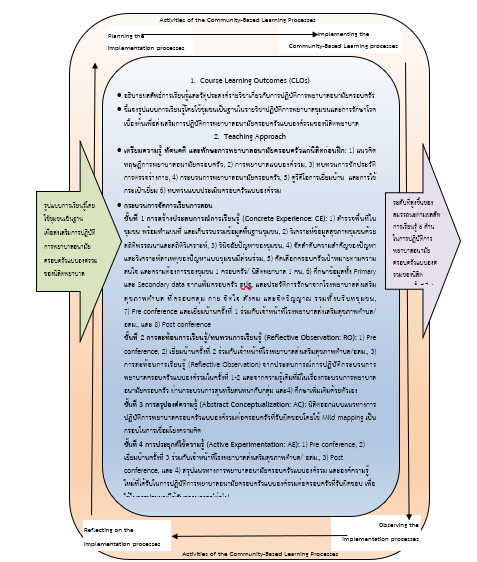
The research findings are as follows: 1. The current management of community health nursing practice is hindered by the lack of clear practice manuals and supporting media, which impairs students’ understanding and skills. Instructors have varying levels of experience and teaching techniques, resulting in an unstructured learning process. Meanwhile, local hospital staff have extensive experience but limited availability, which impacts their support and training of nursing students. Additionally, the lack of appropriate tools and equipment further hampers practical training. Overall, this highlights the need to develop an integrated learning system to enhance students' competencies and enable effective real-world practice, 2. The developed learning model consists of requirements for learning outcomes, community-based teaching management processes, and evaluation criteria, and 3. The results of learning based on the community-based model showed that nursing students demonstrated significant improvements in holistic family health nursing practices across all aspects after the training. The practice group 1 showed notable improvements in knowledge, increasing from a mean score of 2.91 (σ=0.63) to 3.68 (σ=0.46), and in interpersonal relationship skills, from 3.13 (σ=0.66) to 3.82 (σ=0.37). Meanwhile, practice group 2 demonstrated significant development in quantitative analysis skills, from 3.29 (σ=0.97) to 3.77 (σ=0.32), and cognitive skills, from 2.94 (σ=0.81) to 3.42 (σ=0.49). nursing students have a high level of satisfaction with community-based learning management in all aspects and overall, with mean scores of 4.47 (σ=0.56) in Group 1 and 4.58 (σ=0.57) in Group 2. Additionally, instructors and health staff expressed satisfaction after the training, with mean scores of 4.93 (σ=0.12) and 5.00 (σ=0.00), respectively.
The development of a community-based learning model requires close collaboration and teamwork among educational institutions, service facilities, and communities to enhance learning effectiveness. It is also essential to diversify learning approaches and incorporate technology to meet the needs of nursing students.
References
Angel, B. F., Duffey, M., & Belyea, M. (2000). An evidence-based project for evaluating strategies To improve knowledge acquisition and critical-thinking performance in nursing students. Journal of Nursing Education, 39(5), 219-228.
Aydin, A., & Hiçdurmaz, D. U. Y. G. U. (2019). Holistic Nursing Competence Scale: Turkish translation and psychometric testing. International Nursing Review, 66(3), 425-433.
Fongkoet, S., Phukritsana, S., & Tantalanukoon, S. (2016). Nursing Role with Family Health Promotion Based On Family Development Theory. Journal of Health Sciences and Wellness, 20(39), 133–142.
Isaacs, W. (1999). Dialogue: The art of thinking together. Currency. Janjamsai, M. (2015). Experiential Modeling of Community Based Learning Case Study of Integration of Architectural Design Learning and Low-income Housing development (Baan Munkong: Project at RAMA 9 Suma9 Sump3 Community). Phranakhon Rajabhat Research Journal, 10(1), 143-156. (in Thai)
Kemmis, S., & McTaggart, R. (1988). The action research planner Victoria. Australia: Deakin University. Kolb, D. A. (1984). Experience as the source of learning and development. Upper Saddle River: Prentice Hall.
Kraichan, K., Chumnanboriluk, P., & Kraichan, S. (2015). A Model of Integration of Research and Community Based Pedagogy for Health of Elderly at Samukkee Urban Community of Mahasarakham Province: Case study of the Samakkee community, Talad sub-district, Mueang district, Maha Sarakham province. Nursing Journal of the Ministry of Public Health, 25(1), 124-130.
Li, C., Yang, Y., & Jing, Y. (2022). Formulation of teaching strategies for graduation internship- based on the experiential learning styles of nursing undergraduates: a non-randomized controlled trial. BMC Medical Education, 22(1), 1-7.
Oupra, R., Tanasuwan, P., Kantawong, E., Amattayakong, C., & Chaiwong, C. (2020). Development of Learning Outcome Assessment Tools following the Qualification Framework for Higher Education, and the Learning Outcomes of Nursing Students in Family and Community Nursing I Practicum. The Southern College Network Journal of Nursing and Public Health, 7(2), 138-151.
Piwpong, R., Chaiwong, N., Bunmee, P., Khongruangrat, Y., Hormneam, N., & Sonwicha, S. (2022). A Development of a Community-based Learning Model in the Geriatric Nursing and Adult and Geriatric Nursing Practice I to Promote 21st Century Nursing Students’Learning. Journal of Boromaraionani College of Nursing, Surin, 12(1), 16-31.
Rittikoop, W. (2018). Community-Based Learning: Effective Pedagogy Strategies for Teachers in the 21st Century. Graduate School Journal Chiang Rai Rajabhat University,11(3), 179- 191.
Singhard, S., Meenakate, P., & Suriya, A. (2019). The Effect of myCourseville as a tool for teaching and learning to promote the development of 21st Century Learning skills, in Gerontological Nursing Subject of Nursing Students, Faculty of Nursing, Ubon Ratchathani University. Journal of Rangsit University: Teaching & Learning 13 (2)164-179.
Takase, M., & Teraoka, S. (2011). Development of the holistic nursing competence scale. Nursing & health sciences, 13(4), 396-403. Uppanan, A. (2021). Designing CBL Learning to Address the Development of Place-Based Teacher Identity. Retrieved February 3, 2024 from https://lpn.mcu.ac.th/mculpn/wp-content/uploads/2022/07/CBL.pdf. (in Thai)
Wanchai, A., Saengpak, C., & Leaungsomnapa, Y. (2017). Learning and teaching methods by using reflective thinking technique in nursing education. Journal of Health Science Research, 11(2), 105-115.
Wongchai, S. (2019). Resource-Based Learning for Development of Higher-Order Thinking Skills in 21st Century. Veridian E-Journal, Silpakorn University (Humanities, Social Sciences and arts), 12(2). 1131-1149.
Warabamrungkul, T., Sirasatanan, P., Mulmanee, S., & Nilkote, R. (2020). The Activities That Support the Learning Model of the 21st Century Students’ Learning Skills According to the Learning and Innovation Skill of Schools in The Eastern Region. Journal of MCU Nakhondhat, 7(9), 283-300.
Downloads
Published
How to Cite
Issue
Section
License
Copyright (c) 2025 Boromarajonani College of Nursing, Nakhon Si Thammarat

This work is licensed under a Creative Commons Attribution-NonCommercial-NoDerivatives 4.0 International License.
บทความที่ได้รับการตีพิมพ์เป็นลิขสิทธิ์ของ วิทยาลัยพยาบาลบรมราชชนนี นครศรีธรรมราช
ข้อความที่ปรากฏในบทความแต่ละเรื่องในวารสารวิชาการเล่มนี้เป็นความคิดเห็นส่วนตัวของผู้เขียนแต่ละท่านไม่เกี่ยวข้องกับวิทยาลัยพยาบาลบรมราชชนนี นครศรีธรรมราช และบุคคลากรท่านอื่น ๆ ในวิทยาลัยฯ แต่อย่างใด ความรับผิดชอบองค์ประกอบทั้งหมดของบทความแต่ละเรื่องเป็นของผู้เขียนแต่ละท่าน หากมีความผิดพลาดใดๆ ผู้เขียนแต่ละท่านจะรับผิดชอบบทความของตนเองแต่ผู้เดียว