Development of an Innovative Natural Rubber Infant Manikin for Suction Skill Practice
Keywords:
Innovation, Suctioning skill, Infant manikin, Natural rubberAbstract
This study aimed to develop and evaluate the effectiveness of an innovative natural rubber infant manikin for suction skill practice. The research was conducted in two phases. Phase 1 involved the design and development of the innovative natural rubber infant manikin for suction skill practice. Phase 2 focused on evaluating the effectiveness of the developed manikin. The sample consisted of 27 third-year Bachelor of Nursing Science students at Boromarajonani College of Nursing, Songkhla, in the 2024 academic year. The research instruments included: (1) a natural rubber infant manikin for suction skill practice, and (2) a questionnaire assessing the effectiveness of the innovative natural rubber infant manikin. The effectiveness questionnaire demonstrated an item–objective congruence (IOC) index of 0.78 and a Cronbach’s alpha reliability coefficient of 0.77. Data were analyzed using content analysis, descriptive statistics including means, standard deviations, frequencies, and percentages. The research findings revealed that:
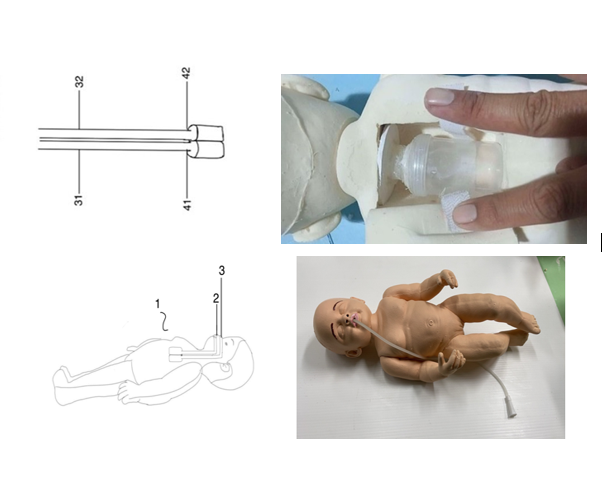
1. Innovative natural rubber infant manikin for suction skill practice: (1) External characteristics: The innovation was developed using natural rubber latex. The infant manikin is designed with an oral cavity and nasal openings. (2) Internal characteristics: The oral cavity is connected to the trachea, which extends to a simulated lung hilum model. The lung hilum model is designed as a container with an openable lid and a connector to the trachea. Inside the lung hilum model, a liquid substance simulating sputum is contained.
2. Effectiveness of the innovative natural rubber infant manikin: Overall effectiveness was rated at the highest level (M = 4.53, S.D. = 0.63). The structural dimension demonstrated a high level of effectiveness (M = 4.45, S.D. = 0.68), while the usability dimension demonstrated the highest level of effectiveness (M = 4.60, S.D. = 0.57), respectively.
The findings indicate that this innovation can be effectively implemented in teaching and learning activities in pediatric and adolescent nursing courses, both in laboratory and clinical practice components. The manikin’s anatomically and physiologically realistic design enhances students’ understanding and builds confidence in practicing infant suctioning skills. Future studies should further refine the development of the natural rubber infant suction training manikin to enhance its effectiveness. Comparative studies between conventional manikins and the natural rubber infant manikin are recommended, as well as studies involving larger sample sizes.
References
Anurak, C., Prommul, J., Fuengthin, A., Jitjum, C., Nancha, S., & Maming, H., (2023). Research and Innovation in nursing: An infant heel venipuncture-training manikin. The Southern College Network Journal of Nursing and Public Health, 11(3), e270579. https://he01.tci- thaijo.org/ index.php/scnet/article/view/270579/183972
Chaiyasang, P., Machompoo, N., Sakulkhaemaruethai, C., Sridet, R., & Nanudorn, A. (2022). Development of an innovative model from natural rubber for practicing suture skills. Journal of Health Science Research. 16(3), 13 - 25. https://he01.tci-thaijo.org/index.php/JHR/ issue/view/17600
Cohen, J. (1988). Statistical Power Analysis for the Behavioral Sciences (2th ed.). Ni Lawrence Earm Associates. College of Nursing Boromarajonani Songkhla. (2024). Strategic Plan, Boromarajonani College of Nursing, Songkhla, Fiscal Year 2022-2026. Author.
Faul, F., Erdfelder, E., Lang, A.-G., & Buchner, A. (2007). G*Power 3: A flexible statistical power. analysis program for the social, behavioral, and biomedical sciences. Behavior Research Methods, 39, 175 - 191. https://so04.tci-thaijo.org/index.php/svittj/article/view/181958
Charoensuk, S., Tasbut, W., & Setthawanit, H. (2023). Strategic Plan for the Development of the Boromarajonani College of Nursing, 2023-2027 Revised Edition, Budget 2020. Office of Strategy and International Affairs, Boromarajonani College of Nursing. Boromarajonani College of Nursing.
Henkaew, W., Thongsawat, T., & Yotkat, P. (2018). Development of DeeTorJai Model for chest compression training among nursing students. Nursing Journal, 45(4), 171-180. https://search.tci-thailand.org/article.html?b3BlbkFydGljbGUmaWQ9MzAxMzY0
Laowprachawit, K., Prommune, J., Aitsaro, C., Chuklang, C., Jitbanjong, J., & Phokwan, C., (2024). The Development of an Intramuscular Injection Simulation Pad Innovation. Princess of Naradhiwas University Journal. 43(2), 142 – 151.
Nontaput, T., & Chotiban, P. (2021). Intravenous venipuncture: New development in training on arm manikin. The Southern College Network Journal of Nursing and Public Health, 8(3), 49 - 60. https://he01.tci-thaijo.org/index.php/scnet/article/view/249150
Prommul. J, Nelson. W, Perngyai. C, Damsangsawat. N, Klerlhee. T., & Nawsuwan. K. (2024). Developmental Innovation of neonate model used for orogastric intubation.
Praboromarajchanok Institute Office of the Permanent Secretary, Ministry of Health. Yimyaem, S. (2016). Developing Stimulation Model for to Training Clinical skill of Health sciences students. Nursing Journal. 43(2), 142 – 151. (in Thai)
Tansiri, P., Prasertwong, S., Kathikarn, R., Traipak, C., & Insakol, C. (2018). The Effectiveness of Teaching Techniques of Injection by Using A Newly Produced Models. Kanchanaburi Faculty of Nursing Western University.
Thongpaknam, C, Wannarit, L, & Khuntong T. (2022). Knowledge and nursing care in emergency situationsof nurses at Bhumibol Adulyadej Hospital. Journal of Health Center. 16(2), 673 – 683.
Downloads
Published
How to Cite
Issue
Section
License
Copyright (c) 2026 Boromarajonani College of Nursing, Nakhon Si Thammarat

This work is licensed under a Creative Commons Attribution-NonCommercial-NoDerivatives 4.0 International License.
บทความที่ได้รับการตีพิมพ์เป็นลิขสิทธิ์ของ วิทยาลัยพยาบาลบรมราชชนนี นครศรีธรรมราช
ข้อความที่ปรากฏในบทความแต่ละเรื่องในวารสารวิชาการเล่มนี้เป็นความคิดเห็นส่วนตัวของผู้เขียนแต่ละท่านไม่เกี่ยวข้องกับวิทยาลัยพยาบาลบรมราชชนนี นครศรีธรรมราช และบุคคลากรท่านอื่น ๆ ในวิทยาลัยฯ แต่อย่างใด ความรับผิดชอบองค์ประกอบทั้งหมดของบทความแต่ละเรื่องเป็นของผู้เขียนแต่ละท่าน หากมีความผิดพลาดใดๆ ผู้เขียนแต่ละท่านจะรับผิดชอบบทความของตนเองแต่ผู้เดียว