Technology Acceptance Factors that Affect Postpartum Mothers’ Self-Care Behaviors
Keywords:
Technology Acceptance, Self-Care Behaviors, Postpartum MothersAbstract
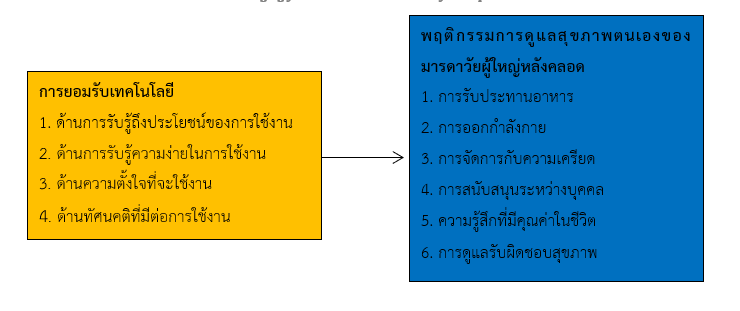
This descriptive research aimed to examine technology acceptance, self-care health behaviors, and technology acceptance that affect postpartum mothers’ self-care .The participants were postpartum mothers who attended postpartum check-ups and brought their infants for health examinations and vaccinations at Well-Child Clinics in Hatyai Hospital and Songkhla Hospital between February and April 2025. A total of 327 participants were recruited using simple random sampling without replacement. The research instruments included a Technology Acceptance Questionnaire and a Postpartum Mothers’ Self-Care Behavior Questionnaire. The content validity index (CVI) values were 0.87 and 0.84, respectively, and the Cronbach’s alpha reliability coefficients were .83 and .86, respectively. Data were analyzed using descriptive statistics, including frequency, percentage, mean, and standard deviation. Multiple linear regression analysis using the enter method was also performed.
The results revealed that: 1) overall technology acceptance among postpartum mothers was at the highest level (M = 4.27, S.D. = 0.76). Among the subdimensions, perceived usefulness had the highest mean score (M = 4.38, S.D. = 0.59), whereas attitudes toward technology use had the lowest mean score (M = 4.19, S.D. = 0.70). Overall self-care health behaviors among postpartum mothers were at a high level (M = 4.13, S.D. = 0.53); 2) technology acceptance factors, including perceived usefulness, perceived ease of use, and intention to use technology for self-care, significantly predicted self-care health behaviors among postpartum mothers at the .001 and .05 significance levels. These factors explained 38.7% of the variance in self-care health behaviors.
Relevant organizations can apply these research findings as guidelines for designing and developing technology-based programs to promote postpartum maternal health care. Such programs should integrate the promotion of personal health responsibility and mental health simultaneously. Additionally, government and public health agencies should enhance digital health literacy among postpartum mothers through training programs or educational activities. They should also develop health information resources that are easy to understand and accessible to support continuous and sustainable positive health behaviors.
References
Asathong, S. (2015). Self-care behaviors of the elderly in Wang Thong Municipality, Wang Sombun District, Sa Kaeo Province. A master’s thesis submitted in partial fulfillment of the requirements for the Master of Public Administration. Bangkok: Burapha University. (in Thai)
Choomjit, S. (2020). A study of knowledge and self-care behaviors among first-time postpartum mothers at Health Promoting Hospital, Health Center Region 5, Ratchaburi Province [Research report]. (in Thai)
Davis, F.D., Bagozzi, R.P. & Warshaw, P. R. (1989). User Acceptance of Computer Technology : A Comparison of Two Theoretical Models. Management Science, 35, 982-1003.
Hair, F.J., Black, C.W., Babin, J.B, & Anderson, E.R. (2019). Multivariate Data Analysis 7th ed. New Jersey: Pearson Education.
Hat Yai Hospital. (2024). Internal service statistics of postpartum mothers attending obstetrics and gynecology clinics and well-baby clinic. Medical Records Department, Hat Yai Hospital, Songkhla, Thailand. (in Thai)
Inchot, K. (2021). A study of the quality of information systems, technology acceptance, and medical innovations affecting the decision to use online doctor consultation applications among residents in Bangkok. A master’s thesis submitted in partial fulfillment of the requirements for the Master of Business Administration in Accounting. Bangkok: Ramkhamhaeng University. (in Thai)
Khosakul, W. (2018). Research methodology in public administration [Textbook] [in Thai]. Bangkok: Ramkhamhaeng University.
Klaikoet, C., et al. (2019). The effectiveness of an information technology–based educational model for postpartum mothers. In Proceedings of the 11th National Conference, Nakhon Pathom Rajabhat University. (in Thai)
Krejcie, R.V. and Morgan, D.W. (1970). Determining sample size for research activities. Educational and Psychological Measurement, Vol.30, p. 607-610.
Lertpureevong, W., & Pornsakulvanich, V. (2022). Technology acceptance factors, attitudes, and social influences predicting intention to use public hospital applications. NIDA Journal of Communication and Innovation, 9(2), 106–129. (in Thai)
Pender N J, Murdaugh C L, Parsons M A. (2011). Health promotion in nursing practice. 6th ed. New Jersey: Prentice-Hall.
Sangsawang, J., Chupradit, P., & Wongmuneeworn, W. (2022). Acceptance of the use of technology, websites, and social networks on health-promoting behaviors among teenage mothers. Journal of Health and Nursing Research, 38(2), 84–96. (in Thai)
Senawong, N. (2021). The study of social media usage behavior of Generation Z in the new normal era in Bangkok. An independent study submitted in partial fulfillment of the requirements for the Master of Business Administration in Marketing. Bangkok: Siam University. (in Thai)
Songkhla Hospital. (2024). Internal service statistics of postpartum mothers attending obstetrics and gynecology clinics and well-baby clinics. Medical Records Department, Songkhla Hospital, Songkhla, Thailand. (in Thai)
Suddhavej Hospital. (2023). Postpartum self-care and infant care at home: A guide for mothers. Retrieved from https://med.msu.ac.th/suddhavej/wp-content/uploads/2023/03/manual-affter-mom.pdf. (in Thai)
Sunthonthammakun, K. (2021). Technology acceptance and attitudes influencing intention to purchase vegetables and fruits through online channels in Bangkok metropolitan area. A master’s project in business administration. Bangkok: Srinakharinwirot University. (in Thai)
Thato, R. (2024). Nursing research [in Thai]. Bangkok: Chulalongkorn University Press. Thongmullek, T., & Vichitthamaros, P. (2017). A study of factors influencing acceptance and use of social networks in Thai society. Journal of Communication and Social Innovation, 5(2), 114–124. (in Thai)
UNICEF. (2025). Trends in maternal mortality 2000 to 2023. UNICEF Data. https://data.unicef.org/resources/trends-in-maternal-mortality-2000-to-2023/
Walker, SN., Sechrist, K., & Pender, N,. (1995). The health-promoting lifestyle profile II. Omaha: University of Nebraska Medical Center, College of Nursing.
World Health Organization. (2023). Maternal mortality. World Health Organization. https://www.who.int/news-room/fact-sheets/detail/maternal-mortality
Downloads
Published
How to Cite
Issue
Section
License
Copyright (c) 2026 Boromarajonani College of Nursing, Nakhon Si Thammarat

This work is licensed under a Creative Commons Attribution-NonCommercial-NoDerivatives 4.0 International License.
บทความที่ได้รับการตีพิมพ์เป็นลิขสิทธิ์ของ วิทยาลัยพยาบาลบรมราชชนนี นครศรีธรรมราช
ข้อความที่ปรากฏในบทความแต่ละเรื่องในวารสารวิชาการเล่มนี้เป็นความคิดเห็นส่วนตัวของผู้เขียนแต่ละท่านไม่เกี่ยวข้องกับวิทยาลัยพยาบาลบรมราชชนนี นครศรีธรรมราช และบุคคลากรท่านอื่น ๆ ในวิทยาลัยฯ แต่อย่างใด ความรับผิดชอบองค์ประกอบทั้งหมดของบทความแต่ละเรื่องเป็นของผู้เขียนแต่ละท่าน หากมีความผิดพลาดใดๆ ผู้เขียนแต่ละท่านจะรับผิดชอบบทความของตนเองแต่ผู้เดียว