การพัฒนารูปแบบการจัดส่งยาถึงบ้านสำหรับผู้ป่วยโรคเรื้อรังในเขตชุมชนชนบท อำเภอบ้านหมอ จังหวัดสระบุรี
Keywords:
Home Drug Delivery, Chronic Disease, Telepharmacy, Rural Community, Smart Medication Delivery SystemAbstract
This research and development aimed to develop and evaluate an integrated home drug delivery model for chronic disease patients in rural communities, Ban Mo District, Saraburi Province. A mixed-methods research design was employed across three phases from July 2024 to May 2025. The sample consisted of 214 chronic disease patients selected through purposive and systematic random sampling, and 45 key informants. Research instruments included the Health Rider system developed as an intelligent drug delivery management platform, real-time telepharmacy services, satisfaction surveys, and in-depth interview guides. Content validity index was 0.89 and reliability coefficient was 0.92. Quantitative data were analyzed using descriptive statistics, McNemar's test, and Binary Logistic Regression. Qualitative data were analyzed using content analysis.
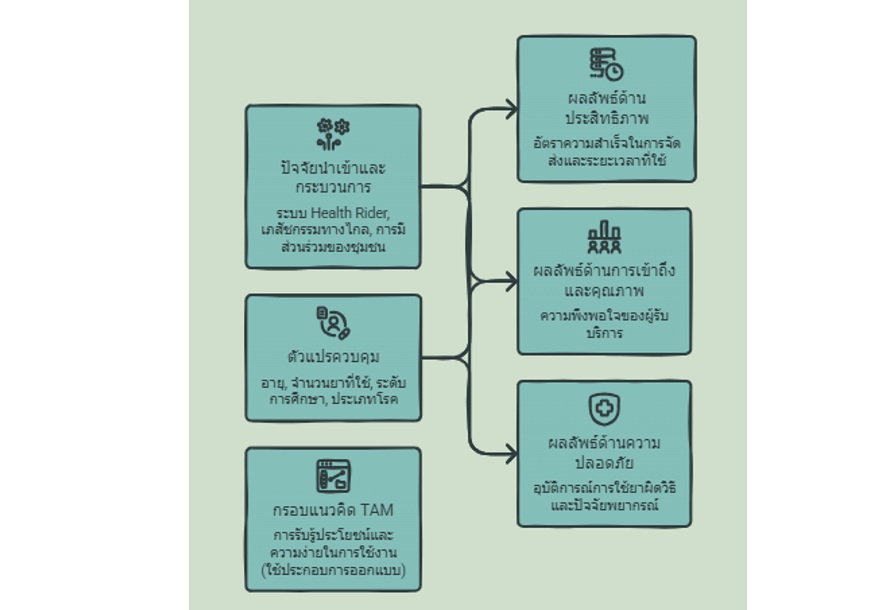
The developed model comprised three main components: the Health Rider system for intelligent route planning and real-time tracking, real-time telepharmacy services, and community participation mechanisms. Implementation results showed 100 percent delivery success rate with an average time of 15-20 minutes per patient. Overall patient satisfaction was at the highest level (M=4.98, SD=0.08). Medication error incidence significantly decreased from 12.3 percent to 2.5 percent (McNemar's test, χ²=18.05, p<0.001). Receiving telepharmacy services significantly reduced the risk of medication errors (OR=0.18; 95% CI: 0.06, 0.51; p=0.001).
The developed integrated drug delivery model demonstrated high efficiency and effectiveness, significantly reducing patients' time and expenses while enhancing medication safety. The model should be expanded to other areas with similar contexts.
Keywords: Home drug delivery, Chronic disease, Telepharmacy, Rural community, Health Rider
References
กองโรคไม่ติดต่อ กรมควบคุมโรค. (2567). รายงานสถานการณ์โรคไม่ติดต่อในประเทศไทย พ.ศ. 2567.สมาคมโรคไม่ติดต่อแห่งประเทศไทย.
Al-Aqeel, S., Mutlaq, A., Alkhalifa, N., Alnassar, D., Alghanim, R., Algarni, W., & Alshammari, S.(2025). Pharmacists' interventions in virtual diabetes clinics: Cost-effectiveness feasibility study. Healthcare (Basel), 13(17), 2130. https://doi.org/10.3390/healthcare13172130
Borg, W. R., & Gall, M. D. (1983). Educational research: An introduction (4th ed.). Longman.
Buathong, N., Naruephai, S., Wanichanon, W., Rodkitvitthaya, K., Thananinkul, P., Jankaew, N., Wessamanon, P., Khaotrakul, S., Boonmak, R., Choo-eard, N., Nintap, T., Sarakitphan, T., Kaewchuay, P., Naruephai, K., & Chaison, M. (2024). Exploring symptoms perception and barriers to medication adherence among Thai Muslim patients with non-communicable diseases in a rural community in southern Thailand: A mixed-methods study. BMJ Open, 14(12), e089301. https://doi.org/10.1136/bmjopen-2024-089301
Cochran, W. G. (1977). Sampling techniques (3rd ed.). John Wiley & Sons.Davis, F. D. (1989). Perceived usefulness, perceived ease of use, and user acceptance of information technology. MIS Quarterly, 13(3), 319-340. https://doi.org/10.2307/249008
Diaz, R. R., Satheesh, G., Moran, A. E., Perel, P., Rodgers, A., & Schutte, A. E. (2026). Delivery models to improve adherence to medicines for chronic diseases in primary care. The Lancet Primary Care, 2(1), 100074. https://doi.org/10.1016/j.lanprc.2025.100074
He, J., Chen, J., Li, Q., Yang, Z., Liang, H., Wang, L., Sun, Z., & Zhao, H. (2022). Application of family-involved smart medication management system in rural-dwelling middle-aged and older adult participants with chronic diseases. Medicine (Baltimore), 101(45),
e31662. https://doi.org/10.1097/MD.0000000000031662
Hussain, A., & Bowen, A. M. (2024). Exploring pharmacist roles in telepharmacy for chronic disease management in New York State. Cureus, 16(6), e62982. https://doi.org/10.7759/cureus.62982
National Rural Health Association. (2024). Impacts of telehealth on rural health care access.
Parasuraman, A., Zeithaml, V. A., & Berry, L. L. (1988). SERVQUAL: A multiple-item scale for measuring consumer perceptions of service quality. Journal of Retailing, 64(1), 12-40.
Shrivastava, S. R. B. L., Bobhate, P. S., & Wibawa, A. (2025). Facilitating access to pharmaceutical care in rural and remote communities by strengthening telepharmacy. Nigerian Postgraduate Medical Journal, 32(1), 68-70. https://doi.org/10.4103/npmj.npmj_23_25
World Health Organization. (2025). Noncommunicable diseases: Fact sheet. https://www.who.int/news-room/fact-sheets/detail/noncommunicable-diseases
Downloads
Published
How to Cite
Issue
Section
License
Copyright (c) 2026 Boromarajonani College of Nursing, Nakhon Si Thammarat

This work is licensed under a Creative Commons Attribution-NonCommercial-NoDerivatives 4.0 International License.
บทความที่ได้รับการตีพิมพ์เป็นลิขสิทธิ์ของ วิทยาลัยพยาบาลบรมราชชนนี นครศรีธรรมราช
ข้อความที่ปรากฏในบทความแต่ละเรื่องในวารสารวิชาการเล่มนี้เป็นความคิดเห็นส่วนตัวของผู้เขียนแต่ละท่านไม่เกี่ยวข้องกับวิทยาลัยพยาบาลบรมราชชนนี นครศรีธรรมราช และบุคคลากรท่านอื่น ๆ ในวิทยาลัยฯ แต่อย่างใด ความรับผิดชอบองค์ประกอบทั้งหมดของบทความแต่ละเรื่องเป็นของผู้เขียนแต่ละท่าน หากมีความผิดพลาดใดๆ ผู้เขียนแต่ละท่านจะรับผิดชอบบทความของตนเองแต่ผู้เดียว