DEVELOPMENT OF SYMPTOM MANAGEMENT PROGRAM WITH THAI STYLE QIGONG ON INSOMNIA AMONG END OF LIFE PRESONS WITH CANCER
Keywords:
Symptom Management, Thai-Style Qigong Mind-Body Exercise, Insomnia, Persons with End-Stage CancerAbstract
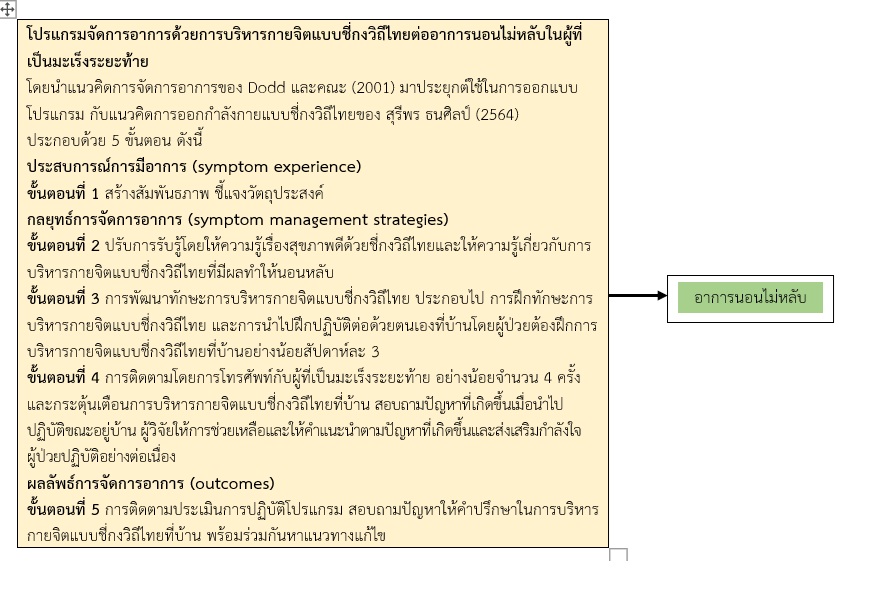
The purpose of this quasi-experimental research was to compare the symptoms of sleeplessness in end of life presons with cancer of their lives before and after they underwent a symptom management program that included Thai Style Qigong mind-body activities. The study examined the differences in insomnia symptoms between the groups of terminally ill cancer patients getting routine nursing care and the group receiving a symptom management program with Thai Style Qigong. Male and female patients who were 18 years of age or older and who were treated at the Oncology Unit after receiving a stage 4 cancer diagnosis made up the sample. Patients at a tertiary hospital were split into 22 experimental and 22 control groups. The experimental group received a symptom management program using Thai Style Qigong for 6 weeks, while the control group routine standard nursing care. Data were analyzed using percentages, means, and t-tests.
The study discovered that the insomnia in the experimental group after receiving the Symptom Management Program with Thai-Style Qigong was significantly lower than before receiving the program (p< .05) and The posttest insomnia of the experimental group was significantly lower than that of the control group (p< .05).
Professional nurses or related agencies can apply the research findings to nursing practice for terminally ill cancer patients experiencing insomnia, enabling them to manage insomnia effectively and ultimately improve their quality of life.
References
กรรณิกา ชูจิตร, ชนกพร จิตปัญญา และจรรยา ฉิมหลวง. (2561). ผลของโปรแกรมการปรับพฤติกรรมการนอนต่ออาการนอนไม่หลับของผู้ป่วยโรคหัวใจล้มเหลว. วารสารพยาบาลทหารบก. 19, 184-191.
จุฑาทิพย์ เหมบุตร. (2563). ผลของโปรแกรมการปรับสุขวิทยาการนอนหลับต่ออาการนอนไม่หลับในผู้ป่วยมะเร็งเต้านมที่ได้รับยาเคมีบำบัด. วิทยานิพนธ์ปริญญามหาบัณฑิต, จุฬาลงกรณ์มหาวิทยาลัย.
จุติรัตน์ ภูติรักษ์. (2564). ผลของโปรแกรมการให้ความรู้สุขวิทยาการนอนร่วมกับการออกกำลังกายแบบชี่กงวิถีไทยต่ออาการนอนไม่หลับของผู้ป่วยสูงอายุหลังเปลี่ยนข้อเข่าเทียม. วิทยานิพนธ์ปริญญามหาบัณฑิต,จุฬาลงกรณ์มหาวิทยาลัย.
นงลักษณ์ กลิ่นพุดตาล, ชนกพร จิตปัญญา และ ปชาณัฎฐ์ ตันติโกสุม. (2559). ความสัมพันธ์ระหว่างอาการหายใจลำบาก อาการนอนไม่หลับและภาวะซึมเศร้ากับความเหนื่อยล้าในผู้ป่วยภาวะหัวใจล้มเหลวเรื้อรัง. วารสารพยาบาลตำรวจ. 8(2). 1-12.
เบญจมาภรณ์ บุญรัก, ธีรนุช ยินดีสุข และ ดรุณี คชพรหม. (2567). การจัดการความเจ็บปวดในผู้ป่วยมะเร็งระยะท้าย: การวิจัยเชิงคุณภาพ. วารสารศูนย์อนามัยที่ 9. 18(2), 526-536.
ประภาพรรณ สุคนธจิตต์ และคณะ.(2559). ประสบการณ์การมีอาการนอนไม่หลับ กลวิธีการจัดการกับอาการนอนไม่หลับ และคุณภาพชีวิตในผู้ป่วยโรคอุดกั้นเรื้อรัง. Journal of Nursing Science. 35(2), 100-110.
ปิติ ชาคริยานุโยค. (2566). การศึกษาผลของการดูแลผู้ป่วยมะเร็งระยะท้ายแบบประคับประคองในโรงพยาบาลสามพราณ จังหวัดนครปฐม. วารสารสมาคมเวชศาสตร์ป้องกันแห่งประเทศไทย, 13(1), 60-72.
พรทิพย์ ปรีชาไชยวิทย์. (2564). การพัฒนาเครื่องมือประเมินคุณภาพชีวิตประจำวันโดยผู้ป่วยหรือผู้ดูแลเพื่อการบริบาลผู้ป่วยมะเร็งระยะท้าย. วิทยานิพนธ์ปริญญาดุษฎีบัณฑิต, จุฬาลงกรณ์มหาวิทยาลัย.
เพชรรัตน์ เจิมรอด. (2560). ชี่กงกับการดูแลสุขภาพ. วารสารพยาบาลสภากาชาดไทย, 10(1), 44-54.
เพ็ญภพ พันธุ์เสือ. (2560). ประสิทธิผลของการออกกำลังกายแบบชี่กงต่อภาวะซึมเศร้าในผู้สูงอายุไทยวิทยานิพนธ์ปริญญาดุษฎีบัณฑิต, จุฬาลงกรณ์มหาวิทยาลัย.
วันเพ็ญ เทศวิรัช. (2557). ปัจจัยทำนายคุณภาพการนอนหลับในผู้ป่วยโรคมะเร็งที่ได้รับยาเคมีบำบัด.วิทยานิพนธ์ปริญญาพยาบาลศาสตรมหาบัณฑิต, สาขาพยาบาลศาสตร์, มหาวิทยาลัยบูรพา.
สมชาย ธนะสิทธิชัย และคณะ. (2563). ความปลอดภัยและประสิทธิผลของการสารสกัดกัญชาทางการแพทย์เกรดยาตัวแรกของประเทศไทย ในผู้ป่วยมะเร็งระยะท้าย. วารสารกรมการแพทย์, 45(3), 116-122.
สุรีพร ธนศิลป์. (2563). การดูแลผู้ป่วยมะเร็งระยะสุดท้ายแบบองค์รวม. สำนักพิมพ์จุฬาลงกรณ์มหาวิทยาลัย.
สุรีพร ธนศิลป์. (2564). สุขภาพดี ด้วยชี่กงวิถีไทย (พิมพ์ครั้งที่ 5). บีพีเค ปริ้นติ้ง.
อรุณศรี สารธิมา. (2568). ผลของโปรแกรมการจัดการอาการร่วมกับการบริหารกาย-จิตแบบชี่กงต่ออาการเหนื่อยล้าอาการนอนไม่หลับและอาการวิตกกังวล ในผู้ที่เป็นมะเร็งเต้านมที่ได้รับยาเคมีบำบัดแบบเสริม. วารสารการวิจัยทางการพยาบาล นวัตกรรม และสุขภาพ, 37(1), 55–69
Dodd, M., Janson, S., Facione, N., Faucett, J., Froelicher, E. S., Humphreys, J., Lee, K., Miaskowski, C., Puntillo, K., Rankin, S., & Taylor, D. (2001). Advancing the science of symptom management. Journal of Advanced Nursing, 33(5), 668-676.
Morin, C. M., Bootzin, R. R., Buysse, D. J., Edinger, J. D., Espie, C. A., & Lichstein, K. L. (2006). Psychological and behavioral treatment of insomnia: Update of therecent evidence (1998-2004). Sleep, 29(11), 1398- 1414.
Morin, C. M., & Espie, C.A (2003). Insomnia a chinican’s guide to assessment and treatment. New York: Plenum.
Polit, D. F., & Beck, C. T. (2004). Nursing research: Principles and methods (7th ed.). Lippincott Williams & Wilkins.
Savard, J., Simard, S., Ivers, H., & Morin, C. M. (2005). Randomized study on efficacy of cognitive behavioral therapy for insomnia secondary to breast cancer, Part I: Sleep and psychological effects. Journal of Clinical Oncology, 23(25), 6083-6096.
Downloads
Published
How to Cite
Issue
Section
License
Copyright (c) 2026 Boromarajonani College of Nursing, Nakhon Si Thammarat

This work is licensed under a Creative Commons Attribution-NonCommercial-NoDerivatives 4.0 International License.
บทความที่ได้รับการตีพิมพ์เป็นลิขสิทธิ์ของ วิทยาลัยพยาบาลบรมราชชนนี นครศรีธรรมราช
ข้อความที่ปรากฏในบทความแต่ละเรื่องในวารสารวิชาการเล่มนี้เป็นความคิดเห็นส่วนตัวของผู้เขียนแต่ละท่านไม่เกี่ยวข้องกับวิทยาลัยพยาบาลบรมราชชนนี นครศรีธรรมราช และบุคคลากรท่านอื่น ๆ ในวิทยาลัยฯ แต่อย่างใด ความรับผิดชอบองค์ประกอบทั้งหมดของบทความแต่ละเรื่องเป็นของผู้เขียนแต่ละท่าน หากมีความผิดพลาดใดๆ ผู้เขียนแต่ละท่านจะรับผิดชอบบทความของตนเองแต่ผู้เดียว