โปรแกรมการปรับเปลี่ยนพฤติกรรมการบริโภคเครื่องดื่มรสหวานที่มีน้ำตาลของวัยรุ่นไทยโดยใช้ทฤษฎีพฤติกรรมตามแผน
คำสำคัญ:
การปรับเปลี่ยนพฤติกรรม, การบริโภค, เครื่องดื่มรสหวานที่มีน้ำตาล, วัยรุ่น, ทฤษฎีพฤติกรรมตามแผนบทคัดย่อ
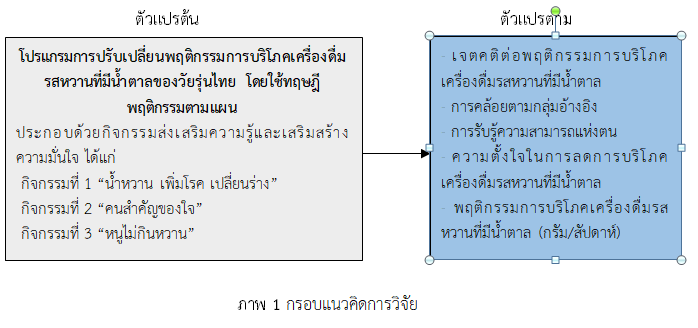
การวิจัยแบบกึ่งทดลองครั้งนี้ มีวัตถุประสงค์เพื่อศึกษาประสิทธิผลของโปรแกรมการปรับเปลี่ยนพฤติกรรมการบริโภคเครื่องดื่มรสหวานที่มีน้ำตาลของวัยรุ่นไทยโดยใช้ทฤษฎีพฤติกรรมตามแผน กลุ่มตัวอย่าง คือ นักเรียนระดับมัธยมศึกษาในเขตสุขภาพที่ 3 รวมจำนวน 450 คน โดยแบ่งเป็นกลุ่มทดลองและกลุ่มควบคุมกลุ่มละ 225 คน ที่ได้จากการเลือกแบบจำเพาะเจาะจง จับฉลากนักเรียนของแต่ละโรงเรียนเพื่อแบ่งเป็นกลุ่มทดลองและกลุ่มควบคุม กลุ่มทดลองได้รับโปรแกรมที่พัฒนาขึ้นโดยใช้ทฤษฎีพฤติกรรมตามแผน ส่วนกลุ่มควบคุมได้รับการส่งเสริมสุขภาพแบบทั่วไป ข้อมูลถูกรวบรวมโดยแบบสอบถามที่มีค่า IOC ระหว่าง 0.67 - 1.00 และค่าครอนบาคแอลฟา เท่ากับ 0.82 0.87 0.95 0.90 และ 0.88 วิเคราะห์ข้อมูลโดยใช้สถิติพรรณนา ทดสอบประสิทธิผลของโปรแกรมระหว่างกลุ่ม โดยใช้สถิติ Independent t-test และสถิติ Paired t-test
ผลการวิจัย พบว่า หลังการจัดโปรแกรม กลุ่มทดลองมีคะแนนเฉลี่ยเจตคติต่อพฤติกรรมการบริโภคเครื่องดื่มรสหวานที่มีน้ำตาล การคล้อยตามกลุ่มอ้างอิง การรับรู้ความสามารถแห่งตน ความตั้งใจในการลดการบริโภคเครื่องดื่มรสหวานที่มีน้ำตาลสูงกว่าก่อนการจัดโปรแกรมและสูงกว่ากลุ่มควบคุม และมีคะแนนเฉลี่ยพฤติกรรมการบริโภคเครื่องดื่มรสหวานที่มีน้ำตาล (ปริมาณน้ำตาล กรัม/สัปดาห์) ต่ำกว่าก่อนการจัดโปรแกรมและต่ำกว่ากลุ่มควบคุม อย่างมีนัยสำคัญทางสถิติที่ระดับ 0.05
แสดงให้เห็นว่า โปรแกรมที่พัฒนาขึ้นสามารถปรับเปลี่ยนพฤติกรรมในกลุ่มทดลองได้ จึงควรนำไปใช้ให้ครอบคลุมกลุ่มวัยรุ่นมากยิ่งขึ้น และประยุกต์ใช้ในกลุ่มเป้าหมายอื่นต่อไป
เอกสารอ้างอิง
Ajzen, I. (1991). The theory of planned behavior. Organizational Behavior & Human Decision Processes, 50(2), 179-212.
Bernard, R. (2000). Fundamentals of biostatistics (5th ed.). Duxbery: Thomson learning, 308.
Bleich, S. N., Vercammen, K. A., Koma, J. W., & Li, Z. (2018). Trends in beverage consumption among children and adults, 2003-2014. Obesity, 26(2), 432-441.
Cronbach, L. J. (1951). Coefficient alpha and the internal structure of tests. Psychometrika, 16, 297–334.
de Boer, E. C., de Rooij, S. R., Olthof, M. R., & Vrijkotte, T. G. M. (2018). Sugar-sweetened beverages intake is associated with blood pressure and sympathetic nervous system activation in children. Clinical Nutrition ESPEN, 28, 232-235.
Ezendam, N. P., Brug, J., & Oenema, A. (2012). Evaluation of the Web-based computer-tailored FATaintPHAT intervention to promote energy balance among adolescents: results from a school cluster randomized trial. Archives of Pediatrics Adolescent Medicine, 166(3), 248-255.
Fung, T. T., Malik, V., Rexrode, K. M., Manson, J. E., Willett, W. C., & Hu, F. B. (2009). Sweetened beverage consumption and risk of coronary heart disease in women. The American Journal of Clinical Nutrition, 89(4), 1037-1042.
Godin, K. M, Chaurasia, A., Hammond, D., & Leatherdale, S. T. (2018). Food purchasing behaviors and sugar-sweetened beverage consumption among canadian secondary school students in the compass study. Journal of Nutrition Education and Behavior, 50(8), 803-812.
Health Data Center. (2021). Standard report. Retrieved September 28, 2021 from https://www.hdcservice.moph.go.th/hdc/main/index.php. (in Thai)
Hongsanun, W. (2020) Development of a thai adolescence sugar sweetened beverage intake Questionnaire (THASSI). A dissertation submitted in partial fulfillment of the requirement for doctor of public health degree in public health program faculty of public health, Naresuan University. (in Thai)
Louie, J. C, Moshtaghian, H, Rangan, A. M, Flood, V. M, & Gill, T. P. (2016). Intake and sources of added sugars among australian children and adolescents. European Journal of Nutrition, 55(8), 2347-2355.
Ma, J., Fox, C. S., Jacques, P. F., Speliotes, E. K., Hoffmann, U., Smith, C. E., et al., (2015). Sugar-sweetened beverage, diet soda, and fatty liver disease in the framingham heart study cohorts. Journal of Hepatology, 63(2), 462-469.
Ministry of Public Health. (2020). Health data center KPI report 2020. Retrieved September 30, 2020 from https://www.hdcservice.moph.go.th/hdc/reports/page_kpi.php?flag_kpi_level= 1&flag_kpi_year=2020 (in Thai)
Pan, A. & Hu, F. B. (2011). Effects of carbohydrates on satiety: Differences between liquid and solid food. Obesite. 6(4), 206-211.
Singh, G. M., Micha, R., Khatibzadeh, S., Shi, P., Lim, S., Andrews, K. G., et al. (2015). Global, regional, and national consumption of sugar-sweetened beverages, fruit juices, and milk: A systematic assessment of beverage intake in 187 countries. PLoS ONE, 10(8), e0124845.
Stern, D., Piernas, C., Barquera, S., Rivera, J. A, & Popkin, B. M. (2014). Caloric beverages were major sources of energy among children and adults in mexico, 1999-2012. The Journal of Nutrition, 144(6), 949-956.
Thai Health Promotion Foundation. (2018). Report of the effect of sugary drink price increases on consumption behavior. Retrieved September 30, 2020 from https://www.resourcecenter.thaihealth.or.th/media/9zWx. (in Thai)
Yuzbashian, E., Asghar, G., Mirmiran, P., Zadeh-Vakili, A., & Azizi, F. (2016). Sugar-sweetened beverage consumption and risk of incident chronic kidney disease: Tehran lipid and glucose study. Nephorogy, 21(7), 608-16.
Vezina-Im, L. A., Beaulieu, D., Belanger-Gravel, A., Boucher, D., Sirois, C., Dugas, M., et al., (2017). Efficacy of school-based interventions aimed at decreasing sugar-sweetened beverage consumption among adolescents: a systematic review. Public Health Nutrition, 20(13), 2416-2431.
Wang, M., Yu, M., Fang, L., & Hu, R. Y. (2015). Association between sugar-sweetened beverages and type 2 diabetes: A meta-analysis. Journal of Diabetes Investigation, 6(3), 360-366.
World Health Organization. (2015) Guideline sugars intake for adults and children. Geneva: World Health Organization.
Zoellner, J., Chen, Y., Davy, B., You, W., Hedrick, V., Corsi, T, et al., (2014). Talking health, A pragmatic randomized-controlled health literacy trial targeting sugar-sweetened beverage consumption among adults: Rationale, design & methods. Contemporary Clinical Trials, 37(1), 43-57.
ดาวน์โหลด
เผยแพร่แล้ว
รูปแบบการอ้างอิง
ฉบับ
ประเภทบทความ
สัญญาอนุญาต
ลิขสิทธิ์ (c) 2023 วิทยาลัยพยาบาลบรมราชชนนี นครศรีธรรมราช

อนุญาตภายใต้เงื่อนไข Creative Commons Attribution-NonCommercial-NoDerivatives 4.0 International License.
บทความที่ได้รับการตีพิมพ์เป็นลิขสิทธิ์ของ วิทยาลัยพยาบาลบรมราชชนนี นครศรีธรรมราช
ข้อความที่ปรากฏในบทความแต่ละเรื่องในวารสารวิชาการเล่มนี้เป็นความคิดเห็นส่วนตัวของผู้เขียนแต่ละท่านไม่เกี่ยวข้องกับวิทยาลัยพยาบาลบรมราชชนนี นครศรีธรรมราช และบุคคลากรท่านอื่น ๆ ในวิทยาลัยฯ แต่อย่างใด ความรับผิดชอบองค์ประกอบทั้งหมดของบทความแต่ละเรื่องเป็นของผู้เขียนแต่ละท่าน หากมีความผิดพลาดใดๆ ผู้เขียนแต่ละท่านจะรับผิดชอบบทความของตนเองแต่ผู้เดียว