
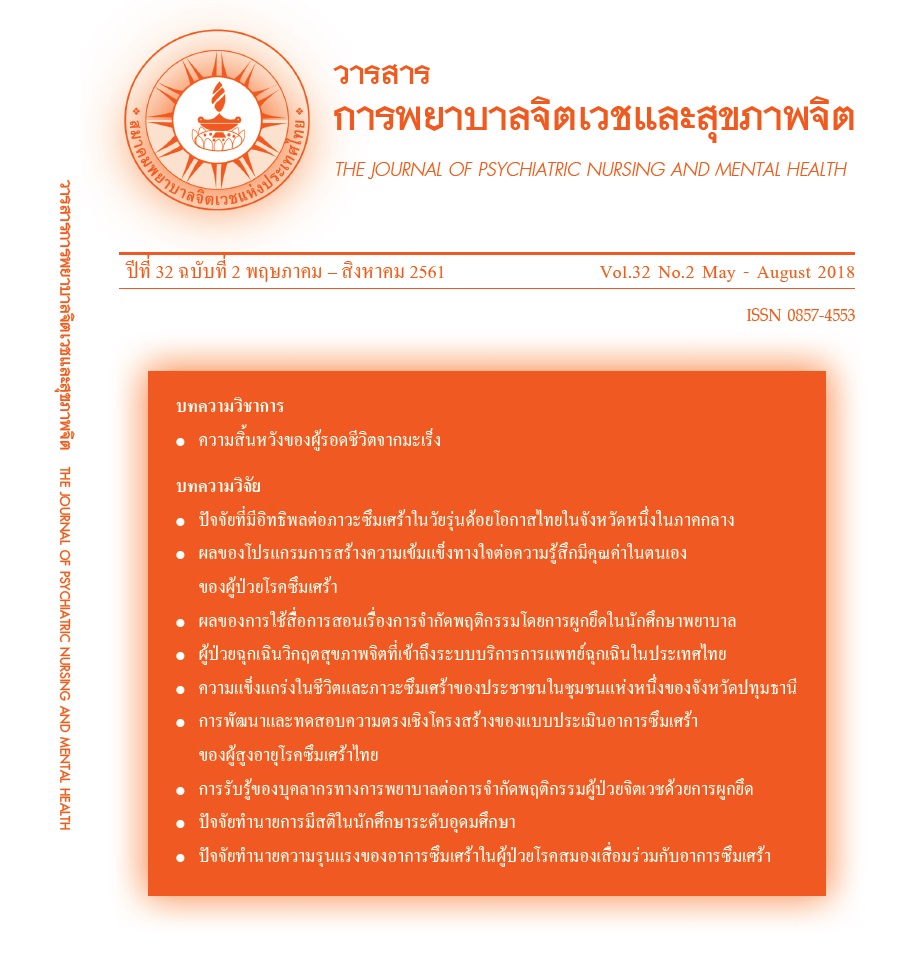
THE DEVELOPMENT AND CONSTRUCT VALIDITY TESTING OF DEPRESSIVE SYMPTOM INVENTORY FOR THAI OLDER PERSONS WITH DEPRESSIVE DISORDERS
Article Sidebar
Main Article Content
Abstract
Objective: To develop and evaluate the construct validity of the Depressive Symptom Inventory for Thai Older Persons with depressive disorders
Methods: The study samples were divided into two groups. First was a group of 40 older persons that were diagnosed with a depressive disorder. Second, 390 samples were older persons with chronic disease that were diagnosed with a depressive disorder. Both samples were recruited from the clinic at the government hospitals in four regions of Thailand. The instrument was the Depressive Symptom Inventory for Thai Older Persons and was judged by eight experts. The content validity index of the instrument was 0.73. The instrument’s reliability using Cronbach’s alpha coefficient was 0.95. After the data collection, the data were analyzed using exploratory factor analysis with Mplus.
Results: The Depressive Symptom Inventory for Thai Older Persons with depressive disorders was composed of sixteen items with two components: 1) the depression factor included 12 items with factor loadings between 0.431 and 0.784; and 2) the suicidality factor included 4 items with factor loadings between 0.451 and 0.933. The instrument’s reliability using Cronbach’s alpha coefficient was 0.95.
Conclusion: The two factors of depression and suicidality were found to be the major components of the Depressive Symptom Inventory for Thai Older Persons with depressive disorders. Moreover, the items were commonly used according to the perspectives of Thai older adults. However, this instrument needs further improvement and testing with other psychometric properties.
Article Details
บทความที่ได้รับการตีพิมพ์แล้ว เป็นลิขสิทธิ์ของสมาคมพยาบาลจิตเวชแห่งประเทศไทย
References
ธรณินทร์ กองสุข และคณะ. (2557). แนวทางการดูแลเฝ้าระวังโรคซึมเศร้าระดับจังหวัด ฉบับ ปรับปรุงครั้งที่ 3. นนทบุรี: กรมสุขภาพจิต กระทรวงสาธารณสุข.
สังคม ศุภรัตนกุล. (2557). เอกสารประกอบการ สอนวิชา ระเบียบวิธีวิจัยและสถิติขั้นสูง. สำนักงานโครงการบัณฑิตศึกษา: มหาวิทยาลัย ราชภัฏอุดรธานี.
สุวรรณา อรุณพงค์ไพศาล, พุนศรี รังสีขจี, นิรมล พัจนสุนทร, สุรพล วีระศิริ, สุชาติ พหลภาคย์, และธวัชชัย กฤษณะประกรกิจ. (2549). การ พัฒนาเครื่องมือคัดกรองภาวะซึมเศร้าชื่อ Khon Kaen University Depression Inventory (KKU-DI) สำหรับคนไทยในชุมชนภาค ตะวันออกเฉียงเหนือ. วารสารสมาคม จิตแพทย์แห่งประเทศไทย, 51, 330-348.
สุวรรณา อรุณพงค์ไพศาล และสมพร รุ่งเรืองกลกิจ. (2553). การปรับปรุงเครื่องมือคัดกรองภาวะ ซึมเศร้า KKU-DI เพื่อให้มีความไวต่อ เพศภาวะ. วารสารสมาคมจิตแพทย์แห่ง ประเทศไทย, 55(2), 177-189.
วรรณี แกมเกตุ. (2557). วิธีวิทยาการวิจัยทาง พฤติกรรมศาสตร์ (พิมพ์ครั้งที่ 3). กรุงเทพฯ: โรงพิมพ์แห่งจุฬาลงกรณ์มหาวิทยาลัย.
Beck, A., & Alford, B. A. (2009). Depression: causes and treatment, second edition. University of Philadelphia, PA: Pennsylvania Press.
Christensen, H., Jorm, A. F., Mackinnon A. J., Korten, A. E., Jacomb, P. A., Henderson, A. S., & Rodgers, B. (1999). Age differences in depression and anxiety symptoms: A structural equation modelling analysis of data from a general population sample. Psycho¬logical Medicine, 29(2), 325-339.
Conwell, Y., & Brent, D. (1996). Suicide and aging I: Patterns of psychiatric diagnosis. In J. L., Pearson & Y., Conwell, (Eds). Suicide: International perspectives. New York: Springer.
DeVellis, R. F. (2012). Scale development: Theory and applications (3rd ed.). Newbury Park: Sage.
Flacker, J. M., & Spiro, L. (2003). Does question comprehension limit the utility of the geriatric depression scale in older African Americans? Journal of American Geriatric Society, 51(10), 1511-1512.
Gallo, J. J., Anthony, J. C., & Muthen, B. O. (1994). Age differences in the symptoms of depression: A latent trait analysis. Journal of Gerontology, 49(6), 251-264.
Houtjes, W., van Meijel, B., Deeg, D. J. H., & Beekman, A. T. F. (2011). Unmet needs of outpatients with late-life depression: A comparison of patient, staff and carer perceptions. Journal of Affective Disorders, 134, 242–248.
Hsiao, C. Y., Lan, C. F., Chang, P. L., & Li, I. C. (2015). Development of the psychometric property of a minimum data-set based depression rating scale for use in long-term care facilities in Taiwan. Aging & Mental Health, 19(2), 129-135.
Jirapramukpitak, T., Darawuttimaprakorn, N., Punpuing, S., & Abas, M. (2009). Validation and factor structure of the Thai version of the EURO-D scale for depression among older psychiatric patients. Aging and Mental Health, 13(6), 899-904.
Kim, G., Decoster, J., Huang, C. H., & Bryant, A. N. (2013). A meta-analysis of the factor structure of the Geriatric Depression Scale (GDS): The effect of language. International of Psychogeriateics, 25(1), 71-81.
Leblanc, M. F., Desjardins, S., &, Desgagné A. (2015). Sleep problems in anxious and depressive older adults. Psychology Research and Behavior Management, 8, 161-169.
Muthen, L. K., Muthen, B. O. (2012). Mplus User’s Guide (7th ed.). Los Angeles, CA: Muthen & Muthen.
Norman, G. R., & Streiner, D. L. (1986). PDQ statistics. U.K.: Mosby.
Ponte, C., Almedia, V., & Fernandes, L. (2014). Suicidal ideation, depression and quality of life in the elderly: Study in a gerontopsy¬chiatric consultation. The Spanish Journal of Psychology, 17, E14. doi:10.1017/ sjp.2014.15.
Prince, M. J., Reischies, F., Beekman, A. T., Fuhrer, R., Jonker, C., Kivela, S. L., et al. (1999). Development of the EURO-D scale–A European Union initiative to compare symptoms of depression in 14 European centres. British Journal of Psychiatry, 174, 330–338.
Robinson, L., Smith, M., & Segal, J. (2017). Depression in older adults: Recognizing the signs of elderly depression and getting treatment. Retrieved April 2, 2017 from https://www.helpguide.org/articles/de¬pression/depression-in-older-adults. htm?pdf=true.
Roose, S. P., & Sackeim, H. A. (2004). Late life depression. Oxford: University Press.
Soonthornchaiya, R., & Dancy, B. L. (2006). Perceptions of depression among elderly Thai immigrants. Issues in Mental Health Nursing, 26(6), 681-698.
Suebwonglee, C., Sujiva, S., & Wongwanich, S. (2011). Development of a nursing caring behavior assessment instrument using the cognitive interview technique. SDU Research Journal Humanities and Social Sciences, 7(2), 127-142.
Wang, S., & Blazer, D. J. (2015). Depression and cognition in the elderly. Annual Review Clinical Psychology, 11, 331–60.
Wiersma, D. (2006). Needs of people with severe mental illness. Acta Psychiatra Scandinavica, 113(s429). https://doi.org/10.1111/j.1600- 0447.2005.00728.x
Wongpakarun, N., Wongpakarun, T., & Reekum, R. V. (2013). The use of GDS-15 in detecting MDD: A comparison between residents in a Thai long-term care home and geriatric outpatients. Journal of Clinical Medicine Research, 5(2), 101-111.
