
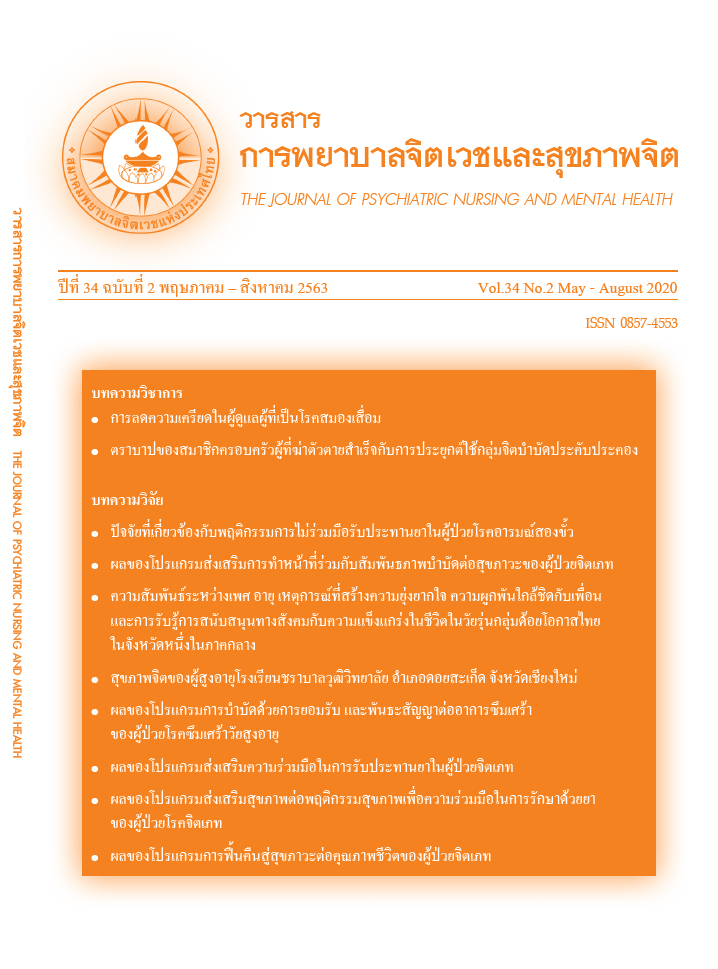
ผลของโปรแกรมส่งเสริมการทำหน้าที่ร่วมกับสัมพันธภาพบำบัดต่อสุขภาวะของผู้ป่วยจิตเภท
Article Sidebar
Main Article Content
บทคัดย่อ
บทคัดย่อ
วัตถุประสงค์: การวิจัยกึ่งทดลองครั้งนี้ มีวัตถุประสงค์เพื่อ 1) เพื่อเปรียบเทียบสุขภาวะ ของผู้ป่วยจิตเภทก่อนและหลังได้รับโปรแกรมการ ส่งเสริมการทำหน้าที่ร่วมกับสัมพันธภาพบำบัด และ 2) เพื่อเปรียบเทียบสุขภาวะของผู้ป่วยจิตเภท ในกลุ่มที่ได้รับโปรแกรมการส่งเสริมการทำหน้าที่ ร่วมกับสัมพันธภาพบำบัด และกลุ่มที่ได้รับการ ดูแลตามปกติ
วิธีการศึกษา: กลุ่มตัวอย่าง คือ ผู้ป่วย จิตเภท จำนวน 40 คนที่ได้รับการคัดเลือกแบบเจาะจงตามเกณฑ์คุณสมบัติ และจับคู่ด้วยอายุ และความเพียงพอของรายได้ แล้วสุ่มเข้ากลุ่มทดลอง และกลุ่มควบคุม กลุ่มละ 20 คน โดยกลุ่มทดลองจะได้รับโปรแกรมส่งเสริมการทำหน้าที่ร่วมกับสัมพันธภาพบำบัด ส่วนกลุ่มควบคุมจะได้รับการดูแลตามปกติ เครื่องมือที่ใช้ในการวิจัย ได้แก่ 1) โปรแกรมการส่งเสริมการทำหน้าที่ร่วม กับสัมพันธภาพบำบัด 2) แบบวัดสุขภาวะ และ 3) แบบวัดทักษะชีวิต เครื่องมือทุกชุด ผ่านการ ตรวจสอบความตรงเชิงเนื้อหาและการหาค่าความเที่ยง เครื่องชุดที่ 2 และ 3 มีค่า .92 และ .87 ตามลำดับ วิเคราะห์ข้อมูลโดยใช้สถิติบรรยาย สถิติทดสอบที การวิเคราะห์ความแปรปรวนร่วม (ANCOVA) และวิเคราะห์ค่าขนาดอิทธิพล (effect size)
ผลการศึกษา:
- ค่าขนาดอิทธิพลและสุขภาวะของ ผู้ป่วยจิตเภทหลังได้รับโปรแกรมส่งเสริมการ ทำหน้าที่ร่วมกับสัมพันธภาพบำบัดสูงกว่า ก่อน ได้รับโปรแกรมส่งเสริมการทำหน้าที่ร่วมกับ สัมพันธภาพบำบัดอย่างมีนัยสำคัญทางสถิติ ที่ระดับ 0.05
- ภายหลังการทดลอง ค่าขนาดอิทธิพล และคะแนนสุขภาวะของผู้ป่วยจิตเภทกลุ่มที่ ได้รับโปรแกรมส่งเสริมการทำหน้าที่ร่วมกับ สัมพันธภาพบำบัดสูงกว่ากลุ่มที่ได้รับการดูแลตาม ปกติ อย่างมีนัยสำคัญทางสถิติ ที่ระดับ 0.05
Article Details
บทความที่ได้รับการตีพิมพ์แล้ว เป็นลิขสิทธิ์ของสมาคมพยาบาลจิตเวชแห่งประเทศไทย
เอกสารอ้างอิง
กรมสุขภาพจิต. (2560). สถิติผู้ป่วยที่มารับบริการโรงพยาบาลสังกัดกรมสุขภาพจิต. ศูนย์สารสนเทศ กองแผนงาน กรมสุขภาพจิต กระทรวงสาธารณสุข.
กุณฑ์ชลี เพียรทอง. (2547). ปัจจัยคัดสรรที่มีความสัมพันธ์กับภาวะสุขภาพของผู้ป่วยจิตเภท. วิทยานิพนธ์ปริญญาพยาบาลศาสตรมหาบัณฑิต, สาขาการพยาบาลสุขภาพจิตและจิตเวช คณะพยาบาลศาสตร์, จุฬาลงกรณ์มหาวิทยาลัย.
จิราพร รักการ. (2549). ผลของการใช้โปรแกรมสุขภาพจิตศึกษาต่อภาระในการดูแลของผู้ดูแลผู้ป่วยจิตเภทในชุมชน. วิทยานิพนธ์ ปริญญามหาบัณฑิต, สาขาการพยาบาล สุขภาพจิตและจิตเวช คณะพยาบาลศาสตร์, จุฬาลงกรณ์มหาวิทยาลัย.
จินตนา ยูนิพันธุ์. (2544). การพยาบาลเพื่อชีวิต ปกติสุข.วารสารการพยาบาลจิตเวชและ สุขภาพจิต, 13, 1-11.
ทุลภา บุปผาสังข์. (2545). ภาระและความสามารถ ในการดูแลของผู้ดูแลกับการกลับมารักษา ซ้ำของผู้ที่เป็นโรคจิตเภท. วิทยานิพนธ์ ปริญญาพยาบาลศาสตรมหาบัณฑิต, สาขา การพยาบาลสุขภาพจิตและจิตเวช คณะ พยาบาลศาสตร์, มหาวิทยาลัยเชียงใหม่.
ธวัชชัย ลีฬหานาจ. (2552). การดำเนินโรคและ การพยากรณ์โรค. ใน พิเชษฐ์ อุดมรัตน์ และสรยุทธ วาสิกนานนท์, บก. ตำรา โรคจิตเภท. สงขลา: ชานเมืองการพิมพ์.
ธีระ ลีลานันทกิจ. (2552). การรักษาทางจิตสังคม. ใน พิเชษฐ์ อุดมรัตน์ และสรยุทธ วาสิกนานนท์, บก. ตำราโรคจิตเภท. สงขลา: ชานเมือง การพิมพ์.
นวนันท์ ปิยะวัฒน์กูล. (2552). การรักษาทางจิตสังคม. ใน พิเชษฐ์ อุดมรัตน์ และสรยุทธ วาสิกนานนท์, บก. ตำราโรคจิตเภท. สงขลา: ชานเมืองการพิมพ์.
บุษกล ศุภอักษร. (2553). ผลของโปรแกรม การจัดการความเครียดต่อการทำหน้าที่ ของผู้ป่วยจิตเภทในชุมชน. วิทยานิพนธ์ ปริญญาพยาบาลศาสตรมหาบัณฑิต, สาขา การพยาบาลสุขภาพจิตและจิตเวช คณะ พยาบาลศาสตร์, จุฬาลงกรณ์มหาวิทยาลัย.
พิศสมร เดชดวง. (2545). การศึกษาสุขภาวะของ ผู้ป่วยจิตเภทที่ไม่ป่วยซ้ำ. วิทยานิพนธ์ ปริญญาพยาบาลศาสตรมหาบัณฑิต, สาขา การพยาบาลสุขภาพจิตและจิตเวช คณะ พยาบาลศาสตร์, จุฬาลงกรณ์มหาวิทยาลัย.
พิเชฐ อุดมรัตน์. (2552). หลักทั่วไปในการรักษา. ใน พิเชษฐ์ อุดมรัตน์ และสรยุทธ วาสิกนานนท์, บก. ตำราโรคจิตเภท. สงขลา: ชานเมืองการพิมพ์.
พิเชษฐ์ อุดมรัตน์ และสรยุทธ วาสิกนานนท์ (2552). ตำราโรคจิตเภท. สงขลา: ชานเมือง การพิมพ์.
ยุรัชชา ปรีชา และพิเชฐ อุดมรัตน์. (2552). หลักทั่วไปในการรักษา. ใน พิเชษฐ์ อุดมรัตน์ และสรยุทธ วาสิกนานนท์, บก. ตำราโรคจิตเภท. สงขลา: ชานเมืองการพิมพ์.
สมภพ เรืองตระกูล. (2547). ตำราจิตเวชศาสตร์. พิมพ์ครั้งที่ 7. กรุงเทพมหานคร: เรือนแก้ว การพิมพ์.
สัมพันธ์ มณีรั ตน์ .(2546). ผลของการใช้ โปรแกรม การเสริมสร้างพลังอำนาจและสัมพันธภาพ เพื่อการบำบัดต่อคุณภาพชีวิตผู้ป่วยจิตเภท ในชุมชน. วิทยานิพนธ์พยาบาลศาสตรมหาบัณฑิต สาขาวิชาการพยาบาล สุขภาพจิตและจิตเวช, บัณฑิตวิทยาลัย, จุฬาลงกรณ์มหาวิทยาลัย.
Cohen, J. (1988). Statistical power analysis for the behavioral sciences (2nd ed.). Hillsdale, New Jersy: Lawrence Erlbaum.
Eby, L., & Brown, N. (2005). Mental Health Nursing Care. New Jersey: Pearson.
Galderisi et al. (2014). The influence of illness-related variables, personals resources and context-related factors on real-life functioning of people with schizophrenia. World psychiatry, 13(3), 275-162.
Health Canada. (1999). Budget 1999: Strengthening Health Care for Canadians, Ottawa, Ontario: Health Canada.
Husberger, M. M. (1989). Health concept: Children’s perceptions and behaviors. In R. L. R. Foster, M. M. Husberger, & J. J. Aderson (eds.). Family center nursing care of child, pp. 377-398. Philadephia: W. B. Saunders.
Hofer, A., et al. (2005). Patient outcomes in schizophrenia I: correlates with sociode-mographic variables, psychopathology, and side effects. European Psychiatry, 20, 386-394.
Forchuk, C. (1993). Hildegarde E. Peplau: Interpersonal Nursing Theory. California: SAGE publications, Inc.
Foust, J. B. (2007). Discharge planning as part of daily nursing practice. Applied Nursing Research, 20, 72-77.
Foussias, G., Mann, S., Zakzanis, K. K., Van Reekum, R., Agid, O., & Remington, G. (2011). Prediction of longitudinal functional outcomes in schizophrenia: The impact of baseline motivation deficit. Schizophrenia Research, 132, 24-27.
Martin, T., & Street, A. F. (2003). Exploring evidence of the therapeutic relationship in Forensic psychiatric nursing. Journal of Psychiatric and mental Health Nursing, 10, 543-551.
Miles, A. A., Heinrichs, R. W., & Ammari, N. (2010). “Real world” Functioning in schizophrenia patients and healthy adults: Assessing validity of the Multidimensional Scale of Independent Functioning. [doi: DOI: 10.1016/j.psychres.2010.07.052]. Psychiatry Research. In Press, Corrected.
Montejo, A. L. (2010). The need for routine physical health care in schizophrenia. European Psychiatry, 25, 3-5.
Morris, M. (2009). Mental health for primary care: A practical guide for non-specialists. Oxford: Rackliffe Publishing.
Mueser, K. T., & Gingerich, S. (2006). The complete family guide to schizophrenia. New York: The Guilford Press.
Peplau, H. E. (1991). Interpersonal Relations in Nursing. New York: Springer Publishing Company.
Perivoliotisa, D., Granholmb, E. C., & Patterson, T. L. (2004). Psychosocial functioning on the Independent Living Skills Survey in older outpatients with schizophrenia. Schizophrenia Research, 69, 307-316.
Phanthunane, P., Vos, T., & Bertram, M. (2010). Health outcomes of schizophrenia in Thailand: Health care providers and patient perspectives. Asian Journal of Psychiatry, 3, 200-205.
Pichitpornchai, W., Street, A., & Boontong, T. (1999). Discharge planning and trandsi-tional care: issue in Thai nursing. Inter-national Journal of Nursing studies, 36, 355-362.
Rosen, A., HadziPavlovic, D., & Parker, G. (1989). The Life Skills Profile: A Measure Assessing Function and Disability in Schizophrenia. Schizophrenia Bulletin. 15(2), 325-337.
Sadock, J. B., & Sadock, A. V. (2007). Synopsis of Psychiatry (10th ed.). Philadelphia: Lipincott Williams& Wilkins: 467-97.
Sadock, B. J., & Sadock, A. V. (2017). Comprehensive textbook of psychiatry. Philadelphia: Lippincott, Williams and wilkins.
Santos, J. C., & Cutcliffe, J. R. (2018). European Psychiatric Nursing/Mental Health Nursing in the 21st Century: A Person Centered Evidence-Based Approach J. C. Santos, & Cutcliffe, J. R (Ed.). Cham: Springer International publishing.
Townsend, C. M. (2000). Psychiatric mental health nursing concepts of care. Philadel-phia: F. A Davis company.
Woolf, S. H., Dekker, M. M., Byrne, F. R., & Miller, W. D. (2011). Citizen-Centered Health Promotion: Building Collaborations to Facilitate Health Living. American Journal of Preventive Medicine, 40 (1S1), 38-47.
World Health Organization (WHO). (2015). World health statistics 2015. Switzerland: World Health Organization.
Yeh, L-L., Hwu, H-G., Chen, C-H., Chen, C-H., & Wu, A. C. C. (2008). Factors related to perceived needs of primary caregivers of patients with schizophrenia. Journal Formosan Medical Association, 107(8), 644-652.
