
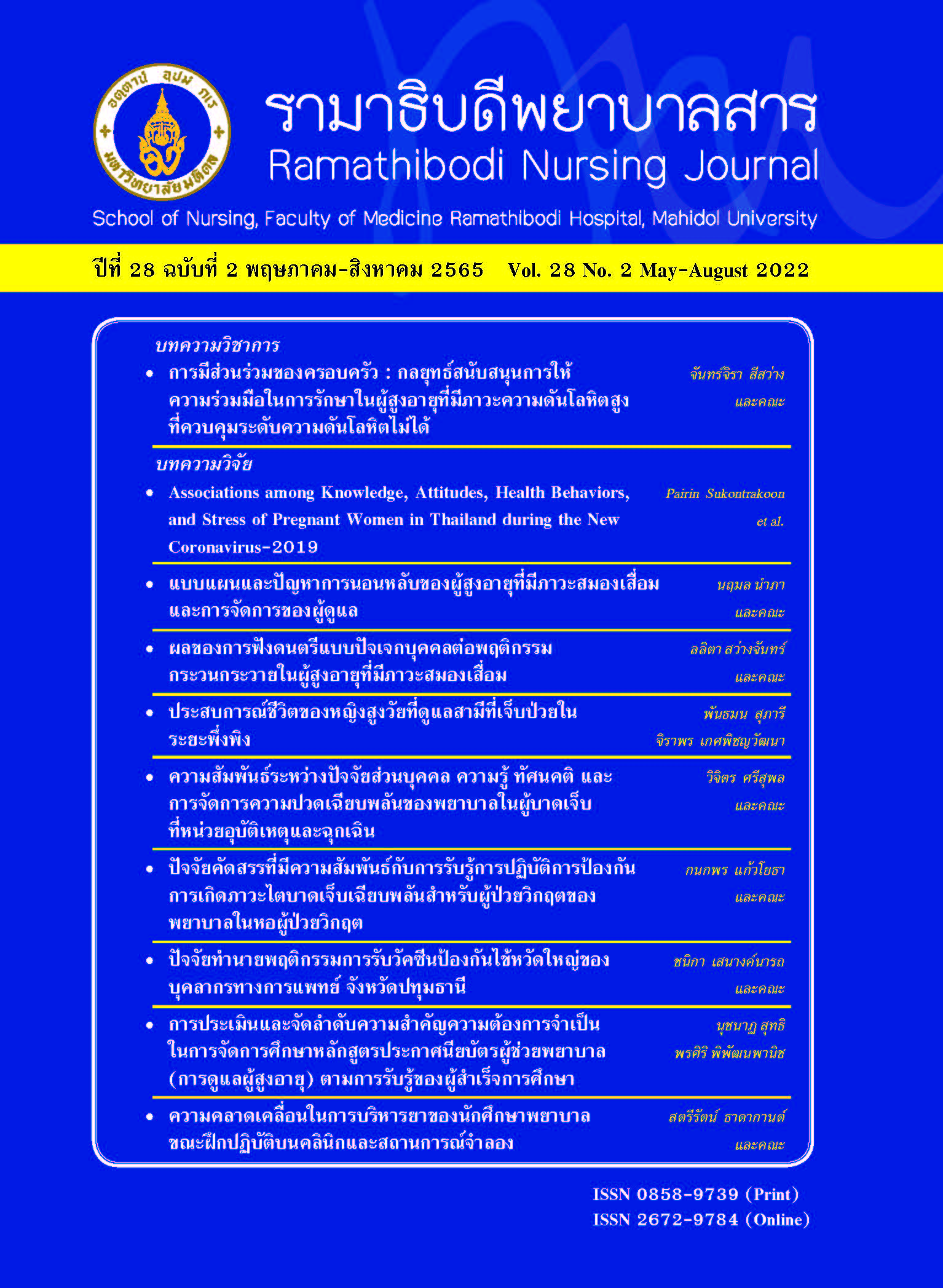
แบบแผนและปัญหาการนอนหลับของผู้สูงอายุที่มีภาวะสมองเสื่อม และการจัดการของผู้ดูแล
Article Sidebar
Main Article Content
บทคัดย่อ
การศึกษาเชิงบรรยายครั้งนี้มีวัตถุประสงค์เพื่อศึกษาแบบแผนและปัญหาการนอนหลับในผู้สูงอายุที่มีภาวะสมองเสื่อมและการจัดการของผู้ดูแล คัดเลือกกลุ่มตัวอย่างแบบเจาะจงตามเกณฑ์กลุ่มตัวอย่างเป็นผู้ที่มีอายุตั้งแต่ 60 ปีขึ้นไปที่มีภาวะสมองเสื่อมระยะใดก็ได้จำนวน 88 ราย และผู้ดูแลผู้สูงอายุจำนวน 88 ราย เก็บรวบรวมข้อมูลด้วยแบบสอบถามข้อมูลส่วนบุคคล แบบบันทึกการนอนหลับ และเครื่องติดตามการนอนหลับแบบสายรัดข้อมือ รวมถึงแบบสอบถามข้อมูลส่วนบุคคลของผดูู้แลและการจัดการปัญหาการนอนหลับในผู้สูงอายุเก็บข้อมูลระหว่างเเดือนมิถุนายนถึงสิงหาคม พ.ศ. 2562 วิเคราะห์ข้อมูลมูลด้วยสถิติบรรยาย และไคสแควร์ ผลการศึกษาพบว่ากลุ่มตัวอย่างผู้สูงอายุเกือบทั้งหมดมีรูปแบบการนอนหลับแบบโพลีเฟสิก (นอนหลับหลายครั้งต่อวัน) มีส่วนน้อยที่เป็นแบบไบเฟสิก (นอนหลับ 2 ครั้งต่อวัน) และแบบโมโนเฟสิก (การนอนหลับ 1 ครั้งต่อวัน) ส่วนปัญหาการนอนที่พบ คือ การหายใจผิดปกติขณะหลับ (นอนกรน) ละเมอพูด การนอนหลับมากผิดปกติและตื่นกลางดึกตามลำดับ ผู้ดูแลส่วนใหญ่จัดการการนอนหลับของผู้สูงอายุแบบไม่ใช้ยา ได้แก่ การใช้เทคนิคผ่อนคลาย การใช้แสง การสร้างสุขนิสัยการนอนหลับที่ดี การส่งเสริมกิจกรรมทางกายและประมาณ 1 ใน 4 มีการจัดการแบบใช้ยาตามแพทย์สั่ง ผลจากการศึกษาครั้งนี้ จะช่วยให้บุคลากรทีมสุขภาพสามารถนำข้อมูลที่ได้ไปปรับใช้ในการจัดการและส่งเสริมการนอนหลับของผู้สูงอายุที่มีภาวะสมองเสื่อมเพื่อลดการนอนหลับแบบโพลีเฟสิก ลดการนอนหลับมากในช่วงกลางวัน รวมถึงพัฒนา
โปรแกรมการให้ความรู้แก่ผู้ดูแลเกี่ยวกับการจัดการปัญหาการนอนหลับในผู้สูงอายุที่มีภาวะสมองเสื่อมได้อย่างเหมาะสม
คำสำคัญ : แบบแผนการนอนหลับ ปัญหาการนอนหลับ การจัดการการนอนหลับ ผู้สูงอายุภาวะสมองเสื่อม
Article Details

อนุญาตภายใต้เงื่อนไข Creative Commons Attribution-NonCommercial-NoDerivatives 4.0 International License.
บทความ ข้อมูล เนื้อหา รูปภาพ ฯลฯ ที่ได้รับการตีพิมพ์ในรามาธิบดีพยาบาลสาร ถือเป็นลิขสิทธิ์ของวารสาร หากบุคคลหรือหน่วยงานใดต้องการนำทั้งหมดหรือส่วนหนึ่งส่วนใดไปเผยแพร่หรือเพื่อกระทำการใด ใด จะต้องได้รับอนุญาตเป็นลายลักษณ์อักษรจากรามาธิบดีพยาบาลสารก่อนเท่านั้น
เอกสารอ้างอิง
Mekawichai P, Saetang S. Caregiver burden among Thai dementia patients’ caregivers. Journal of the Psychiatrist
Association of Thailand. 2013;58(1):101-10. (in Thai)
Alzheimer’s Disease International. Dementia statistics;2017 [cited 2018 October 15]. Available from: https://
www.alz.co.uk/research/statistics. (in Thai)
Sittironnarit G. Behavioral and psychological symptoms of dementia (BPSD): concept and treatment. Journal of
the Psychiatrist Association of Thailand. 2011;56(4):449-62. (in Thai)
Cipriani G, Lucetti C, Danti S, Nuti A. Sleep disturbances and dementia. Psychogeriatrics. 2015;15(1):65-74.doi: 10.1111/psyg.12069.
Romsai W. Quality of sleep and related factors in caregivers of patients with dementia at dementia clinic, King Chulalongkorn Memorial Hospital. Bangkok: Chulalongkorn University; 2012. (in Thai)
Gibson RH, Gander PH, Jones LM. Understanding the sleep problems of people with dementia and their family caregivers. Dementia. 2014;13(3):350-65.
Bombois S, Derambure P, Pasquier F, Monaca C. Sleep disorders in aging and dementia. J Nutr Health Aging.
;14(3):212-7.
Maneethanue O. Selected factors related to sleep quality in older persons with Alzheimer’s disease [thesis].Bangkok: Chulalongkorn University; 2553. (in Thai)
Morgenthaler T, Kramer M, Alessi C, Friedman L,Boehlecke B, Brown, T, et al. Practice parameters for the psychological and behavioral treatment of insomnia: an update. An American Academy of Sleep Medicine Report.Sleep. 2006;29(11):1415–9.
Martin JL, Hakim AD. Wrist actigraphy. Chest. 2011;139(6):1514-27.
Stampi C. Evolution, chronobiology, and functions of polyphasic and ultrashort sleep: main issues. In: Stampi C,editor. Why we nap. Birkhäuser, Boston, MA; 1992. p. 1-20.https://doi.org/10.1007/978-1-4757-2210-9_1
Matuzaki L, Santos-Silva R, Marqueze EC, de Castro Moreno CR, Tufik S, Bittencourt, L. Temporal sleep patterns in adults using actigraph. Sleep Sci. 2014;7(3):152-7.
Jordan, P. The different types of sleep patterns–polyphasic,biphasic & monophasic. [Internet]. 2018, [cited 2020, Oct 1].
Available from: https://sleepsurge.com/sleep-patterns.
Sateia MJ. International classification of sleep disorders-Third edition: highlights and modifications. Chest. 2014;
(5):1387-94.
Panpanit L. Sleep problems in older people and nursing management. Journal of Nursing Science and Health
[Internet]. 2020 [cited 2021Apr 5];43(1):139-50.Available from: https://he01.tci-thaijo.org/index.php/nah/article/view/240808 (in Thai)
Urrestarazu E, Iriarte J. Clinical management of sleep disturbances in Alzheimer’s disease: current and emerging
strategies. Nat Sci Sleep. 2016;8:21–33. doi: 10.2147/NSS.S76706.
Marhoney FI, Barthel DW. Functional evaluation: the Barthel index. Md State Med J. 1965;14(1):61-5.
Jitapunkul S. Principles of geriatric medicine. Bangkok:Chulalongkorn University Printing House; 1998.
Carney CE, Buysse DJ, Ancoli-Israel S, Edinger JD,Krystal AD, Lichstein KL, et al. The consensus sleep diary:standardizing prospective sleep self-monitoring. Sleep.2012;35(2):287-302.
Marino M, Li Y, Rueschman MN, Winkelman JW,Ellenbogen JM, Solet JM, Buxton, et al. Measuring sleep:accuracy, sensitivity, and specificity of wrist actigraphy compared to polysomnography. Sleep. 2013;36(11):1747-55.
de Zambotti M, Goldstone A, Claudatos S, Colrain IM,Baker FC. A validation study of Fitbit Charge 2™ compared with polysomnography in adults. Chronobiol Int.2018;35(4):465-76.
Andrade AG, Bubu OM, Varga AW, Osorio RS. The relationship between obstructive sleep apnea and Alzheimer’s
disease. J Alzheimers Dis. 2018;64(s1): S255–70. doi:10.3233/JAD-179936.
Boeve A, Ferman TJ, Aakre J, St Louis E, Silber M,Machulda M, et al. Excessive daytime sleepiness in major dementia syndromes. Am J Alzheimers Dis. Other Demen.2019; 34(4):261–4. doi: 10.1177/1533317519828046.
Huang Y, Potter R, Sigurdson W, Santacruz A, Shih S,Ju YE, et al. Effects of age and amyloid deposition on Aβ dynamics in the human central nervous system. Arch Neurol. 2012;69(1):51-8.
Lim AS, Ellison BA, Wang JL, Yu L, Schneider JA,Buchman AS, et al. Sleep is related to neuron numbers in the ventrolateral preoptic/intermediate nucleus in older adults with and without Alzheimer’s disease. Brain.2014;137(10):2847-61.
Wang H, Zheng H, Augusto JC, Martin S, Mulvenna M,Carswell W, et al. Monitoring and analysis of sleep pattern for people with early dementia. In 2010 IEEE International Conference on Bioinformatics and Biomedicine Workshops (BIBMW); 2010. p. 405-10.
Insrichuen S, Choowattanapakorn T. The effect of nursing care using aromatherapy on sleep quality in older persons
with dementia. JFONUBUU. 2017;25(1):37-48.(in Thai)
McCurry SM, Pike KC, Vitiello MV, Logsdon RG, Larson EB, Teri L. Increasing walking and bright light exposure to improve sleep in community‐dwelling persons with Alzheimer’s disease: results of a randomized, controlled trial. J Am Geriatr Soc. 2011;59(8):1393-402.
Figueiro MG. Light, sleep and circadian rhythms in older adults with Alzheimer’s disease and related dementias.Neurodegener Dis Manag. 2017;7(2):119-45.
Blume C, Garbazza C, Spitschan M. Effects of light on human circadian rhythms, sleep and mood. Somnologie
(Berl). 2019; 23(3):147-56. doi:10.1007/s11818-019-00215-x.
Ooms S, Ju YE. Treatment of sleep disorders in dementia.Curr Treat Options Neurol. 2016;18(9):40. doi:10.1007/s11940-016-0424-3.
