
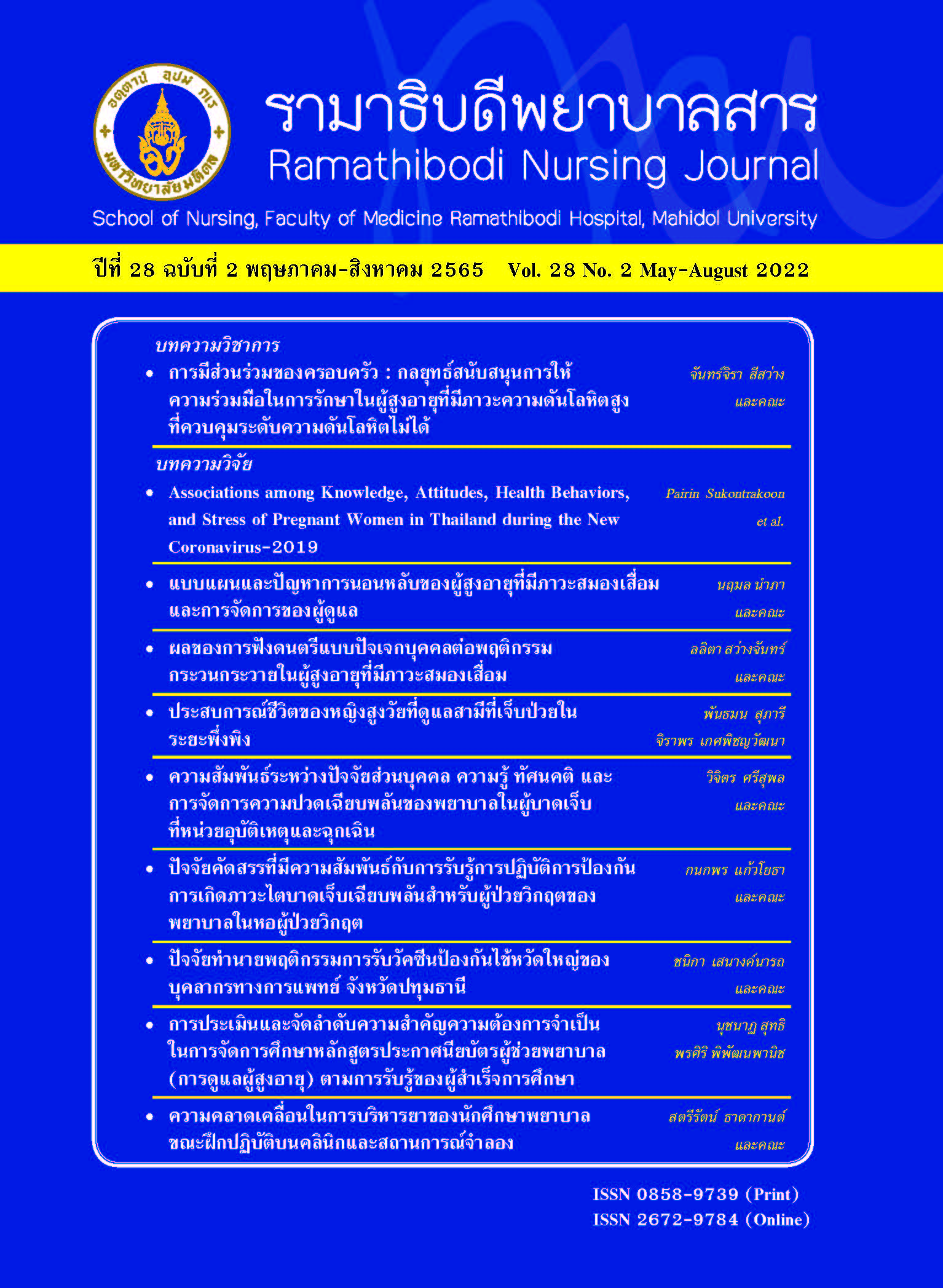
ปัจจัยทำนายพฤติกรรมการรับวัคซีนป้องกันไข้หวัดใหญ่ของบุคลากรทางการแพทย์ จังหวัดปทุมธานี
Article Sidebar
Main Article Content
บทคัดย่อ
บทคัดย่อ
การวิจัยแบบหาความสัมพันธ์เชิงทำนายนี้มีวัตถุประสงค์เพื่อศึกษาพฤติกรรมการรับวัคซีนและปัจจัยทำนายพฤติกรรมการรับวัคซีนป้องกันไข้หวัดใหญ่ของบุคลากรทางการแพทย์ในพื้นที่จังหวัดปทุมธานี โดยใช้แนวคิด PRECEDE-PROCEED Model เป็นกรอบแนวคิดในการศึกษากลุ่มตัวอย่างเป็นบุคลากรทางการแพทย์จำนวน 358 ราย ของโรงพยาบาลสังกัดกระทรวงสาธารณสุขในระดับปฐมภูมิ ทุติยภูมิ และตติยภูมิ เลือกกลุ่มตัวอย่างด้วยวิธีการสุ่มแบบแบ่งชั้นและแบบอย่างง่ายเก็บข้อมูลโดยใช้วิธีการตอบแบบสอบถามด้วยตนเองตั้งแต่เดือนมกราคม ถึง กุมภาพันธ์ พ.ศ. 2564 แบบสอบถามจำนวน 8 ชุด ประกอบด้วย ข้อมูลส่วนบุคคล ประสบการณ์การรับวัคซีน ทัศนคติต่อวัคซีน ไข้หวัดใหญ่ การเข้าถึงบริการ การได้รับการกระตุ้นเตือน การรับรู้นโยบายการรับวัคซีนการชักจูงจากบุคคลอื่น และพฤติกรรมการรับวัคซีน วิเคราะห์ข้อมูลโดยใช้สถิติพรรณนา และวิเคราะห์หาปัจจัยทำนายโดยใช้สถิติการวิเคราะห์แบบถดถอยโลจิสติคทวิ ผลการศึกษาพบว่า บุคลากรทางการแพทย์มีพฤติกรรมการได้รับวัคซีนไข้หวัดใหญ่ร้อยละ 78.80 ซึ่งปัจจัยที่สามารถทำนายพฤติกรรมการรับวัคซีนป้องกันไข้หวัดใหญ่ของบุคลากรทางการแพทย์ได้อย่างมีนัยสำคัญทางสถิติมี 3 ปัจจัย ได้แก่ อายุ ประสบการณ์การรับวัคซีนป้องกันไข้หวัดใหญ่ และการชักจูงจากบุคคลอื่น โดยกลุ่มตัวอย่างที่อายุน้อยกว่า 45 ปีมีโอกาสในการรับวัคซีนไข้หวัดใหญ่เป็น 2.33 เท่าของผู้ที่มีอายุมากกว่าหรือเท่ากับ 45 ปี กลุ่มตัวอย่างที่มีประสบการณ์ที่ดีต่อการรับวัคซีนไข้หวัดใหญ่มีโอกาสเป็น 46.34 เท่าของผู้ที่มีประสบการณ์ที่ไม่ดีกลุ่มตัวอย่างที่ได้รับการชักจูงจากบุคคลอื่นมากมีโอกาสในการรับวัคซีนไข้หวัดใหญ่เป็น 2.54 เท่าของผู้ที่ได้รับการชักจูงจากบุคคลอื่นน้อย ผลการศึกษาครั้งนี้สามารถนำไปจัดโปรแกรมส่งเสริมพฤติกรรมการรับวัคซีนไข้หวัดใหญ่เพื่อเพิ่มพฤติกรรมการรับวัคซีนของบุคลากรทางการแพทย์ต่อไป
คำสำคัญ : ปัจจัยทำนาย วัคซีนป้องกันไข้หวัดใหญ่ พฤติกรรมการรับวัคซีน บุคลากรทางการแพทย์
Article Details

อนุญาตภายใต้เงื่อนไข Creative Commons Attribution-NonCommercial-NoDerivatives 4.0 International License.
บทความ ข้อมูล เนื้อหา รูปภาพ ฯลฯ ที่ได้รับการตีพิมพ์ในรามาธิบดีพยาบาลสาร ถือเป็นลิขสิทธิ์ของวารสาร หากบุคคลหรือหน่วยงานใดต้องการนำทั้งหมดหรือส่วนหนึ่งส่วนใดไปเผยแพร่หรือเพื่อกระทำการใด ใด จะต้องได้รับอนุญาตเป็นลายลักษณ์อักษรจากรามาธิบดีพยาบาลสารก่อนเท่านั้น
เอกสารอ้างอิง
World Health Organization. Seasonal influenza. WHO;2019 [cited 2019 January 4]. Available from: World Health Organization Web site: https://www.euro.who.int/en/health-topics/communicable-diseases/influenza/seasonal-influenza
Bureau of Epidemiology, Department of Disease Control,Ministry of Public Health, Thailand. Reports in the surveillance system 506 influenza; 2020 [cited 2020 January 13]. Available from Bureau of Epidemiology Web site: http://www.boe.moph.go.th/boedb/surdata/
disease.php?ds=15 (in Thai)
Bureau of General Communicable Diseases, Department of Disease Control, Ministry of Public Health, Thailand. Advice on vaccination in healthcare and public health personnel; 2019 [cited 2019 January 15]. Available from Department of Disease Control Web site: http://e-lib.ddc. moph.go.th/pdf/material_453/material_453.pdf(in Thai)
Lohsunthorn P. Epidemiology. 8th ed. Bangkok: CU Print;2013. (in Thai)
Bureau of Information Office of the Permanent Secretary,Department of Disease Control, Ministry of Public Health.Influenza vaccination; 2016 [cited 2019 March 5].Available from Department of Disease Control Web site:http://beid.ddc.moph.go.th/th/diseases/253
Lee PH, Benjamin JC, Lin Y. Seasonal influenza vaccination among Chinese health care workers. Am J Infect Control. 2017;45(5):575-78.
Tanavikrankoon M. Acceptance of seasonal influenza vaccination among medical personnel in a super tertiary care hospital, Bangkok. Vajira Nursing Journal. 2015;17(2):15-30. (in Thai)
Ponjaroen S. Predicting factors of receiving influenza type A H1N1 vaccine among health care workers. Nursing Journal.
;43(5):196-206. (in Thai)
Chanthatero K, Boonmark P, Kimsri N, Kamolsukyuenyong A, Charoentum N. Factors related to influenza A (H1N1)vaccination among healthcare workers in Prapokklao Hospital. Journal of Prapokklao Hospital Clinical Medical Education Center. 2011;28(2):85-97. (in Thai)
Sanlung T, Soitong K, Thawisap K, Lanamtieng T,Areesawangvong P, Komonpaisarn W, et al. Factors associated with the uptake of Influenza vaccine among the health care workers and personal staff in Faculty of Medicine, Khon Kaen University. Srinagarind Medical
Journal. 2013;28(2):229-38. (in Thai)
Kung YM. Factors associated with health care personnel influenza vaccination behavior. J Nurse Pract. 2013;9(2):87-92.
Mangmeesrisuk P, A/H1N1 2009 Vaccine acceptance in health care workers experienced in pandemic influenza;2011 [cited 2019 January 20]. Available from Queen Sirikit National Institute of Child Health Web site: http://library.childrenhospital.go.th/elib/multim/km/723.pdf (in Thai)
Thepsupha S, Maithong N, Thanakamdee S, Tiantong W.actors associated with influenza vaccination among healthcare workers in Bamrasnaradura Infectious Diseases Institute. Journal of Bamrasnaradura Infectious Diseases Institute. 2016;10(2):94-117. (in Thai)
Jennifer LE, David CM, Kathleen MM, Richard AK,Richard AM. Access, education and policy awareness:predictors of influenza vaccine acceptance among healthcare workers. Infect Control Hosp Epidemiol.2017;38(8):970–5.
Theo L, David M, Kath W, Katy S. Amanda S. Seasonal influenza vaccination of healthcare workers: systematic review of qualitative evidence. BMC Health Services Research. 2017;17(1):1-8. doi: 10.1186/s12913-017-2703-4.
Lehmann BA, Ruiter RAC, Van Dam D, Wicker S, KOK G.Sociocognitive predictors of the intention of health care workers to receive the influenza vaccine in Belgain, Dutch and German hospital settings. J Hosp Infect. 2015;89(3):202-9.
Mosoongnern W. An investigation of the public health communication in response to the 2009 influenza outbreak by the Public Health Ministry of Thailand. Journal of Nursing and Education. 2011;4(3):2-15. (in Thai)
Green LW, Kreuter MW. Health program planning: an educational and ecological approach. 4th ed. New York:McGraw Hill; 2005.
Pratumchompoo K. Factor of motivation protection in diseases affecting services influenza vaccination in the elderly Sansuk
subdistrict, Muang Chonburi district, Chonburi province[thesis]. Chonburi: Burapha University; 2016. (in Thai)
Krongyuth P, Khumkaew J, Sarati P, Sukaree W. Factors associated with the intension to receive influenza vaccination among elderly people with chronic diseases: Warinchamrab district, Ubon Ratchathani province. Journal of Science and Technology Mahasarakham University. 2018;37(6):815-22. (in Thai)
Strategy and Planning Division, Ministry of Public Health. Public Health Personnel Information Report 2018; [cited 2019 December 20]. Available from Strategy and Planning Division Web site: http:// bps. moph.go.th/new_bps/sites/default/files/Ministry%20of%20Public%20Health%20 personnel%202561.pdf (in Thai)
Srisatitnarakun B. Development and validation of research instruments: psychometric properties. Bangkok: CU Print;2012. (in Thai)
Steven J. Applied multivariate statistics for the social sciences. 3rd ed. New Jersey: Lawrence Erlbaum Associates;1996.
Limpawittayakul M, Taisuwan PK. Risk perceptions and influenza vaccination in high risk groups. 1st ed. Bangkok:
Danex Intercorporation; 2015. (in Thai)
Coracc K, Prematunge C, McCarthy A, Nair R, Roth V,Hayes T. Predicting influenza vaccination uptake among health care works: what are the key motivatiors? Am J Infect Control. 2013;41(8):679-84.
