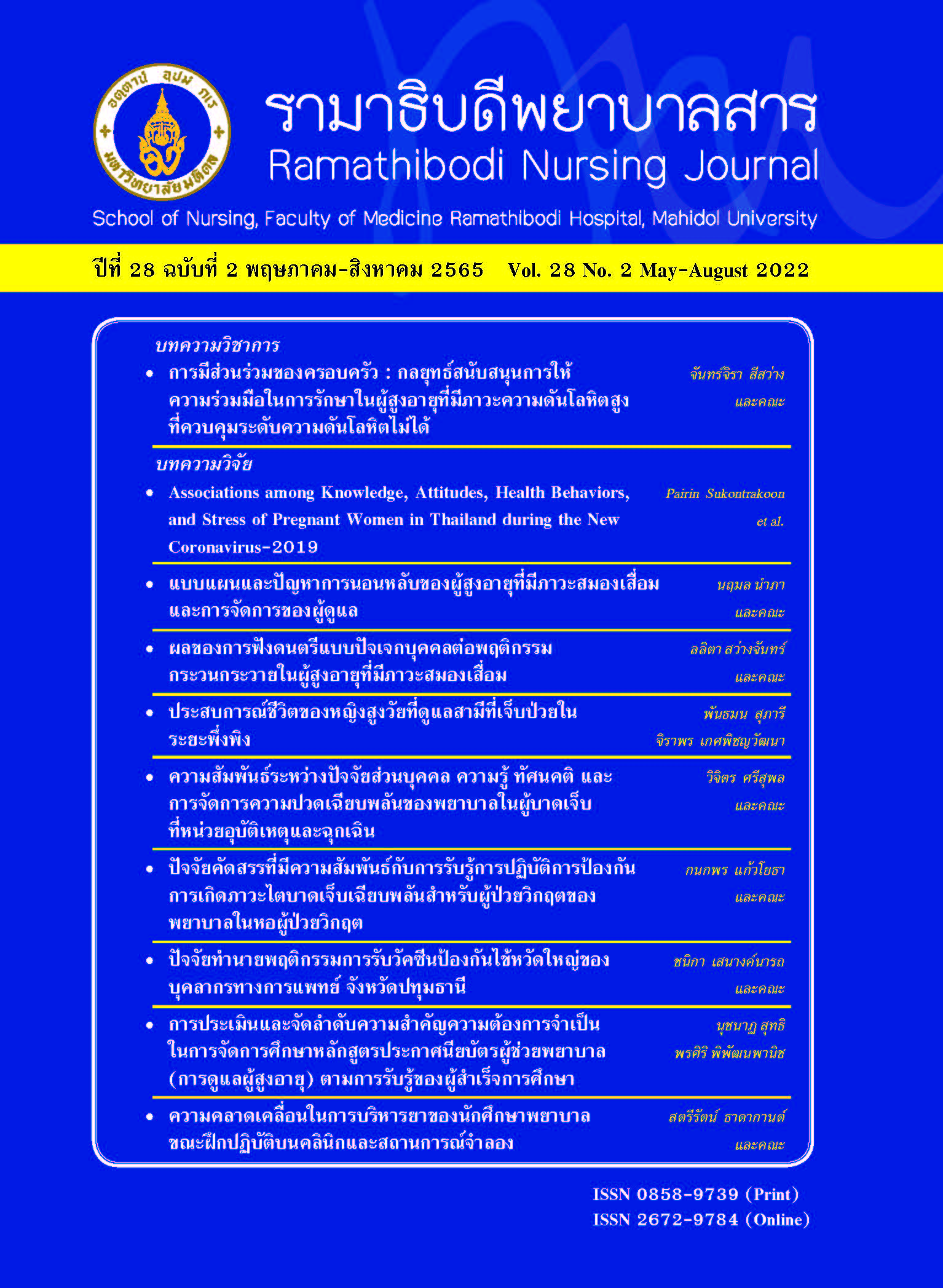
ความสัมพันธ์ระหว่างความรู้ ทัศนคติ พฤติกรรมปฏิบัติด้านสุขภาพ และความเครียดของสตรีตั้งครรภ์ในประเทศไทยระหว่างการระบาดของเชื้อไวรัสโคโรนาสายพันธ์ใหม่ 2019
Article Sidebar
Main Article Content
บทคัดย่อ
การศึกษาครั้งนี้เป็นการวิจัยเชิงพรรณนา มีวัตถุประสงค์เพื่อศึกษาความสัมพันธ์ระหว่างความรู้เกี่ยวกับไวรัสโคโรนาสายพันธุ์ใหม่ 2019 ทัศนคติต่อไวรัสโคโรนาสายพันธุ์ใหม่ 2019 พฤติกรรมปฏิบัติด้านสุขภาพ และความเครียดของสตรีตั้งครรภ์ในประเทศไทยในช่วงสถานการณ์การระบาดของโรคติดเชื้อไวรัสโคโรนาสายพันธ์ใหม่ 2019 กลุ่มตัวอย่างเป็นสตรีตั้งครรภ์ตามคุณสมบัติที่กำหนดจำนวน 283 ราย ตอบแบบสอบถามด้วยตนเองผ่านทางออนไลน์ ประกอบด้วย ข้อมูลส่วนบุคคลแบบประเมินความรู้ ทัศนคติ และพฤติกรรมการปฏิบัติด้านสุขภาพที่เกี่ยวข้องกับโควิด-19 ในสตรีตั้งครรภ์ และแบบประเมินความเครียด วิเคราะห์ข้อมูลโดยใช้สถิติบรรยายและสถิติสหสัมพันธ์สเปียร์แมน ผลการศึกษาพบว่า สตรีตั้งครรภ์ส่วนใหญ่มีความรู้และพฤติกรรมการปฏิบัติด้านสุขภาพอยู่ในระดับสูง (ร้อยละ 75.62 และ ร้อยละ 88.34 ตามลำดับ) มีทัศนคติและความเครียดอยู่ในระดับปานกลาง (ร้อยละ 78.09 และ ร้อยละ 76.32 ตามลำดับ) ความรู้มีความสัมพันธ์ทางบวกกับพฤติกรรมปฏิบัติด้านสุขภาพ ทัศนคติเชิงลบมีความสัมพันธ์ทางบวกกับพฤติกรรมการปฏิบัติด้านสุขภาพและทัศนคติเชิงลบมีความสัมพันธ์ทางบวกกับความเครียดอย่างมีนัยสำคัญทางสถิติ โดยที่ความรู้ไม่มีความสัมพันธ์กับทัศนคติและความเครียด และพฤติกรรมการปฏิบัติด้านสุขภาพไม่มีความสัมพันธ์กับความเครียด ดังนั้น สตรีตั้งครรภ์จึงควรได้รับความรู้เกี่ยวกับโรคติดเชื้อโคโรนาไวรัสสายพันธุ์ใหม่อย่างต่อเนื่อง เพื่อช่วยให้สตรีตั้งครรภ์สามารถปฏิบัติตัวในการป้องกันการติดเชื้อดังกล่าวได้ รวมทั้งควรมีการส่งเสริมทัศนคติในด้านบวกและดูแลทางด้านจิตใจแก่สตรีตั้งครรภ์เพื่อจะได้จัดการกับภาวะเครียดได้อย่างเหมาะสม
คำสำคัญ : ความรู้ ทัศนคติ พฤติกรรมปฏิบัติด้านสุขภาพ ความเครียด สตรีตั้งครรภ์ โควิด-19
Article Details

อนุญาตภายใต้เงื่อนไข Creative Commons Attribution-NonCommercial-NoDerivatives 4.0 International License.
บทความ ข้อมูล เนื้อหา รูปภาพ ฯลฯ ที่ได้รับการตีพิมพ์ในรามาธิบดีพยาบาลสาร ถือเป็นลิขสิทธิ์ของวารสาร หากบุคคลหรือหน่วยงานใดต้องการนำทั้งหมดหรือส่วนหนึ่งส่วนใดไปเผยแพร่หรือเพื่อกระทำการใด ใด จะต้องได้รับอนุญาตเป็นลายลักษณ์อักษรจากรามาธิบดีพยาบาลสารก่อนเท่านั้น
เอกสารอ้างอิง
References
Wang C, Horby PW, Hayden FG, Gao GF. A novel coronavirus outbreak of global health concern. Lancet. 2020;395(10223):470-3. doi: 10.1016/S0140-6736(20)30185-9
Royal College of Obstetricians & Gynaecologists.Coronavirus (COVID-19) infection in pregnancy: Information for healthcare professionals. Version 12: 14 October 2020. [cited 2021 Feb 5]. Available from: https://www.rcog.org.uk/globalassets/documents/guidelines/2020-10-14-coronavirus-covid-19-infection- inpregnancy-v12.pdf
Lechien JR, Chiesa-Estomba CM, Place S, Van Laethem Y,Cabaraux P, Mat Q, et al. Clinical and epidemiological characteristics of 1420 European patients with mild-tomoderate coronavirus disease 2019. J Intern Med. 2020;288(3):335-44. doi: 10.1111/joim.13089.
Allotey J, Stallings E, Bonet M, Yap M, Chatterjee S, Kew T,et al. Clinical manifestations, risk factors, and maternal and
perinatal outcomes of coronavirus disease 2019 in pregnancy:living systematic review and meta-analysis. BMJ. 2020;
:m3320. doi: 10.1136/bmj.m3320.
Ayed A, Embaireeg A, Benawadh A, Al-Fouzan W,Hammoud M, Al-Hathal M, et al. Maternal and perinatal characteristics and outcomes of pregnancies complicated with COVID-19 in Kuwait. BMC Pregnancy Childbirth.2020;20:754. doi:10.1186/s12884-020-03461-2.
Griffiths LJ, Johnson RD, Broadhurst K, Bedston S,Cusworth L, Alrouh B, et al. Maternal health, pregnancy and birth outcomes for women involved in care proceedings in Wales: a linked data study. BMC Pregnancy Childbirth.2020;20:697. doi: 10.1186/s12884-020-03370-4.
Boekhorst MGBM, Muskens L, Hulsbosch LP, Deun KV,Bergink V, Pop VJM, et al. The COVID-19 outbreak increases maternal stress during pregnancy, but not the risk for postpartum depression. Arch Womens Ment Health.2021;24(6):1037-43. doi: 10.1007/s00737-021-
-9.
Coussons-Read ME. Effect of prenatal stress on pregnancy and human development: mechanisms and pathways.
Obstet Med. 2013;6:52-7. doi: 10.1177/1753495X12473751
Thornton CA. Immunology of pregnancy. Proc Nutr Soc.2010; 69:357-65. doi:10.1017/S0029665110001886
Fransson E, Ortenstrand A, Hjelmstedt A. Antenatal depressive symptoms and preterm birth: a prospective study of a Swedish national sample. Birth. 2011;38(1):10-6.doi: 10.1111/j.1523-536X.2010.00441.x.
de Paz NC, Sanchez SE, Huaman LE, Chang GD, Pacora PN, Garcia PJ, Neal Jret al. Risk of placental abruption in relation to maternal depressive, anxiety and stress symptoms. J Affect Disord. 2011;130(1-2):280–4.doi: 10.1016/j.jad.2010.07.024
Marcus S, Lopez JF, McDonough S, Mackenzie MJ, Flynn H, Neal Jr CR, et al. Depressive symptoms during pregnancy:impact on neuroendocrine and neonatal outcomes. Infant Behav Dev. 2011;34(1):26–34. doi: 10.1016/j.infbeh.2010.07.002
Glover V, O’Connor TG, Heron J, Golding J, ALSPAC Study team. Antenatal maternal anxiety is linked with atypical handedness in the child. Early Hum Dev. 2004;79(2):107–18. doi:10.1016/j.earlhumdev.2004.04.012.
O’Connor TG, Heron J, Golding J, Glover V, Team AS.Maternal antenatal anxiety and behavioural/emotional problems in children: a test of a programming hypothesis.J Child Psychol Psychiatry. 2003; 44(7):1025–36. doi:10.1111/1469-7610.00187.
Rogers LK, Velten M. Maternal inflammation, growth retardation, and preterm birth: insights into adult cardiovascular
disease. Life Sci. 2011;89:417–21. doi: 10.1016/j.lfs.2011.07.017.
Rav-Marathe K, Wan TTH, Marathe S. A systematic review on the KAP-O framework for diabetes education and research. Med Res Arch. 2016; 4(1):1-21.
Alavi SS, Dabbagh ST, Abbasi M, Mehrdad R. Radiation protection knowledge, attitude and practice (RP-KAP)as predictors of job stress among radiation workers in Tehran Province, Iran. Iran Red Crescent Med J. 2016; 18(10):e29394. doi: 10.5812/ircmj.29394.
Borjigen A, Huang C, Liu M, Lu J, Peng H, Sapkota C,Sheng, J. Status and factors of menstrual knowledge,attitudes, behaviors and their correlation with psychological stress in adolescent girls. J Pediatr Adolesc Gynecol. 2019;32(6): 584-9. doi:10.1016/j.jpag.2019.08.007.
Zaidi SMIH, Yagoob N, Naveed A, Gulshan N, Hussain S. Positive attitude and stress among adults with coronary
heart disease in Faisalabad. Khyber Med Univ J. 2018;10(3):146-9.
World Health Organization, Stop TB Partnership.Advocacy, communication and social mobilization for TB control: a guide to developing knowledge, attitude and practice surveys; 2008 [cited 2021 Feb 5]. Available from: https://apps.who.int/iris/handle/10665/43790
World Health Organization. Knowledge, attitudes, and practice (KAP) surveys during cholera vaccination campaigns:
guidance for oral cholera vaccine stockpile campaigns;2014 [cited 2021 Feb 5]. Available from: https://www.
who.int/publications/m/item/knowledge-attitudes-andpractices-(kap)-surveys-during-cholera-vaccinationcampaigns-
guidance-for-oral-cholera-vaccine-stockpilecampaigns
Theppitak T. The KAP model and a study of behavior and attitude on prevention HIV/AIDS infection in Thai Seafarers.
Journal of Management Science Chiangrai Rajabhat University. 2013;8:84-102. (in Thai)
Calvo MG, Gutie’rrez-Garci’a A. Cognition and stress.In: Fink G, editor. Stress: concepts, cognition, emotion,and behavior. London: Elsevier; 2016. p. 139-44.
Glanz K, Schwartz MD. Stress, coping, and health behavior. In: Glanz K , Rimer BK, Visvanath K, editors.Health behavior and health education: theory, research,and practice. 4th ed. Jossey-Bass; 2008. p. 211-36.
Cohen J. Statistical power analysis for the behavioral sciences.2nd ed. New York: Lawrence Erlbaum Associates Publishers;
Grove SK. Sampling. In: Gray JR, Grove SK, Sutherland S,editors. Burns and grove’s the practice of nursing research:appraisal, synthesis, and generation of evidence. 8th ed. St.Louis: Elsevier; 2017. p. 329-62.
Cohen S, Kamarck T, Mermelstein R. A global measure of perceived stress. J Health Soc Behav. 1983; 24(4):385-96. doi.org/10.2307/2136404
Wongpakaran N, Wongpakaran T. The Thai version of the PSS-10: an investigation of its psychometric properties. Biopsychosoc
Med. 2010;4:6. doi: 10.1186/1751-0759-4-6.
Al-Hanawi MK, Angawi K, Alshareef N, Qattan AMN,Helmy HZ, Abudawood Y, et al. Knowledge, attitude and practice toward COVID-19 among the public in the Kingdom of Saudi Arabia: a cross-sectional study. Front Public Health. 2020;8:217. doi:10.3389/fpubh.2020.00217.
Kamal D, Thakur VD, Swain SK, Vikneshram CR.Knowledge, attitude, and practice toward COVID‑19 among pregnant women in a tertiary care hospital during the COVID‑19 outbreak. J Mar Med Soc. 2020; 22:S66-71.
Peng Y, Pei C, Zheng Y, Wang J, Zhang K, Zheng Z, et al.A cross-sectional survey of knowledge, attitude and practice
associated with COVID-19 among undergraduate students in China. BMC Public Health. 2020; 20:1292. doi: 10.1186/s12889-020-09392-z.
Singh JP, Sewda A, Gupta SD. Assessing the knowledge,attitude and practices of students regarding the COVID-19
pandemic. J. Health Manag. 2020;22(2): 281–90. doi:10.1177/0972063420935669.
Hoque AM, Alam AM, Hoque M, Hoque ME, Van Hal G. Knowledge, attitudes, and practices towards COVID-19 of pregnant women at a primary health care facility in South Africa. Eur J Med Res. 2021;3(1):50-5. doi: http://dx.doi.org/10.24018/ejmed.2021.3.1.654.
Moyer CA, Compton SD, Kaselitz E, Muzik M. Pregnancyrelated anxiety during COVID-19: a nationwide survey of 2740 pregnant women. Arch Womens Ment Health.2020;23(6):757-65. doi: https://doi.org/10.1007/s00737-020-01073-5.
Parra-Saavedra M, Villa-Villa I, Pérez-Olivo J, Guzman-Polania L, Galvis-Centurion P, Cumplido- Romero A, et al.Attitudes and collateral psychological effects of COVID-19 in pregnant women in Colombia. Int J Gynecol Obstet.2020; 151(2): 203- 8. doi: 10.1002/ijgo.13348.
Dantzer R. Behavior: overview. In: Fink G, editor. Stress:concepts, cognition, emotion, and behavior. London:Elsevier; 2016. p. 57-63.
Lee M, Kang BA, You M. Knowledge, attitudes and practices (KAP) towards the COVID-19: a cross-sectional study in South Korea. BMC Public Health. 2021;21(1):295.doi: 10.1186/s12889-021-10285-y.
