
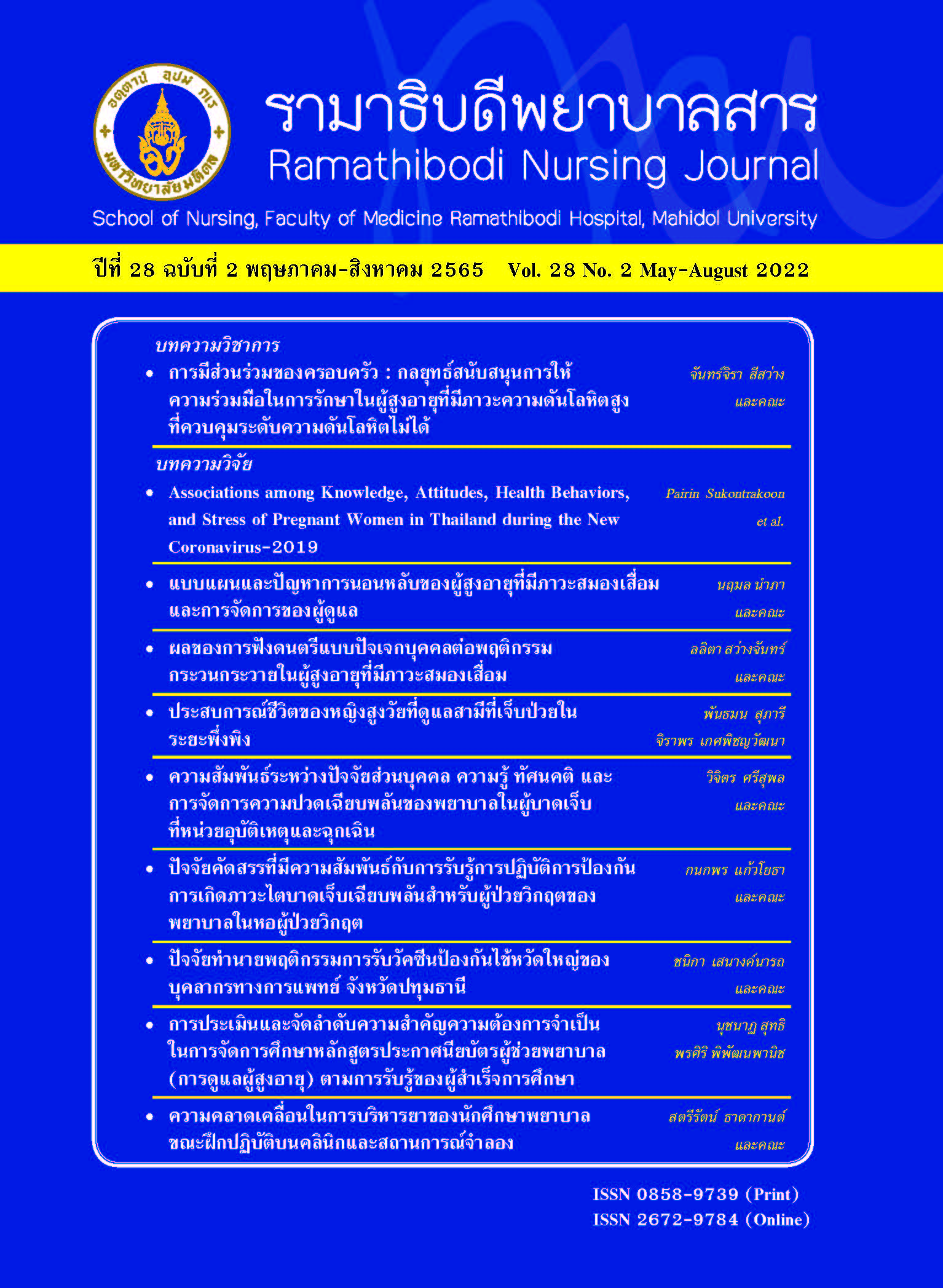
Medication Administration Errors of Nursing Students during Practice in Clinics and in Simulation
Article Sidebar
Main Article Content
Abstract
This cross-sectional observational study aimed at investigating 1) graduating nursing students’ experience in medication administration errors (MAEs) in clinical practice and reporting MAEs, 2) their attitude to the safety climate of practice areas, and 3) types,causes of MAEs, and reasons for not reporting MAEs in simulation. A purposive sample of the 68 fourth-year graduating nursing students was recruited. Simulations of scenarios related to medication administration were set up. Recruited students were assigned to administer medication under nursing roles. The instruments for collecting data were the Medication Administration Errors Experience Questionnaire, the Safety Climate Attitude Questionnaire,and the Medication Administration Error Checklist. Descriptive statistics were used for data analysis. The results are as follows. Firstly, nearly half of the students reported MAEs during actual clinical practice experience. The top three types of reported errors were wrong dosage,wrong time, and wrong drug. Approximately three-quarters who experienced errors did not report MAEs. Secondly, they had a moderate attitude level toward the safety climate of practice areas. Lastly, most students made MAEs in the simulations. Amongst these, three dominant types of errors were wrong patient, wrong dosage, and giving medicine to a patient with a history of drug allergy. The obvious observation for MAEs was not rechecking to reassure before giving medication to a patient. The three reasons for not reporting the errors were: not knowing of mistakes, fear of making errors, and fear of being blamed. Additionally, nearly half of MAEs occurred from insulin administration. In conclusion, this study reflects the types and causes of MAEs and risky behaviours in medication administration of nursing students in clinical practice. The findings can be used to promote and develop nursing students’ medication-safety competencies and positive attitudes towards patient safety management.
Keywords: Medication administration error, Nursing students, Clinics, Simulation
Article Details

This work is licensed under a Creative Commons Attribution-NonCommercial-NoDerivatives 4.0 International License.
บทความ ข้อมูล เนื้อหา รูปภาพ ฯลฯ ที่ได้รับการตีพิมพ์ในรามาธิบดีพยาบาลสาร ถือเป็นลิขสิทธิ์ของวารสาร หากบุคคลหรือหน่วยงานใดต้องการนำทั้งหมดหรือส่วนหนึ่งส่วนใดไปเผยแพร่หรือเพื่อกระทำการใด ใด จะต้องได้รับอนุญาตเป็นลายลักษณ์อักษรจากรามาธิบดีพยาบาลสารก่อนเท่านั้น
References
Wittich CM, Burkle CM, Lanier WL. Medication errors: an overview for clinicians. Mayo Clin Proc. 2014;89(8): 1116-25.
Available from: https://www.ncbi.nlm.nih.gov/pubmed/24981217
Assiri GA, Shebl NA, Mahmoud MA, Aloudah N, Grant E,Aljadhey H, et al. What is the epidemiology of medication errors, error-related adverse events and risk factors for errors in adults managed in community care contexts?. A systematic review of the international literature. BMJ Open 2018;8:e019101. doi:10.1136/ bmjopen-2017-019101.
Yeesoonpan N, Tragulpiankit P, Kaeratigachakorn W,Uaviseswong T, Ninsananda T, Chaikledkaew U, et al.Detecting adverse drug events by trigger tool at a provincial hospital in Thailand. Thai Journal of Pharmacy Practice.2015;7(2):234-49. (in Thai)
Ketpook W, Budnampet K, Plangsanguan A, Sopakorn R. Adverse drug events identification using trigger tools in hospitalized patients. Isan Journal of Pharmaceutical Sciences. 2016;12(3):16-23. (in Thai)
National Coordinating Council for Medication Error Reporting and Prevention. [Internet].2022 [cited 2022 Mar 30]. Available from: https://www.nccmerp.org/about-medication-errors
Rich DS. New JCAHO medication management standards for 2004. Am J Heath Syst Pharm. 2004;61(13):1349-58.
Rattanadechsakul J, Rattanadechsakul P. Medical error and medical management system Utilization. Center for continuing
pharmaceutical education [Internet]. 2015 [cited 2022 Mar 30]. Available from: https://ccpe.pharmacycouncil.org/index.php?option=article_detail&subpage=article_detail&id=303 8
Farzi S, Abedi HA, Ghodousi A, Yazdannik AR. Medication errors experiences of nurses who working in hospitals of Isfahan at 1391. J Qual Res Health Sci. 2014;3(4):10‑9.
Manley HJ, Aweh G, Weiner DE, Jiang H, Miskulin DC, Johnson D, et al. Multidisciplinary medication therapy management and hospital readmission in patients undergoing maintenance dialysis: a retrospective cohort study. Am J Kidney Dis.2020;76:13-21.doi:10.1053/j.ajkd. 2019.12.002
American Society of Health-System Pharmacists. ASHP guidelines on preventing medication errors in hospitals.Am J Health-Syst Pharm. 2018;75:1493–1517.
Ferrah N, Lovell JJ, Ibrahim JE. Systematic review of the prevalence of medication errors resulting in hospitalization and death of nursing home residents. J Am Geriatr Soc.2017;65(2):433-42.
Treiber LA, Jones JH. After the medication error: recent nursing graduates’ reflections on adequacy of Education.J Nurs Educ. 2018;57(5):275-80.
Dehvan F, Dehkordi AH, Gheshlagh RG, Kurdi A. The prevalence of medication errors among nursing students:a systematic and meta-analysis study. Int J Prev Med [Internet].2021 [cited 2021 Nov 8] Available from: http://ijpm.mui.ac.ir/index.php/ijpm/article/view/2432
Ebrahimi Rigi Tanha Z, Baghaei R, Feizi A. A survey of frequency and type of medical errors done by nursing students of Urmia Medical Sciences University in 1390.Nursing and Midwifery Journal. 2012;10:1-10. Available from: https://www.researchgate.net/signup.SignUp.html
Hashish EAA, El-Bialy GG. Nurses’ perceptions of safety climate and barriers to report medication errors. Life Scince
Journal. 2013;10: 2160-8.
Reason J. Human error: models and management. BMJ.2000;320(7237):768-70.
Sexton JB, Helmreich R, Neilands T, Rowan K, Vella K,Boyden J, et al. The safety attitudes questionnaire:psychometric properties, benchmarking data, and emerging research. BMC Health Serv Res. 2006;6:44. Available from:https://bmchealthservres.biomedcentral.com/track/pdf/10.1186/1472-6963-6-44.pdf
Deilkås ET, Hofoss D. Psychometric properties of the Norwegian version of the Safety Attitudes Questionnaire (SAQ),
Generic version (Short Form 2006). BMC Health ServRes. 2008;22;8:191. doi: 10.1186/1472-6963-8-191.
Freeman MA, Dennison S, Giannotti N, Voutt-Goos MJ.An evidence-based framework for reporting student nurse
medication incidents: errors, near misses and discovered errors. Quality Advancement in Nursing Education
[internet]. 2020;6(3) [cited 2021 Dec 10]. Available from: https://qane-afi.casn.ca/journal/vol6/iss3/4/
Sarhadi M, Sheikhbardsiri H, Dastras M, Moein H. A Comparative study of barriers to reporting medication errors
in nursing students in Zahedan University of Medical Sciences,Iran. J Manage Med Inform Sch. 2014;2(1): 38-46.
Koohestani HR, Baghcheghi N. Barriers to the reporting of medication administration errors among nursing students. Aust J Adv Nurs. 2009;27(1):65-74.
Lee HY, Lee E-K. Safety climate, nursing organizational culture and the intention to report medication errors: a
cross-sectional study of hospital nurses. Nursing Practice Today. 2021;8(4):284-92.
Jeffries PR, editor. Simulation in nursing education: from conceptualization to evaluation. New York, NY: National League for Nursing; 2007.
The healthcare accreditation institute. Hospital and healthcare standards. Bangkok: D-one Books; 2015
Salami I. Nursing students’ medication errors and adherence to medication best-practice. Open Journal of Nursing,
;8:281-291. [cited 2021 Dec 20] Available from:file:///C:/Users/001642/Downloads/Nursing_students_medication_errors_and_adherence_.pdf
Wolf ZR, Hicks R, Serembu JF. Characteristics of medication errors made by students during the administration
phase: a descriptive study. J Prof Nurs. 2006;22(1):39-51.
Henneman EA, Roche JP, Fisher DL, Cunningham H, Reilly CA, Nathanson BH, et al. Error identification and recovery by
student nurses using human patient simulation: opportunity to improve patient safety. Appl Nurs Res. 2010;23(1):11-21.
Dolansky MA, Druschel K, Helba M, Courtney K. Nursing student medication errors: a case study using root cause
analysis. J Prof Nurs. 2013;29(2):102-8.
Breitkreuz KR, Dougal RL,Wright MC. How do simulated error experiences impact attitudes related to error prevention?.
Simul Healthc. 2016;11(5):323-333. [cited 2021 Dec25]. Available from: https://www.ncbi.nlm.nih.gov/pmc/articles/PMC6154479/pdf/nihms-988275.pdf
Musharyanti L, Claramita M, Haryanti F, Dwiprahasto I.Why do nursing students make medication errors? a qualitative
study in Indonesia. J Taibah Univ Med Sci. 2019;14(3):282-8. [cited 2021 Dec 25]. Available from: https://www.
ncbi.nlm.nih.gov/pmc/articles/PMC6694917/pdf/main.pdf
