
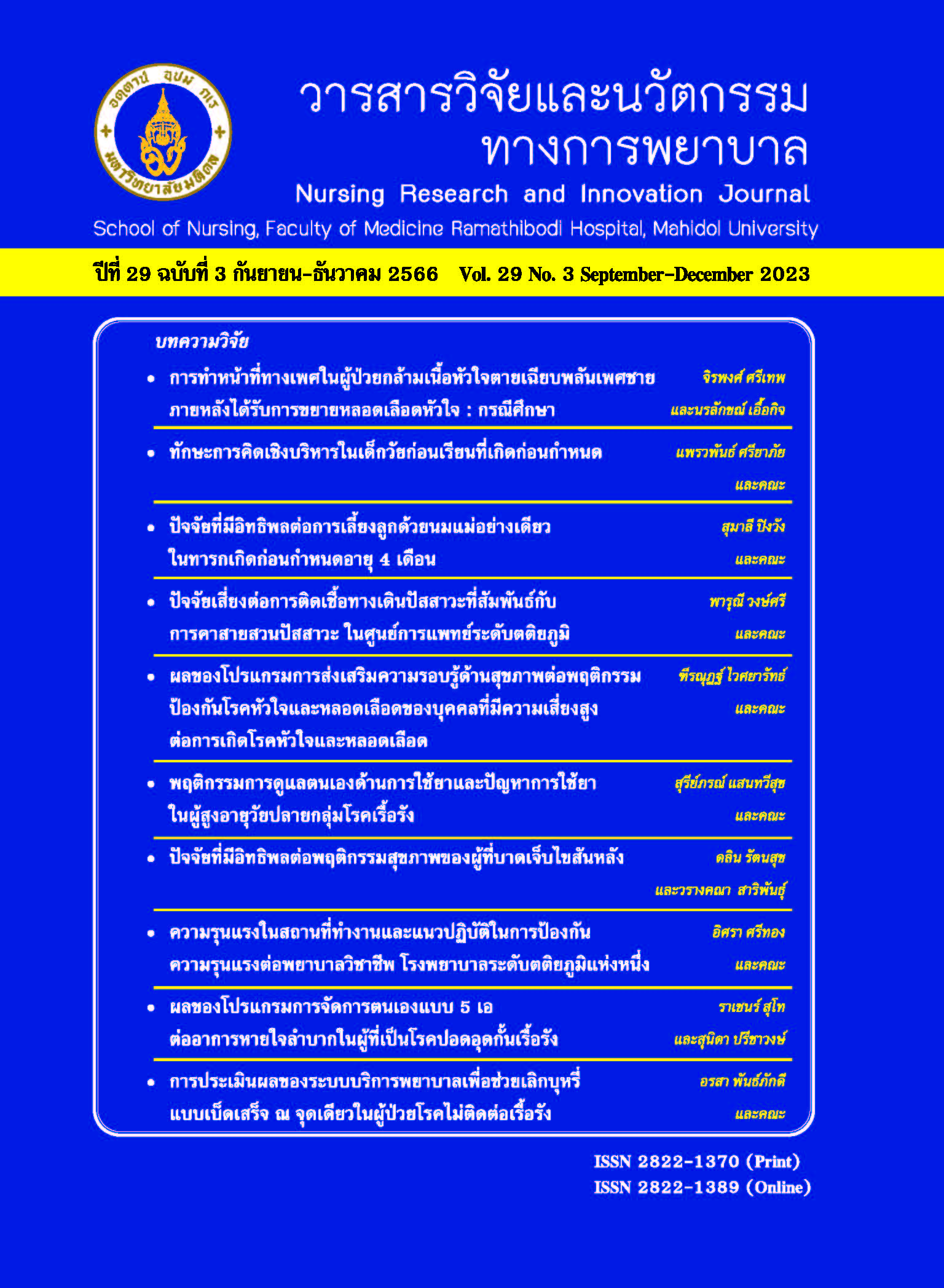
Factors Affecting Exclusive Breastfeeding in Preterm Infants Aged 4 Months
Article Sidebar
Main Article Content
Abstract
Abstract
This predictive study aimed at in vestigating the predictive ability of attitude,subjective norm,andself-efficacy to exclusive breastfeeding during four months of age in preterm infants. The sample group was selected by purposive sampling according to the inclusion criteria of 77 dyads of mothers and preterm infants who visited the pediatrics outpatient department between February 2020 and August 2021. Data were collected by the instruments include five parts: the Demographic Characteristics of Mothers and Preterm Infant Questionnaire,the 24-hour Recall Questionnaire,the Iowa Infant Feeding Attitude Scale (IIFAS), the Subjective Norm Questionnaire, and the Breastfeeding Self-Efficacy Scale-Short Form (BSES-SF). Data were analyzed using descriptive statistics and logistic regression analysis. The results showed that self-efficacy in breastfeeding was the variable predicting exclusive breastfeeding in preterm infants at four monthsof age. This factor could explain the variability of exclusive breastfeeding at four months in preterm infantsat 25%. Therefore,nurses should advise and encourage mothers of preterm infants to have self-efficacy in breastfeeding to help mothers be able to breastfeed.
Keywords: Breastfeeding, Exclusive breastfeeding,Preterm infant,Self-efficacy
Article Details

This work is licensed under a Creative Commons Attribution-NonCommercial-NoDerivatives 4.0 International License.
บทความ ข้อมูล เนื้อหา รูปภาพ ฯลฯ ที่ได้รับการตีพิมพ์ในรามาธิบดีพยาบาลสาร ถือเป็นลิขสิทธิ์ของวารสาร หากบุคคลหรือหน่วยงานใดต้องการนำทั้งหมดหรือส่วนหนึ่งส่วนใดไปเผยแพร่หรือเพื่อกระทำการใด ใด จะต้องได้รับอนุญาตเป็นลายลักษณ์อักษรจากรามาธิบดีพยาบาลสารก่อนเท่านั้น
References
American Academy of Pediatrics. Breastfeeding and the use of human milk.Pediatrics. 2012; 129(3):827-41.doi:10.1542/peds. 2011-3552
Chantry CJ, Howard CR, Auinger P. Full breastfeeding duration and associated decrease in respiratory tract infection in US children.Pediatrics. 2006;117(2):425-32.doi:10.1542/peds.2004-2283.
Vohr BR, Poindexter BB, Dusick AM, McKinley LT,Wright LL, Langer JC, Poole WK; NICHD Neonatal Research Network. Beneficial effects of breast milk in the neonatal intensive care unit on the developmental outcome of extremely low birth weight infants at 18 months of age.Pediatrics. 2006;118(1):e115-23. doi:10.1542/peds.2005-2382.
Underwood MA. Human milk for the premature infant.Pediatr Clin North Am. 2013;60(1):189- 207.
UNICEF &WHO. Low birthweight estimates: levelsand trends 2000–2015. 2019 [cited 2020 April 18]; Availablefrom:https://data.unicef.org/topic/nutrition/low-birthweight/
Centers for Disease Control and Prevention.Percentage of births born preterm by state. 2016 [cited 2020April 18];Available from: http://www.cdc.gov/nchs/data/nvsr/nvsr67/nvsr6701.pdf
EricsonJ,Flacking R, Hellstrom-Westas L, ErikssonM.Changes in the prevalence of breast feeding in preterm infants discharged from neonatal units: a register study over 10 years. BMJ Open. 2016;6(12):e012900.
Office for NationalStatistics Thailand. Childand women situation survey project in thailand 2019,Complete Report [Internet]. Bangkok, Thailand: Office for National Statistics Thailand; 2020 [cited 2020 Jan 17]. Avialable form:www.MICS6_report_071063.pdf(nso.go.th)(inThai)
Walters D,HortonS,Siregar AYM,PitriyanP,Hajeebhoy N, Mathisen R, et al. The cost of not breastfeeding in Southeast Asia.Health Policy and Planning. 2016;31(8):1107–16.https://doi.org/10.1093/heapol/czw044
Suparat S, Inta N, Namprom N. Factors related to breastfeeding among preterm infants mothers after discharge from Maharaj Nakorn Chiang Mai hospital.Nursing Journal. 2017;44(2):12-22. (in Thai)
Pattanapongthorn J, JesprayukS. Breastfeeding rates and factors affect exclusive breastfeeding at least 4 months.Nonthaburi: Department of Health, Ministry of Public Health; 2004. (in Thai)
Nyqvist HK, Ewald U. Infant and maternal factors in the development of breastfeeding behaviour and breastfeeding outcome in preterm infants. Acta Paediatr. 1999;88(11):1194-1203.
Chuprapan P, Thiangthum W, Pichayapinyo P. Factors influencing exclusive breastfeeding within a 6 months’period among mothers in south central region of Thailand [thesis]. Nakhon Pathom: Mahidol University; 2013.(in Thai)
Choosilp K, Assessment a breastfed infant. In:MuttaraS,Chusil K, Suthatworawuth U, Saengtaweesin W,Haengchaownish Y, editor. Breastfeeding textbooks.Bangkok:Aiyara Publishing; 2012.p.163-71.(in Thai)
ChanapaiS,SinsuksaiN,Thananowan N,Phahuwatanakorn W. Knowledge,attitude, self-efficacy, spousal and nurse support predicting 6 weeks exclusive breastfeeding. 2014(cited 2017 January 12); Journal of Nursing Science,32(1):51-60.Avialable from:http://www.ns.mahidol.ac.th/english/journal NS/pdf/vol32/issue1 /Abstract_Suwanna.pdf (in Thai)
Ngerncham S. Rate of breastfeeding for 4 months and promoting factors: a cohort study of preterm infants at Siriraj Hospital;2009(cited2017January12).Avialable from:http://cuir.car.chula.ac.th/handle/123456789/(in Thai)
Kantharot K.Predictors of breastfeeding intention among mothers of preterm infants [thesis]. Chiang Mai; Chiang Mai University; 2006. (in Thai)
WungkumA, Thaiyapirom N,Jintrawet U.Factors related to continued breast feeding among mothers with preterm infants. Thai Journal of Nursing. 2011;38(3):73-83.(in Thai)
Wang Y, Briere CE, Xu W, Cong X. Factors affecting breastfeeding outcomes at six months in preterm infants.J Hum Lact. 2019;35(1): 80-9.
Ajzen, I. The theory of planned behavior: Organ Behav Hum Decis Process. 2006; 50(2):179-211.
Lee HC, Martin-Anderson S, Lyndon A, & Dudley RA.Perspectives on promoting breast milk feedings for premature infants during a quality improvement project.Breastfeed Med. 2013;8(1):176-180.
Herich LC, Cuttini M, Croci I, Franco F, Di Lallo D,Baronciani D, Zeitlin J. Maternal education is associated with disparities in breastfeeding at time of discharge but not at initiation of enteral feeding in the neonatal intensive careunit. JPediatr. 2017; 1829(1):59-65.
RayfieldS, Oakley L, Quigley MA. Association between breastfeeding support and breastfeeding rates in the UK:a comparison of late preterm and term infants.BMJ Open.2015;5(11).e009144.doi: 10.1136/bmjopen2015-009144.
Gerhardsson E,HildingssonI,Mattsson E,Funkquist EL.Prospective questionnaire study showed that higher self-efficacy predicted longer exclusive breastfeeding by the mothers of late preterm infants. Acta Paediatr. 2018;107(5):799-805.
Cohen J. Statistical power analysis for the behavioral sciences. 2nd ed. Hillsdale NJ: Lawrence Erlbaum Associates Publishers; 1988.
World Health Organization.Infant and young child feeding(IYCF) Model chapter for textbooks for medical student and allied health professionals. 2009.(cited 2020 July 20);Available from https://www.who.int/publications-detailredirect/978924159794
De la MoraA,Russell DW,DungyCI,LoschM,Dusdieker L. The Iowa infant feeding attitude: analysis of reliability and validity.J Appl Soc Psychol. 1999;29(1):2362-80.
Dennis C-L. The breastfeeding self-efficacy scale:psychometric assessment of the short form. JOGNN.2003;32(1):734-44.
Thussanasupap B. The effects of systematic instructional program on breastfeeding self-efficacy, nipple pain of cesarean mother [thesis]. Bangkok: Mahidol University;2006. (in Thai)
Polit DF & Beck CT. Nursing research: generating and assessing evidence for nursing practice. 9thed.Philadelphia:Lippincott Williams & Wikins; 2012.
Burns N, Grove SK. The practice of nursing research:Conduct critique and utilization. 5th ed.Missouri: Elsevier Saunders; 2005.
Koletzko B, Poindexter B, Uauy R. Nutritional care of preterm infants: scientific basis and practical quidelines(world review of nutrition and dietetics). Basel, Karger.2014;110(1):4-10.doi:10.1159/00 0358453.
Kaewvichien S, Thavonvattana S,Junmast W,Sangtun S,Thaor S. The development of breastfeeding support model for premature infants with a high risk of having critical condition at Queen National Institute of ChildHealth. Thai Journal of Cardio-Thoracic Nursing. 2019;30(2):141-58.(in Thai)
OrnlaorS,KlunklinP,Urharmnuay M.Factors predicting breastfeeding among mothers of preterm infants.The Journal of Faculty of Nursing Burapha University.2016(cited 2020March 15);24(4):32-42. Avialable from: https://he02.tci-thaijo.org/index.php/Nubuu/
article/view/82401 (in Thai)
SamahaeP,SananreangsakS,Teerarungsikul N.Predictors of breastfeeding intention in preterm infant among muslim mothers.The Journal of Faculty of Nursing Burapha University. 2020 (cited 2020 July 20);28(3):102-12.Available from:https://he02.tci-thaijo.org/index.php/Nubuu/article/view/246092. (in Thai)
Bandura A. Self-efficacy: the exercise of control.New York: W.H.Freeman and Company; 1997.
Ajzen I & Fishbein M. Understanding attitudes and predicting social behavior.Englewood Cliffs, N.J:Prentice-Hall; 1980.
