
Primary Subcutaneous Sporotrichoid Fusarium Infection in Patient with a First HIV Diagnosis: A Case Report
Keywords:
Fusarium infection, Primary subcutaneous fusarium infection, Sporotrichoid pattern, Cat related diseaseAbstract
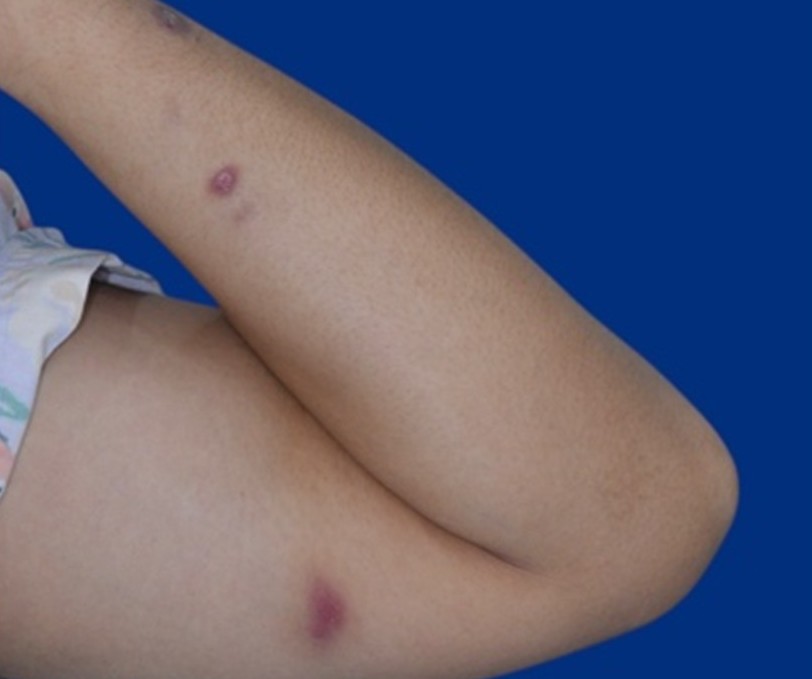
Fusarium species are responsible for various human infections, ranging from superficial to locally invasive and disseminated infections. We reported A 29-year-old Thai male with a primary subcutaneous sporotrichoid fusarium infection on his left arm and forearm, which developed after a stray cat scratch. Histopathology showed dense granulomatous infiltration in the dermis, no microorganism. Tissue culture revealed white colony. Microscopic morphology with Lactophenol cotton blue solution revealed hyaline hyphae with macroconidia. Tissue culture nucleotide BLAST sequencing revealed Fusarium solani. Hemoculture for fungus was negative. An additional assessment confirmed that the patient had HIV infection. The infection complete resolution 3 months after treatment with voriconazole.
References
References
van Diepeningen AD, Feng P, Ahmed S, Sudhadham M, Bunyaratavej S, de Hoog GS. Spectrum of Fusarium infections in tropical dermatology evidenced by multilocus sequencing typing diagnostics. Mycoses 2015;58:48-57.
Sáenz V, Alvarez-Moreno C, Pape PL, Restrepo S, Guarro J, Ramírez AMC. A One Health Perspective to Recognize Fusarium as Important in Clinical Practice. J Fungi (Basel) 2020;6:235.
Connole MD. Review of animal mycoses in Australia. Mycopathologia 1990;111:133-64.
Dignani MC, Anaissie E. Human fusariosis. Clin Microbiol Infect 2004;10:67-75.
Nucci M, Anaissie E. Fusarium infections in immunocompromised patients. Clin Microbiol Rev 2007;20:695-704.
Sugahara G, Kiuchi A, Usui R, et al. Granulomatous pododermatitis in the digits caused by Fusarium proliferatum in a cat. J Vet Med Sci 2014;76:435-8.
Bodey GP, Boktour M, Mays S, et al. Skin lesions associated with Fusarium infection. J Am Acad Dermatol 2002;47:659-66.
Watsky KL. Sporotrichoid nodules in an immunocompromised host. Cutaneous emboli of Fusarium. Arch Dermatol 1995;131:1329, 30.
Esnakula AK, Summers I, Naab TJ. Fatal disseminated fusarium infection in a human immunodeficiency virus positive patient. Case Rep Infect Dis 2013;2013:379320.
Hoenigl M, Salmanton-García J, Walsh TJ, et al. Global guideline for the diagnosis and management of rare mould infections: an initiative of the European Confederation of Medical Mycology in cooperation with the International Society for Human and Animal Mycology and the American Society for Microbiology. Lancet Infect Dis 2021;21:e246-e57.
Muhammed M, Anagnostou T, Desalermos A, et al. Fusarium infection: report of 26 cases and review of 97 cases from the literature. Medicine (Baltimore) 2013;92:305-16.
Maitrisathit W, Vasikasin V, Srisuttiyakorn C. Disseminated fusariosis in leukemia patient. Thai J Dermatol 2018;34:292-8.
Kantarcioglu AS, Summerbell RC, Sutton DA, et al. A dark strain in the Fusarium solani species complex isolated from primary subcutaneous sporotrichioid lesions associated with traumatic inoculation via a rose bush thorn. Med Mycol 2010;48:103-9.
Downloads
Published
How to Cite
Issue
Section
License
Copyright (c) 2026 Thai Journal of Dermatology

This work is licensed under a Creative Commons Attribution-NonCommercial-NoDerivatives 4.0 International License.
เนื้อหาและข้อมูลในบทความที่ลงตีพิมพ์ในวารสารโรคผิวหนัง ถือเป็นข้อคิดเห็นและความรับผิดชอบของผู้เขียนบทความโดยตรงซึ่งกองบรรณาธิการวารสาร ไม่จำเป็นต้องเห็นด้วย หรือร่วมรับผิดชอบใดๆ
บทความ ข้อมูล เนื้อหา รูปภาพ ฯลฯ ที่ได้รับการตีพิมพ์ในวารสารโรคผิวหนัง ถือเป็นลิขสิทธิ์ของวารสารฯ หากบุคคลหรือหน่วยงานใดต้องการนำทั้งหมดหรือส่วนหนึ่งส่วนใดไปเผยแพร่ต่อหรือเพื่อกระทำการใดๆ จะต้องได้รับอนุญาตเป็นลายลักอักษรจากบรรณาธิการวารสารโรคผิวหนังก่อนเท่านั้น

