Topical Statin Use in CHILD Syndrome
Keywords:
topical statins, cholesterol synthesis, CHILD syndrome, pathogenesis-based therapyAbstract
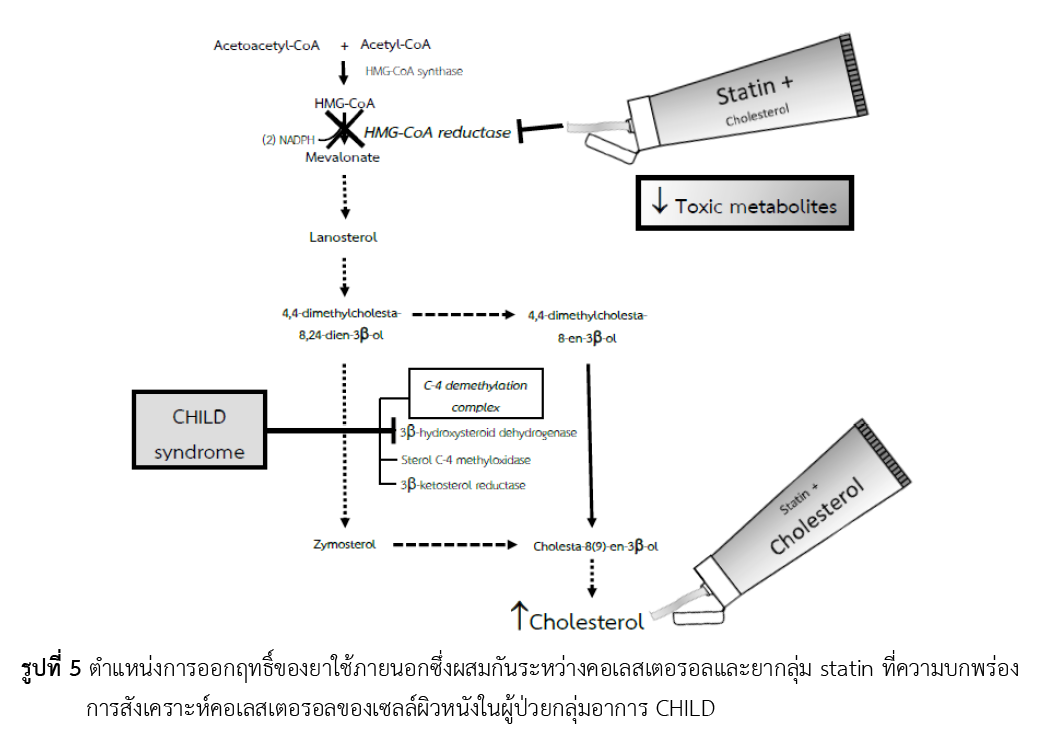
Oral statins are well established for their efficacy and safety in lowering blood lipids to reduce cardiovascular disease. However, its use as an external drug is not very well known because the syndromes that need them is a very rare disorder. These disorders are related to cholesterol biosynthesis due to a consequence of a genetic mutation. One of these disorders is Congenital Hemidysplasia Ichthyosiform erythroderma and Limb Defects (CHILD). Some patients have abnormal cell growth on the extremities and dermatitis with scaly skin. Drug treatments are generally aimed at alleviating the symptoms of the skin. But the pathogenesis-based therapy with the topical application of statins in combination with cholesterol can improve skin symptoms and provide nearly normal skin as seen in case report. Nevertheless, topical use of statins remains an off-label use due to lack of comparative studies on the efficacy and safety, as well as a small number of patients to be enrolled. In the future, more studies conducted will lead to the development of pharmaceutical formulations and registration of topical statins for the treatment of CHILD syndrome, which is the hope for the patients.
References
Benjamin MM, Roberts WC. Facts and principles learned at the 39th annual Williamsburg conference on heart disease. Proc (Bayl Univ Med Cent). 2013;26(2):124-36.
Moon AT, Rosenthal J. CHILD syndrome [Internet]. New York: Medscape; updated 2019 Aug 20 [cited 2020 May 10]. Available from: https://emedicine.medscape.com/article/1110427-overview.
Alexopoulos A, Kakourou T. CHILD syndrome: successful treatment of skin lesions with topical simvastatin/ cholesterol ointment-a case report. Pediatr Dermatol. 2015;32(4):e145-7.
Christiansen AG, Koppelhus U, Sommerlund M. Skin abnormalities in CHILD syndrome successfully trea–ted with pathogenesis-based therapy. Acta Derm Venereol. 2015;95(6):752-3.
Paller AS, van Steensel MA, Rodriguez-Martin M, Sorrell J, Heath C, Crumrine D, et al. Pathogenesis-based therapy reverses cutaneous abnormalities in an inherited disorder of distal cholesterol metabolism. J Invest Dermatol. 2011;131(11):2242-8.
Thomas J, Shentu TP, Singh DK. Cholesterol: biosynthesis, functional diversity, homeostasis and regulation by natural products. Biochemistry. 2012;18:419-42.
Porter FD, Herman GE. Malformation syndromes caused by disorders of cholesterol synthesis. J Lipid Res. 2011;52(1):6-34.
Vaklavas C, Chatzizisis YS, Ziakas A, Zamboulis C, Giannoglou GD. Molecular basis of statin-associated myopathy. Atherosclerosis. 2009;202:18-28.
Stottmann RW, Turbe-Doan A, Tran P, Kratz LE, Moran JL, Kelley RI, et al. Cholesterol metabolism is required for intracellular hedgehog signal transduction In Vivo. PLoS Genet. 2011;7(9):1-16.
Sandoval KR, Machado MCR, Oliveira ZNP, Nico MMS. CHILD syndrome: successful treatment of skin lesions with topical lovastatin and cholesterol lotion. An Bras Dermatol. 2019;94(3):341-3.
Fackler N, Zachary C, Kim DJ, Smith J, Sarpa HG. Not lost to follow-up: a rare case of CHILD syndrome in a boy reappears. JAAD Case Rep. 2018;4(10):1010-3.
วิมล ศิริมหาราช. Basal cell carcinoma. ภาควิชาศัลยศาสตร์ คณะแพทยศาสตร์ มหาวิทยาลัยเชียงใหม่ [สืบค้นเมื่อ 17 พฤษภาคม 2563]. สืบค้นจาก: https://w1.med.cmu.ac.th/surgery/index.php?Option=com_content& view=article&id=234&Itemid=419.
Liu T, Qian G, Wang XX, Zhang YG. CHILD syndrome: effective treatment of ichthyosiform naevus with oral and topical ketoconazole. Acta Derm Venereol. 2015;95(1):91-2.
Schachter M. Chemical, pharmacokinetic and pharmacodynamic properties of statins: an update. Fundam Clin Pharmacol. 2005;19(1):117-25.
Sarr FS, André C, Guillaume YC. Statins (HMG-coenzyme A reductase inhibitors) - biomimetic membrane binding mechanism investigated by molecular chromatography. J Chromatogr B Analyt Technol Biomed Life Sci. 2008;868(1-2):20-7.
อังคนา วิชิต. การดูดซึมเข้าสู่ผิวหนัง [อินเตอร์เน็ต]. นนทบุรี: ศูนย์การศึกษาต่อเนื่องทางเภสัชศาสตร์; 2560 [สืบค้นเมื่อ 14 มิถุนายน 2563]. สืบค้นจาก: https://ccpe.pharmacycouncil.org/index.php?option=article_detail&subpage=article_detail&id=398.
คัทลียา เมฆจรัสกุล. การดูดซึมทางผิวหนัง [อินเตอร์เน็ต]. นนทบุรี: ศูนย์การศึกษาต่อเนื่องทางเภสัชศาสตร์; 2560 [สืบค้นเมื่อ 14 มิถุนายน 2563]. สืบค้นจาก: https://ccpe.pharmacycouncil.org/index.php?option=article_ detail&subpage=article_detail&id=390.
Bracht L, Caparroz-Assef SM, Magon TF, Ritter AM, Cuman RK, Bersani-Amado CA. Topical anti-inflammatory effect of hypocholesterolaemic drugs. J Pharm Pharmacol. 2011;63:971-5.
Jia S, Xie P, Hong SJ, Galiano RD, Mustoe TA. Local application of statins significantly reduced hypertrophic scarring in a rabbit ear model. Plast Reconstr Surg Glob Open. 2017;5(6):1-8.
Atorvastatin [Internet]. In PubChem® (database on the internet) Bethesda (MD): U.S. National Library of Medicine, National Center for Biotechnology Information; updated 2019 March [cited 2020 June 14]. Available from: http://pubchem.ncbi.nlm.nih.gov.
Fluvastatin [Internet]. In PubChem® (database on the internet) Bethesda (MD): U.S. National Library of Medicine, National Center for Biotechnology Information; updated 2019 March [cited 2020 June 14]. Available from: http://pubchem.ncbi.nlm.nih.gov.
Lovastatin [Internet]. In PubChem® (database on the internet) Bethesda (MD): U.S. National Library of Medicine, National Center for Biotechnology Information; updated 2019 March [cited 2020 June 14]. Available from: http://pubchem.ncbi.nlm.nih.gov.
Pitavastatin [Internet]. In PubChem® (database on the internet) Bethesda (MD): U.S. National Library of Medicine, National Center for Biotechnology Information; updated 2019 March [cited 2020 June 14]. Available from: http://pubchem.ncbi.nlm.nih.gov.
Pravastatin [Internet]. In PubChem® (database on the internet) Bethesda (MD): U.S. National Library of Medicine, National Center for Biotechnology Information; updated 2019 March [cited 2020 June 14]. Available from: http://pubchem.ncbi.nlm.nih.gov.
Rosuvastatin [Internet]. In PubChem® (database on the internet) Bethesda (MD): U.S. National Library of Medicine, National Center for Biotechnology Information; updated 2019 March [cited 2020 June 14]. Available from: http://pubchem.ncbi.nlm.nih.gov.
Simvastatin [Internet]. In PubChem® (database on the internet) Bethesda (MD): U.S. National Library of Medicine, National Center for Biotechnology Information; updated 2019 March [cited 2020 June 14]. Available from: http://pubchem.ncbi.nlm.nih.gov.
Wiggins BS, Saseen JJ, Pagell RL, Reed BN, Sneed K, Kostis JB, et al. Recommendations for management of clinically significant drug-drug interactions with statins and select agents used in patients with cardiovascular disease: a scientific statement from the American Heart Association. Circulation. 2016;134(21):e 468-95.
Yu X, Zhang J, Gu Y, Deng D, Wu Z, Bao L, et al. CHILD syndrome mimicking verrucous nevus in a Chinese patient responded well to the topical therapy of compound of simvastatin and cholesterol. J Eur Acad Dermatol Venereol. 2018;32(7):1209-13.
Mi XB, Luo MX, Guo LL, Zhang TD, Qiu XW. CHILD syndrome: case report of a Chinese patient and literature review of the NAD[P]H steroid dehydrogenase-like protein gene mutation. Pediatr Dermatol. 2015;32(6):e277-82.
Bajawi SM, Jafarri SA, Buraik MA, Attas KMA, Hannani HY. Pathogenesis-based therapy: cutaneous abnormalities of CHILD syndrome successfully treated with topical simvastatin monotherapy. JAAD case Rep. 2018;4(3):232-4.
ระพีพรรณ ฉลองสุข. การใช้ยานอกข้อบ่งใช้ในประเทศไทย. วารสารมหาวิทยาลัยศิลปากร. 2561;38(3):170-98.
Downloads
Published
How to Cite
Issue
Section
License
บทความในวารสารเภสัชกรรมโรงพยาบาลเผยแพร่ภายใต้เงื่อนไขของสัญญาอนุญาตครีเอทีฟคอมมอนส์ในรูปแบบที่ต้องอ้างอิงแหล่งที่มา - ห้ามใช้เพื่อการค้า - ห้ามแก้ไขดัดแปลง เวอร์ชั่น 4.0 (CC BY-NC-ND 4.0) สามารถแจกจ่ายและนำบทความไปใช้ประโยชน์เพื่อการศึกษาได้แต่ต้องระบุการอ้างอิงถึงบทความจากเว็บไซต์วารสารเภสัชกรรมโรงพยาบาล ไม่สามารถนำบทความไปใช้เพื่อการพาณิชย์ใด ๆ เว้นแต่ได้รับอนุญาตจากบรรณาธิการวารสารเภสัชกรรมโรงพยาบาล และกรณีมีการนำบทความไปเรียบเรียงใหม่ เปลี่ยนแปลงเนื้อหา หรือเสริมเติมแต่งเนื้อหาของบทความ ท่านไม่สามารถนำบทความที่ปรับแต่งไปเผยแพร่ได้ในทุกกรณี
ข้อความที่ปรากฏในบทความในวารสารเป็นความคิดเห็นส่วนตัวของผู้แต่งแต่ละท่านไม่เกี่ยวข้องกับสมาคมเภสัชกรรมโรงพยาบาล (ประเทศไทย) และบุคลากรในสมาคมฯ แต่อย่างใด ความรับผิดชอบองค์ประกอบทั้งหมดของบทความแต่ละเรื่องเป็นของผู้แต่งแต่ละท่าน หากมีความผิดพลาดใด ๆ ผู้แต่งแต่ละท่านจะรับผิดชอบบทความของตนเอง ตลอดจนความรับผิดชอบด้านเนื้อหาและการตรวจร่างบทความเป็นของผู้แต่ง ไม่เกี่ยวข้องกับกองบรรณาธิการ

.png)

