
Efficacy of Azelastine Hydrochloride and Fluticasone Propionate Intranasal Spray on Allergic Rhinitis
Keywords:
allergic rhinitis, intranasal spray, combination formula of azelastine and fluticasoneAbstract
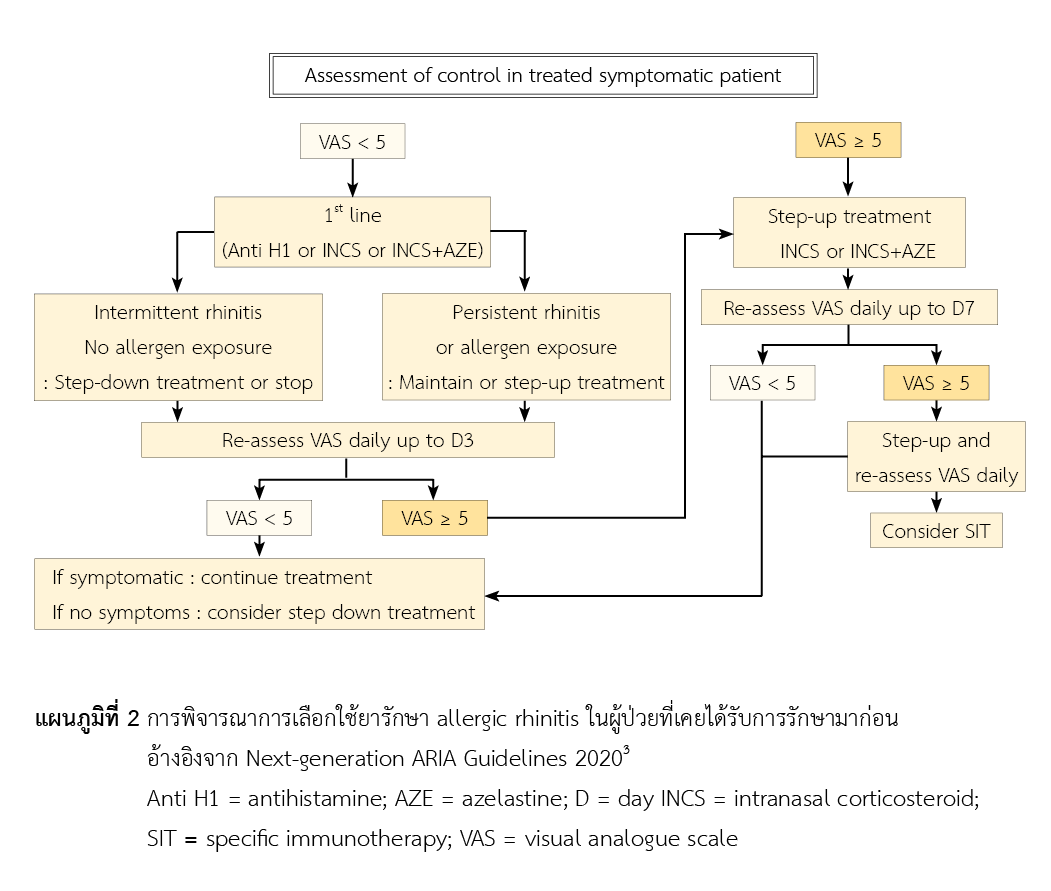
Intranasal corticosteroids play roles in the treatment of allergic rhinitis especially in patients with moderate to severe symptoms. The drug was mentioned in the Allergic Rhinitis and its Impact on Asthma (ARIA) Guidelines 2016, the previous guideline. In 2020, a new treatment guideline for allergic rhinitis was adopted and the new guideline was named as “Next-generation ARIA Guidelines 2020”. The changing point in the new guideline was the drug’s onset of action that was taken as a part of the consideration in drug selection. In the new guideline, the onset of action of the combination of intranasal corticosteroids (INCS) and intranasal antihistamine (INAH) was compared with the monotherapy. All formulations were administered as 1 to 2 sprays in each nostril twice daily. The intranasal formula of fluticasone propionate (FLU) and azelastine hydrochloride (AZE) for moderate to severe allergic rhinitis had the most rapid onset of action (5 minutes) when compared with the use of INCS and INAH monotherapy or combination of non FLU-INCS and AZE. It also showed statistically significant effectiveness in alleviating nasal and ocular symptoms when compared with the use of INCS and INAH monotherapy. Besides, it can also improve the quality of life. The most common adverse effect are bitter taste, headache and nosebleed. In conclusion, the combined AZE and FLU nasal spray should be recommended for the treatment of patients with moderate to severe allergic rhinitis from 12 years old in case of the patients whose symptoms are unable to relieve by INCS alone.


References
Sheikh J, Jean T. What is the global prevalence of allergic rhinitis (hay fever)? [Internet]. 2018 [cited 2021 Feb 9]. Available from: https://www.medscape.com/answers/134825-4371/what-is-the-global-prevalence-of-allergic-rhinitis-hay-fever.
Okubo K, Kurono Y, Ichimura K, Enomoto T, Okamoto Y, Kawauchi H, et al. Japanese guidelines for allergic rhinitis 2020. Allergol Int. 2020;69(3):331-45.
Bousquet J, Schünemann HJ, Togias A, Bachert C, Erhola M, Hellings PW, et al. Next-generation allergic rhinitis and its impact on asthma (ARIA) guidelines for allergic rhinitis based on grading of recommendations assessment, development and evaluation (GRADE) and real-world evidence. J Allergy Clin Immunol. 2020;145(1):70-80.e3.
Klimek L, Bachert C, Pfaar O, Becker S, Bieber T, Brehler R, et al. ARIA guideline 2019: treatment of allergic rhinitis in the German health system. Allergol Select. 2019;3(1):22-50.
สมาคมแพทย์โรคจมูก (ไทย). แนวทางการพัฒนาการตรวจรักษาโรคจมูกอักเสบภูมิแพ้ในคนไทย (ฉบับปรับปรุง พ.ศ.2554). วารสารหู คอ จมูกและใบหน้า. 2554;2:1-80.
ปารยะ อาศนะเสน, ฉวีวรรณ บุนนาค. โรคจมูกอักเสบภูมิแพ้. วารสารการแพทย์แผนไทยและการแพทย์ทางเลือก. 2552;7(1):71-83.
Dykewicz MS, Wallace DV, Amrol DJ, Baroody FM, Bernstein JA, Craig TJ, et al. Rhinitis 2020: a practice parameter update. J Allergy Clin Immunol. 2020;146(4):721-67.
Brozek JL, Bousquet J, Agache L, Agarwa A, Bachert C, Bosnic-Anticevich S, et al. Allergic rhinitis and its impact on asthma (ARIA) guidelines—2016 revision. J Allergy Clin Immunol. 2017;140(4):950-8.
Bousquet J, Reid J, van Weel C, Baena Cagnani C, Canonica GW, Demoly P, et al. Allergic rhinitis management pocket reference 2008. Allergy. 2008;63(8):990-6.
สงวนศักดิ์ ธนาวิรัตนานิจ. Current practice and gui–dance in allergic rhinitis management. Srinagarind Med J. 2011;26(Suppl):20-9.
Bernstein JA. Azelastine hydrochloride: a review of pharmacology, pharmacokinetics, clinical efficacy and tolerability. Curr Med Res Opin. 2007;23(10): 2441-52.
Kaulsay R, Nguyen DT, Kuhl HC. Real-life effectiveness of MP-AzeFlu in Irish patients with persistent allergic rhinitis, assessed by visual analogue scale and endoscopy. Immun Inflamm Dis. 2018;6:456-64.
Bousquet J, Meltzer EO, Couroux P, Koltun A, Kopietz F, Munzel U, et al. Onset of action of the fixed combination intranasal azelastine-fluticasone pro–pionate in an allergen exposure chamber. J Allergy Clin Immunol Pract. 2018;6(5):1726-32.e6.
Hampel FC, Ratner PH, Bavel VJ, Amar NJ, Daftary P, Wheeler W, et al. Double-blind, placebo-controlled study of azelastine and fluticasone in a single nasal spray delivery device. Ann Allergy Asthma Immunol. 2010;105(2):168-73.
Lalitha A, Mamatha KR, Puttamadaiah GM. Azelastine hydrochloride nasal spray and its combination with fluticasone propionate in the management of allergic rhinitis - a comparative study. Natl J Physiol Pharm Pharmacol. 2019;9(5):356-60.
Ilyina NI, Edin AS, Astafieva NG, Lopatin AS, Sidorenko IV, Ukhanova OP, et al. Efficacy of a novel intranasal formulation of azelastine hydrochloride and fluticasone propionate, delivered in a single spray, for the treatment of seasonal allergic rhinitis: results from Russia. Int Arch Allergy Immunol. 2019;178(3):255-63.
Downloads
Published
How to Cite
Issue
Section
License
บทความในวารสารเภสัชกรรมโรงพยาบาลเผยแพร่ภายใต้เงื่อนไขของสัญญาอนุญาตครีเอทีฟคอมมอนส์ในรูปแบบที่ต้องอ้างอิงแหล่งที่มา - ห้ามใช้เพื่อการค้า - ห้ามแก้ไขดัดแปลง เวอร์ชั่น 4.0 (CC BY-NC-ND 4.0) สามารถแจกจ่ายและนำบทความไปใช้ประโยชน์เพื่อการศึกษาได้แต่ต้องระบุการอ้างอิงถึงบทความจากเว็บไซต์วารสารเภสัชกรรมโรงพยาบาล ไม่สามารถนำบทความไปใช้เพื่อการพาณิชย์ใด ๆ เว้นแต่ได้รับอนุญาตจากบรรณาธิการวารสารเภสัชกรรมโรงพยาบาล และกรณีมีการนำบทความไปเรียบเรียงใหม่ เปลี่ยนแปลงเนื้อหา หรือเสริมเติมแต่งเนื้อหาของบทความ ท่านไม่สามารถนำบทความที่ปรับแต่งไปเผยแพร่ได้ในทุกกรณี
ข้อความที่ปรากฏในบทความในวารสารเป็นความคิดเห็นส่วนตัวของผู้แต่งแต่ละท่านไม่เกี่ยวข้องกับสมาคมเภสัชกรรมโรงพยาบาล (ประเทศไทย) และบุคลากรในสมาคมฯ แต่อย่างใด ความรับผิดชอบองค์ประกอบทั้งหมดของบทความแต่ละเรื่องเป็นของผู้แต่งแต่ละท่าน หากมีความผิดพลาดใด ๆ ผู้แต่งแต่ละท่านจะรับผิดชอบบทความของตนเอง ตลอดจนความรับผิดชอบด้านเนื้อหาและการตรวจร่างบทความเป็นของผู้แต่ง ไม่เกี่ยวข้องกับกองบรรณาธิการ


.png)

