
Brexpiprazole: A Novel Third-generation Antipsychotic Drug
Keywords:
brexpiprazole, third-generation antipsychotic drug, schizophreniaAbstract
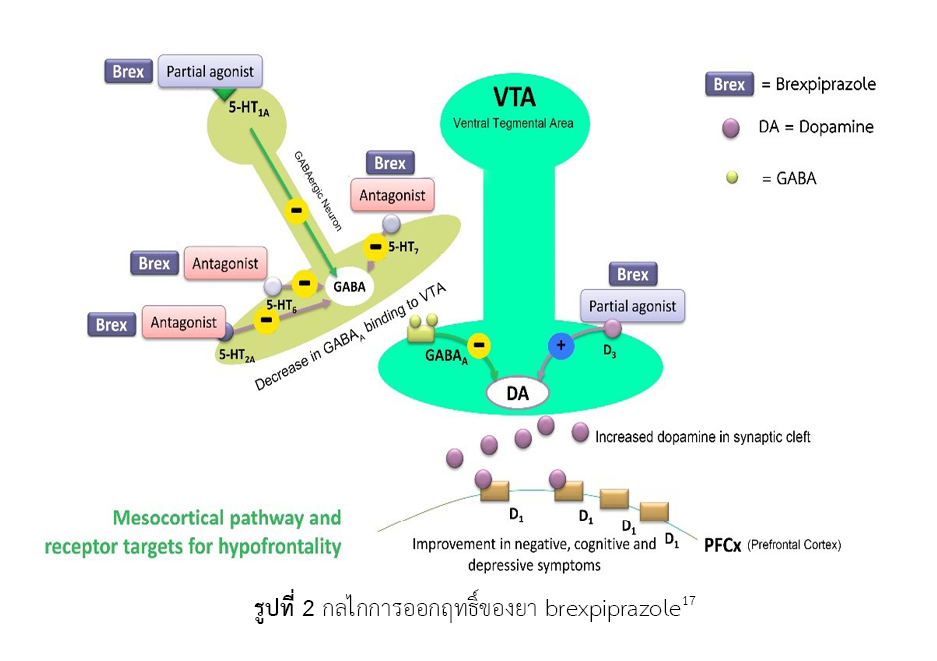
Brexpiprazole, a third-generation antipsychotic drug, was approved for the treatment of schizophrenia and as adjunctive treatment of major depressive disorder in 2015 by the US Food and Drug Administration. The drug is structurally and pharmacologically similar to aripiprazole. Its mechanism of action is serotonin-dopamine activity modulator. It has higher affinity to 5-HT1A, α1B, D2, 5-HT2A and α2C, but lower intrinsic activity at dopamine D2 receptor than aripiprazole. It was also found that brexpiprazole had low antimuscarinic activity. However, the efficacy of brexpiprazole is non-inferior compared with aripiprazole for improving positive and negative symptoms of schizophrenia. Some studies reported that brexpiprazole was better than aripiprazole at reducing impulsi–vity and showing some benefits of social function. In terms of safety, cardiometabolic effects, including weight gain, hypertriglyceridemia and hyperglycemia, are common adverse effects. Nevertheless, the incidence of extrapyramidal symptoms (EPS) and hyperprolactinemia are re–latively low. Compared to aripiprazole, patients treated with brexpiprazole were well tolerated as akathisia was lower. Hence, brexpiprazole is considered to be an alternative drug for trea–ting positive, negative, and cognitive symptoms in patients with acute and chronic schizophrenia, as well as for patients who are intolerant to adverse effects such as EPS, hyperprolactinemia from other antipsychotics.
References
Ashok AH, Baugh J, Yeragani VK. Paul Eugen Bleuler and the origin of the term schizophrenia (SCHIZOPRENIEGRUPPE). Indian J Psychiatry. 2012;54(1):95–6.
Fischer BA, Buchanan RW. Schizophrenia in adults: Epidemiology and pathogenesis [Internet]. UpToDate. 2021 [cited 2021 Jun 18]. Available from: https://www.uptodate.com/contents/schizophrenia-in-adults-epidemiology-and-pathogenesis
มาโนช หล่อตระกูล. บทที่ 11 โรคจิตเภทและโรคอื่นๆ. ใน มาโนช หล่อตระกูล, ปราโมทย์ สุคนิชย์, บรรณาธิการ. จิตเวชศาสตร์ รามาธิบดี. ฉบับพิมพ์ครั้งที่ 4. กรุงเทพฯ: ภาควิชาจิตเวชศาสตร์คณะแพทยศาสตร์โรงพยาบาลรามาธิบดี มหาวิทยาลัยมหิดล; 2558. หน้า 129-54.
Crismon ML, Argo TR, Buckley PF. Schizophrenia. In: DiPiro JT, Talbert RL, Yee GC, Matzke GR, Wells BG, Posey LM, editors. Pharmacotherapy: a pathophysiological approach. 9th ed. New York: McGraw-Hill Education; 2014. p.1019-45.
Stahl SM. Psychosis and schizophrenia. In: Stahl SM. Stahl’s Essential Psychopharmacology: Neuroscientific basic and practical applications. 4th ed. New York: Cambridge university press; 2013: 79-128.
ถนอมพงษ์ เสถียรลัคนา. Pharmacotherapy of schizophrenia. ศูนย์การศึกษาต่อเนื่องทางเภสัชศาสตร์ สภาเภสัชกรรม [อินเทอร์เน็ต]. 2559 [เข้าถึงเมื่อ 9 ธันวาคม 2564]. เข้าถึงได้จาก: https://ccpe.pharmacycouncil.org/index.php?option=article_detail&subpage=article_detail&id=161
American Psychiatric Association. Diagnostic and statistical manual of mental disorders, 5th edition (DSM-5). Washington, DC: American Psychiatric Publishing; 2013.
Morrison AK. Cognitive behavior therapy for people with schizophrenia. Psychiatry (Edgmont). 2009;6(12):32–9.
Divac N, Prostran M, Jakovcevski I, Cerovac N. Second-generation antipsychotics and extrapyramidal adverse effects. Biomed Res Int. 2014;2014:656370. doi:10.1155/2014/656370
Neuroscience Education Institute. Receptor Binding Profiles of Atypical Antipsychotics: Mechanisms of Therapeutic Actions and Adverse Side Effects [Internet]. 2012. [cited 2021 Jun 18]. Available from: http://cdn.neiglobal.com/content/practiceres/posters/50188_nei_009_bindings.pdf
Murray RM, Quattrone D, Natesan S, van Os J, Nordentoft M, Howes O, et al. Should psychiatrists be more cautious about the long-term prophylactic use of antipsychotics? Br J Psychiatry. 2016;209(5):361–5.
Uçok A, Gaebel W. Side effects of atypical antipsychotics: a brief overview. World Psychiatry. 2008;7(1):58–62.
Brexpiprazole [package insert]. Tokyo: Otsuka Pharmaceutical Co., Ltd.; 2018.
Wong DF, Raoufinia A, Bricmont P, Brašić JR, McQuade RD, Forbes RA, et al. An open-label, positron emission tomography study of the striatal D2/D3 receptor occupancy and pharmacokinetics of single-dose oral brexpiprazole in healthy participants. Eur J Clin Pharmacol. 2021;77(5):717–25.
Stahl SM. Mechanism of action of brexpiprazole: Comparison with aripiprazole. CNS Spectr. 2016;21(1):1–6.
Citrome L. The ABC’s of dopamine receptor partial agonists - aripiprazole, brexpiprazole and cariprazine: The 15-min challenge to sort these agents out. Int J Clin Pract [Internet]. 2015;69(11):1211–20.
Meesawatsom P. The ABC’s of Dopamine Receptor Partial Agonists. ในการประชุมวิชาการความก้าวหน้าทางเภสัชวิทยาของยาใหม่ ครั้งที่ 19; วันที่ 11 มิถุนายน 2564; ณ คณะเภสัชศาสตร์ มหาวิทยาลัยมหิดล. กรุงเทพมหานคร; 2564.
Kane JM, Skuban A, Ouyang J, Hobart M, Pfister S, McQuade RD, et al. A multicenter, randomized, double-blind, controlled phase 3 trial of fixed-dose brexpiprazole for the treatment of adults with acute schizophrenia. Schizophr Res. 2015;164(1–3):127–35.
Correll CU, Skuban A, Ouyang J, Hobart M, Pfister S, McQuade RD, et al. Efficacy and safety of brexpiprazole for the treatment of acute schizophrenia: A 6-week randomized, double-blind, placebo-controlled trial. Am J Psychiatry. 2015;172(9):870–80.
Meade N, Shi L, Meehan SR, Weiss C, Ismail Z. Efficacy and safety of brexpiprazole in patients with schizophrenia presenting with severe symptoms: Post-hoc analysis of short- and long-term studies. J Psychopharmacol. 2020;34(8):829–38.
Citrome L, Ota A, Nagamizu K, Perry P, Weiller E, Baker RA. The effect of brexpiprazole (OPC-34712) and aripiprazole in adult patients with acute schizophrenia: Results from a randomized, exploratory study. Int Clin Psychopharmacol. 2016;31(4):192–201.
Kishi T, Ikuta T, Matsuda Y, Sakuma K, Iwata N. Aripiprazole vs. brexpiprazole for acute schizophrenia: A systematic review and network meta-analysis. Psychopharmacology (Berl). 2020;237(5):1459–70.
Leucht S, Corves C, Arbter D, Engel RR, Li C, Davis JM. Second-generation versus first-generation antipsychotic drugs for schizophrenia: a meta-analysis. Lancet. 2009;373:31-41.
Stahl SM. Stahl's essential psychopharmacology: Prescriber's guide. 6th ed. New York: Cambridge university press; 2017.
Brexpiprazole: Drug information [Internet]: Micromedex. [cited 2021 Dec 9]. Available from: http://www.micromedexsolutions.com
Downloads
Published
How to Cite
Issue
Section
License
Copyright (c) 2022 Association of Hospital Pharmacy (Thailand)

This work is licensed under a Creative Commons Attribution-NonCommercial-NoDerivatives 4.0 International License.
บทความในวารสารเภสัชกรรมโรงพยาบาลเผยแพร่ภายใต้เงื่อนไขของสัญญาอนุญาตครีเอทีฟคอมมอนส์ในรูปแบบที่ต้องอ้างอิงแหล่งที่มา - ห้ามใช้เพื่อการค้า - ห้ามแก้ไขดัดแปลง เวอร์ชั่น 4.0 (CC BY-NC-ND 4.0) สามารถแจกจ่ายและนำบทความไปใช้ประโยชน์เพื่อการศึกษาได้แต่ต้องระบุการอ้างอิงถึงบทความจากเว็บไซต์วารสารเภสัชกรรมโรงพยาบาล ไม่สามารถนำบทความไปใช้เพื่อการพาณิชย์ใด ๆ เว้นแต่ได้รับอนุญาตจากบรรณาธิการวารสารเภสัชกรรมโรงพยาบาล และกรณีมีการนำบทความไปเรียบเรียงใหม่ เปลี่ยนแปลงเนื้อหา หรือเสริมเติมแต่งเนื้อหาของบทความ ท่านไม่สามารถนำบทความที่ปรับแต่งไปเผยแพร่ได้ในทุกกรณี
ข้อความที่ปรากฏในบทความในวารสารเป็นความคิดเห็นส่วนตัวของผู้แต่งแต่ละท่านไม่เกี่ยวข้องกับสมาคมเภสัชกรรมโรงพยาบาล (ประเทศไทย) และบุคลากรในสมาคมฯ แต่อย่างใด ความรับผิดชอบองค์ประกอบทั้งหมดของบทความแต่ละเรื่องเป็นของผู้แต่งแต่ละท่าน หากมีความผิดพลาดใด ๆ ผู้แต่งแต่ละท่านจะรับผิดชอบบทความของตนเอง ตลอดจนความรับผิดชอบด้านเนื้อหาและการตรวจร่างบทความเป็นของผู้แต่ง ไม่เกี่ยวข้องกับกองบรรณาธิการ


.png)

