
Hydrofluoric Acid
Keywords:
glass etching acid, hydrofluoric acid, calcium gluconateAbstract
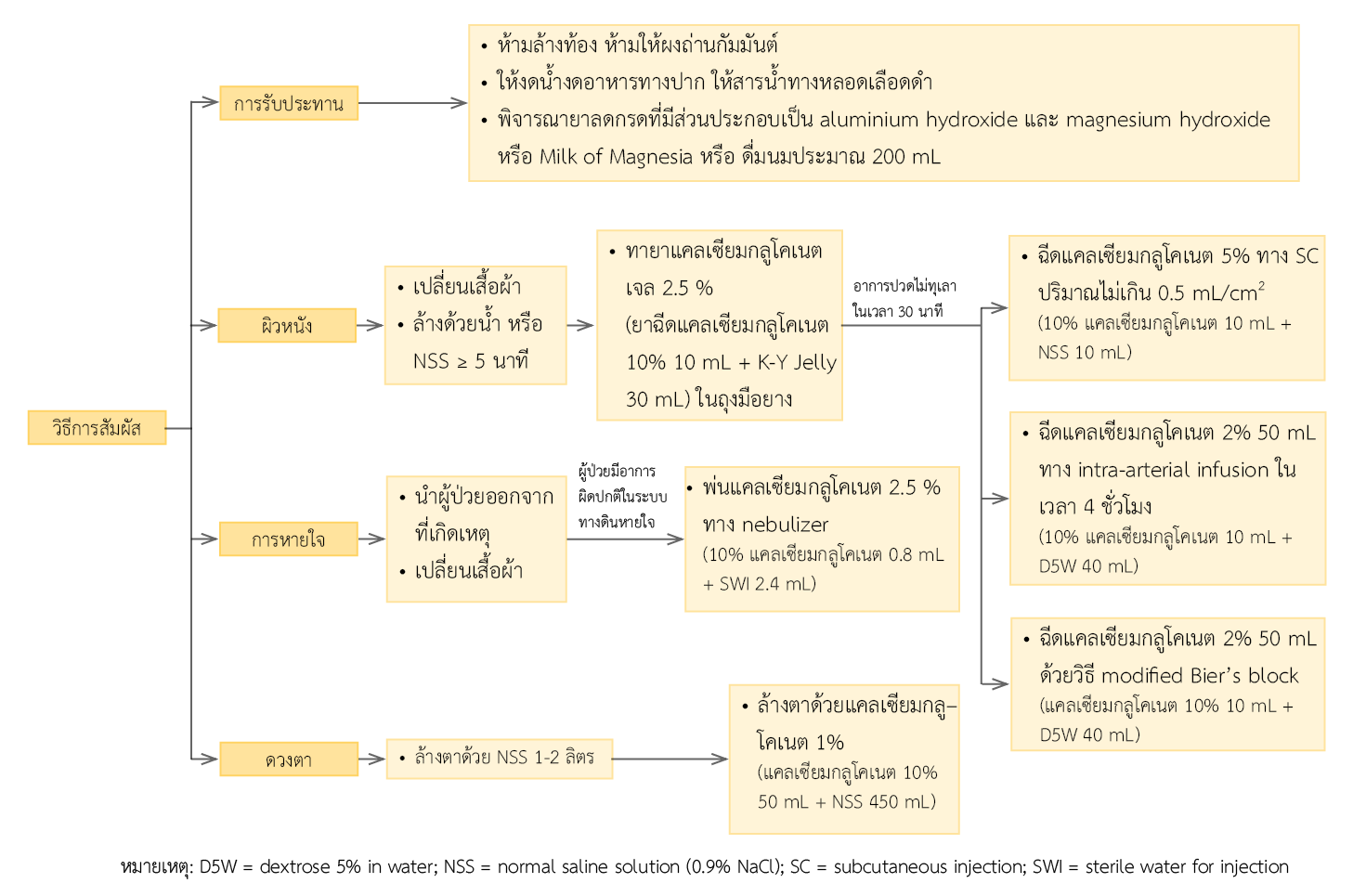
Hydrofluoric acid (glass etching acid) is a weak acid with a strong toxicity. Patients can be exposed to glass etching acid through various routes, including skin or eye exposure, inhalation and ingestion. Most patients exposed by skin exposure. Hydrofluoric acid is absorbed into the deeper tissues and broken down into hydrogen ions and fluoride ions. Fluoride ions avidly bind to blood calcium ions, resulting in low blood calcium levels and severe pain. The patients who exposed to hydrofluoric acid with a concentration greater than 20% over a wide area (> 2.5% of the body surface area) may develop systemic toxicity, which can be life-threatening. The antidote for treatment of hydrofluoric acid poisoning is calcium gluconate which can be prepared in an appropriate dosage form and strength for individual patient treatment. The skin lesions, electrocardiogram and serum electrolyte should be investigated in patients with hydrofluoric acid ingestion, extensive skin exposure and prolonged inhalation of hydrogen fluoride gas or hydrofluoric acid fumes. In the presence of abnormal electrocardiogram, intravenous calcium gluconate should be administered immediately without waiting for the results of blood electrolyte level test.
References
Richard HL, Larry W. Chemical of the month: Fluorine. J Chem Educ. 1983;60(9):759-61.
Su MK. Mushrooms. In: Nelson LS, Howland MA, Lewin NA, Smith SW, Goldfrank LR Hoffman RS, editors. Goldfrank’s toxicologic emergencies.11th ed. New York: McGraw-Hill Education; 2019. p. 1397-402.
สัมมน โฉมฉาย. ไฮโดรเจนฟลูออไรด์ และ Hydrofluoric acid. ใน: ธีระศิษฎ์ เฉินบำรุง, อมรรัตน์ สุขปั้น, บรรณาธิการ. การรักษาภาวะพิษสารเคมี 1. พิมพ์ครั้งที่ 1. กรุงเทพมหานคร: วี พลัส กรุ๊ป (ไทยแลนด์) จำกัด; 2559. หน้า 54-62.
Anthony JS, Carolyn MB. Hydrofluoric acid and other fluorides. In: Michael WS, Stephen WB, Michael JB, editors. Haddad and Winchester’s clinical management of poisoning and drug overdose. 4th ed. Philadelphia: Saunders/Elsevier; 2007. p. 1323-34.
MICROMEDEX®, POISINDEX® System. Hydrofluoric acid [Database on the internet]. Colorado: Thomson Reuters (Healthcare); c1974-2020. [cited 2021 Sep 16]. Available from: https://www.micromedexsolutions.com
Bajraktarova-Valjakova E, Korunoska-Stevkovska V, Georgieva S, Ivanovski K, Bajraktarova-Misevska C, Mijoska A, et al. Hydrofluoric acid: Burns and systemic toxicity, protective measures, immediate and hospital medical treatment. Maced J Med Sci. 2018;6(11):2257-69.
Gad SE, Sullivan DW. Hydrofluoric acid. In: Philip W, editor. Encyclopedia of toxicology. 3rd ed. Academic Press; 2014. p. 964-6.
Gad SE. Hydrofluoric acid. In: Philip W, editor. Encyclopedia of toxicology. 2nd ed. Academic Press; 2005. p. 542-3.
Public Health England. Hydrogen fluoride and hydrofluoric acid (HF) toxicological overview [Internet]. [cited 2021 Sep 15]. Available from: https://assets.publishing.service.gov.uk/government/uploads/system/uploads/attachment_data/file/761014/Hydrogen_fluoride_toxicological_overview.pdf
ชลัย ศรีสุข. อันตรายจากกรดกัดแก้ว. วารสารกรมวิทยาศาสตร์บริการ. 2544;49(156):15-6.
ศูนย์ความปลอดภัยอาชีวอนามัยและสิ่งแวดล้อม จุฬาลงกรณ์มหาวิทยาลัย. ข้อแนะนำในการทำงานกับกรดไฮโดรฟลูออริก (กรดกัดแก้ว) [อินเตอร์เน็ต]. [สืบค้นเมื่อ 15 กันยายน 2564]. สืบค้นจาก: https://www.shecu.chula.ac.th/home/content.asp?Cnt=604
Downloads
Published
How to Cite
Issue
Section
License
Copyright (c) 2022 Association of Hospital Pharmacy (Thailand)

This work is licensed under a Creative Commons Attribution-NonCommercial-NoDerivatives 4.0 International License.
บทความในวารสารเภสัชกรรมโรงพยาบาลเผยแพร่ภายใต้เงื่อนไขของสัญญาอนุญาตครีเอทีฟคอมมอนส์ในรูปแบบที่ต้องอ้างอิงแหล่งที่มา - ห้ามใช้เพื่อการค้า - ห้ามแก้ไขดัดแปลง เวอร์ชั่น 4.0 (CC BY-NC-ND 4.0) สามารถแจกจ่ายและนำบทความไปใช้ประโยชน์เพื่อการศึกษาได้แต่ต้องระบุการอ้างอิงถึงบทความจากเว็บไซต์วารสารเภสัชกรรมโรงพยาบาล ไม่สามารถนำบทความไปใช้เพื่อการพาณิชย์ใด ๆ เว้นแต่ได้รับอนุญาตจากบรรณาธิการวารสารเภสัชกรรมโรงพยาบาล และกรณีมีการนำบทความไปเรียบเรียงใหม่ เปลี่ยนแปลงเนื้อหา หรือเสริมเติมแต่งเนื้อหาของบทความ ท่านไม่สามารถนำบทความที่ปรับแต่งไปเผยแพร่ได้ในทุกกรณี
ข้อความที่ปรากฏในบทความในวารสารเป็นความคิดเห็นส่วนตัวของผู้แต่งแต่ละท่านไม่เกี่ยวข้องกับสมาคมเภสัชกรรมโรงพยาบาล (ประเทศไทย) และบุคลากรในสมาคมฯ แต่อย่างใด ความรับผิดชอบองค์ประกอบทั้งหมดของบทความแต่ละเรื่องเป็นของผู้แต่งแต่ละท่าน หากมีความผิดพลาดใด ๆ ผู้แต่งแต่ละท่านจะรับผิดชอบบทความของตนเอง ตลอดจนความรับผิดชอบด้านเนื้อหาและการตรวจร่างบทความเป็นของผู้แต่ง ไม่เกี่ยวข้องกับกองบรรณาธิการ


.png)

