
Dual Orexin Receptor Antagonists for Treatment of Insomnia: Review of Suvorexant and Lemborexant
Keywords:
insomnia, dual orexin receptor antagonists, suvorexant, lemborexantAbstract
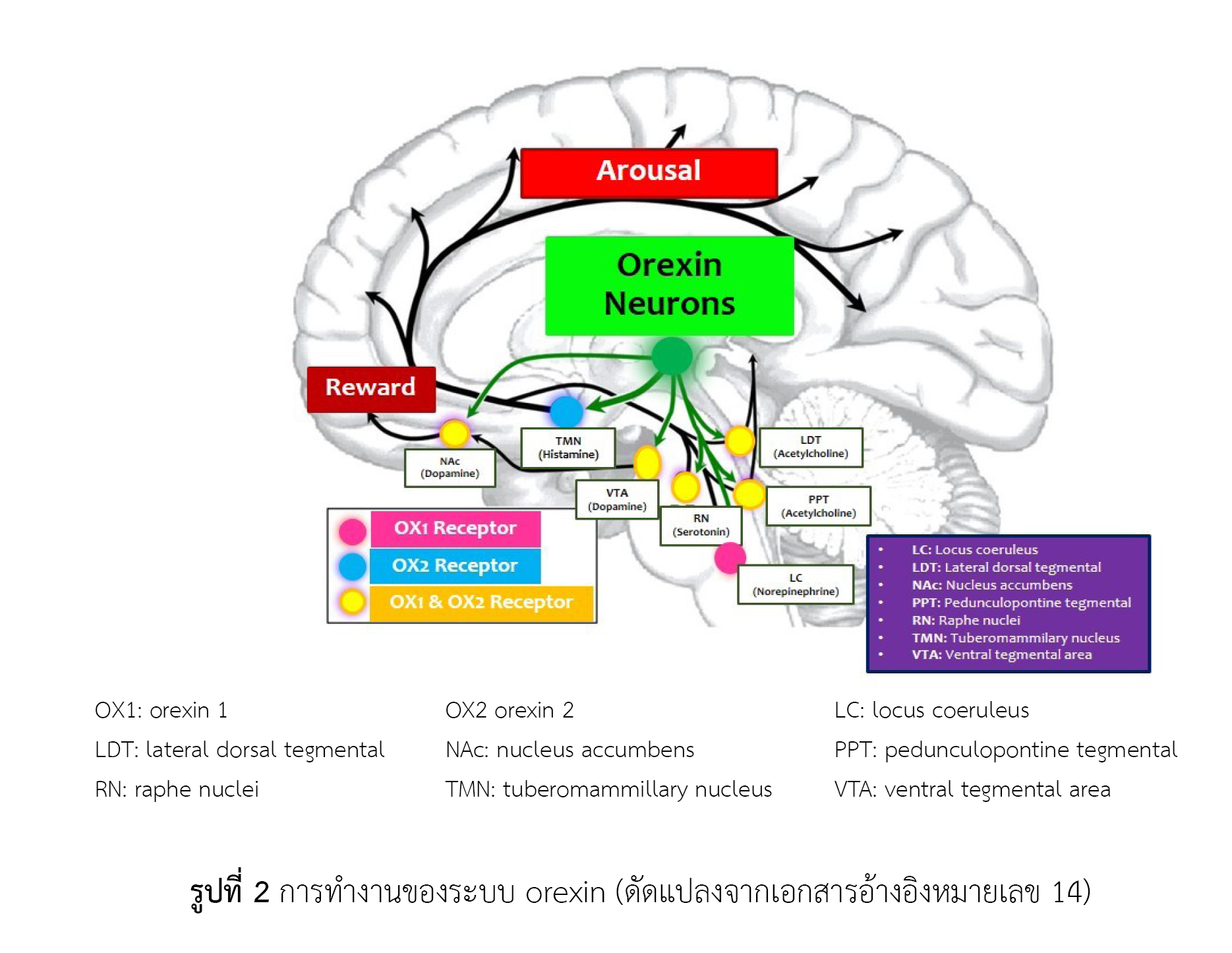
Insomnia is an important problem in healthcare systems since it affects quality of life, working, and increases risk of certain disease. Although, Benzodiazepines and non-benzodiazepine are the major classes of prescribed medication for insomnia, the long-term treatment is still questionable including drug dependence, complex sleep behavior, memory and learning impairment. The new class of medication for treatment of insomnia, dual orexin receptor antagonists, were proposed to promote sleep and decrease wakefulness via competitively binding to orexin 1 and orexin 2 receptor. Suvorexant and lemborexant are dual orexin receptor antagonists approved by U.S.FDA. for treatment of insomnia. The efficacy including deceased sleep onset latency and increased total sleep time were reported. Also, the effectiveness and safety over long-term treatment without dependence and withdrawal symptoms as well as no complex sleep behavioral were observed. The study suggested that efficacy and safety of dual orexin receptor antagonists were dose-related. Lemborexant presented superior efficacy with higher side-effect compared to suvorexant. In conclusion, suvorexant and lemborexant are an alternative treatment for insomnia, especially in people who suffered from the side-effect or had contraindicated of other sleep medication. However, the efficacy and safety of dual orexin receptor antagonist still needs further investigation.
References
Atkin T, Comai S, Gobbi G. Drugs for insomnia beyond benzodiazepines: pharmacology, clinical applications, and discovery. Pharmacol Rev. 2018;70(2):197–245.
American Psychiatric Association. Diagnostic and statistical manual of mental disorders. 5th ed (DSM-5). Washington, DC: American Psychiatric Publishing; 2013. p361-422.
Walsh JK, Coulouvrat C, Hajak G, Lakoma MD, Petukhova M, Roth T, et al. Nighttime insomnia symptoms and perceived health in the American Insomnia Survey (AIS). Sleep. 2011;34(8):997–1011.
Dopp JM, Phillips BG. Sleep disorders. In: DiPiro JT, Talbert RL, Yee GC, Matzke GR, Wells BG, Posey LM, editors. Pharmacotherapy: a pathophysiological approach. 9th ed. New York: McGraw-Hill Education; 2014. p.1115-26.
Neubauer DN, Pandi-Perumal SR, Spence DW, Buttoo K, Monti JM. Pharmacotherapy of insomnia. J Cent Nerv Syst Dis. 2018;10:1-7.
Wilson S, Anderson K, Baldwin D, Dijk D-J, Espie A, Espie C, et al. British Association for Psychopharmacology consensus statement on evidence-based treatment of insomnia, parasomnias and circadian rhythm disorders: an update. J Psychopharmacol. 2019;33(8):923–47.
FDA-Approved Drugs [Internet]. U.S. Food and Drug Administration; [cited 2022 Jan 26]. Available from: https://www.accessdata.fda.gov/scripts/cder/daf/index.cfm
Stahl SM. Stahl’s essential psychopharmacology: neuroscientific basis and practical applications. 5th ed. Cambridge, England: Cambridge University Press; 2021. p401-48.
Owens J, Gruber R, Brown T, Corkum P, Cortese S, O’Brien L, et al. Future research directions in sleep and ADHD: report of a consensus working group. J Atten Disord. 2013;17(7):550–64.
España RA, Scammell TE. Sleep neurobiology from a clinical perspective. Sleep. 2011;34(7):845–58.
Scammell TE, Winrow CJ. Orexin receptors: pharmacology and therapeutic opportunities. Annu Rev Pharmacol Toxicol. 2011;51(1):243–66.
Sakurai T. The neural circuit of orexin (hypocretin): maintaining sleep and wakefulness. Nat Rev Neurosci. 2007;8(3):171–81.
Kakizaki M, Tsuneoka Y, Takase K, Kim SJ, Choi J, Ikkyu A, et al. Differential roles of each orexin receptor signaling in obesity. iScience. 2019;20:1–13.
Gotter AL, Webber AL, Coleman PJ, Renger JJ, Winrow CJ. International union of basic and clinical pharmacology. LXXXVI. Orexin receptor function, nomenclature and pharmacology. Pharmacol Rev. 2012;64(3):389–420.
Equihua AC, De La Herrán-Arita AK, Drucker-Colin R. Orexin receptor antagonists as therapeutic agents for insomnia. Front Pharmacol. 2013;4:1-10.
Schutte-Rodin S, Broch L, Buysse D, Dorsey C, Sateia M. Clinical guideline for the evaluation and management of chronic insomnia in adults. J Clin Sleep Med. 2008;4(5):487–504.
Fekedulegn D, Andrew ME, Shi M, Violanti JM, Knox S, Innes KE. Actigraphy-based assessment of sleep parameters. Ann Work Expo Health. 2020;64(4):350–67.
Norman JL, Anderson SL. Novel class of medications, orexin receptor antagonists, in the treatment of insomnia - critical appraisal of suvorexant. Nat Sci Sleep. 2016;8:239–47.
Beuckmann CT, Suzuki M, Ueno T, Nagaoka K, Arai T, Higashiyama H. In vitro and in silico characterization of lemborexant (E2006), a novel dual orexin receptor antagonist. J Pharmacol Exp Ther. 2017;362(2):287-95.
Patel KV, Aspesi AV, Evoy KE. Suvorexant: a dual orexin receptor antagonist for the treatment of sleep onset and sleep maintenance insomnia. Ann Pharmacother. 2015;49(4):477–83.
Lexicomp. Suvorexant: Drug information [Internet]. UpToDate; [cited 2022 Jan 26]. Available from: https://www.uptodate.com/contents/suvorexant-drug-information , https://www.merck.com/product/usa/pi_circulars/b/belsomra/belsomra_pi.pdf
BELSOMRA® (suvorexant) prescribing information [Internet]. Merck & Co., Inc.; 2021 [cited 2022 Jan 31]. Available from: https://www.merck.com/product/usa/pi_circulars/b/belsomra/belsomra_pi.pdf
Sutton EL. Profile of suvorexant in the management of insomnia. Drug Des Devel Ther. 2015;9:6035–42.
Herring WJ, Connor KM, Ivgy-May N, Snyder E, Liu K, Snavely DB, et al. Suvorexant in patients with insomnia: results from two 3-month randomized controlled clinical trials. Biol Psychiatry. 2016;79(2):136–48.
Michelson D, Snyder E, Paradis E, Chengan-Liu M, Snavely DB, Hutzelmann J, et al. Safety and efficacy of suvorexant during 1-year treatment of insomnia with subsequent abrupt treatment discontinuation: a phase 3 randomised, double-blind, placebo-controlled trial. Lancet Neurol. 2014;13(5):461–71.
Scott LJ. Lemborexant: first approval. Drugs. 2020;80(4):425–32.
Neubauer DN. Lemborexant for insomnia. Current Psychiatry. 2020;19(11):43-9.
Rosenberg R, Murphy P, Zammit G, Mayleben D, Kumar D, Dhadda S, et al. Comparison of lemborexant with placebo and zolpidem tartrate extended release for the treatment of older adults with insomnia disorder: a phase 3 randomized clinical trial. JAMA Netw Open. 2019;2(12):e1918254. doi: 10.1001/jamanetworkopen.2019.18254.
Kärppä M, Yardley J, Pinner K, Filippov G, Zammit G, Moline M, et al. Long-term efficacy and tolerability of lemborexant compared with placebo in adults with insomnia disorder: results from the phase 3 randomized clinical trial SUNRISE 2. Sleep. 2020;43(9):1-11.
Yardley J, Kärppä M, Inoue Y, Pinner K, Perdomo C, Ishikawa K, et al. Long-term effectiveness and safety of lemborexant in adults with insomnia disorder: results from a phase 3 randomized clinical trial. Sleep Med. 2021;80:333–42.
DAYVIGO® (lemborexant) prescribing information [Internet]. Eisai Inc; 2021 [cited 2022 Jan 31]. Available from: https://www.dayvigo.com/-/media/Files/DAYVIGO/PDF/prescribing-information.pdf
Lexicomp. Lemborexant: drug information [Internet]. Uptodate; [cited 2022 Jan 26]. Available from: https://www.uptodate.com/contents/lembolexant-drug-information
Kishi T, Nomura I, Matsuda Y, Sakuma K, Okuya M, Ikuta T, et al. Lemborexant vs suvorexant for insomnia: a systematic review and network meta-analysis. J Psychiatr Res. 2020;128:68–74.
Downloads
Published
How to Cite
Issue
Section
License
Copyright (c) 2022 Association of Hospital Pharmacy (Thailand)

This work is licensed under a Creative Commons Attribution-NonCommercial-NoDerivatives 4.0 International License.
บทความในวารสารเภสัชกรรมโรงพยาบาลเผยแพร่ภายใต้เงื่อนไขของสัญญาอนุญาตครีเอทีฟคอมมอนส์ในรูปแบบที่ต้องอ้างอิงแหล่งที่มา - ห้ามใช้เพื่อการค้า - ห้ามแก้ไขดัดแปลง เวอร์ชั่น 4.0 (CC BY-NC-ND 4.0) สามารถแจกจ่ายและนำบทความไปใช้ประโยชน์เพื่อการศึกษาได้แต่ต้องระบุการอ้างอิงถึงบทความจากเว็บไซต์วารสารเภสัชกรรมโรงพยาบาล ไม่สามารถนำบทความไปใช้เพื่อการพาณิชย์ใด ๆ เว้นแต่ได้รับอนุญาตจากบรรณาธิการวารสารเภสัชกรรมโรงพยาบาล และกรณีมีการนำบทความไปเรียบเรียงใหม่ เปลี่ยนแปลงเนื้อหา หรือเสริมเติมแต่งเนื้อหาของบทความ ท่านไม่สามารถนำบทความที่ปรับแต่งไปเผยแพร่ได้ในทุกกรณี
ข้อความที่ปรากฏในบทความในวารสารเป็นความคิดเห็นส่วนตัวของผู้แต่งแต่ละท่านไม่เกี่ยวข้องกับสมาคมเภสัชกรรมโรงพยาบาล (ประเทศไทย) และบุคลากรในสมาคมฯ แต่อย่างใด ความรับผิดชอบองค์ประกอบทั้งหมดของบทความแต่ละเรื่องเป็นของผู้แต่งแต่ละท่าน หากมีความผิดพลาดใด ๆ ผู้แต่งแต่ละท่านจะรับผิดชอบบทความของตนเอง ตลอดจนความรับผิดชอบด้านเนื้อหาและการตรวจร่างบทความเป็นของผู้แต่ง ไม่เกี่ยวข้องกับกองบรรณาธิการ


.png)

