
Clinical Characteristics, Prolactin Level and Management of Psychotropic Drug-Induced Hyperprolactinemia
Keywords:
prolactin level, psychotropic medications, hyperprolactinemia, managementAbstract
Background: Hyperprolactinemia is a common adverse drug reaction from antipsychotics in psychiatric patients.
Objectives: The study aims to assess clinical presentation and outcomes of management of hyperprolactinemia.
Method: A cross-sectional analytical study in psychiatric patients with symptom of hyperprolactinemia after being treated with antipsychotics was conducted. Patients were recruited using hyperprolactinemia symptom-based questionnaire, we developed. Blood prolactin level were measured before and after receiving management of hyperprolactinemia.
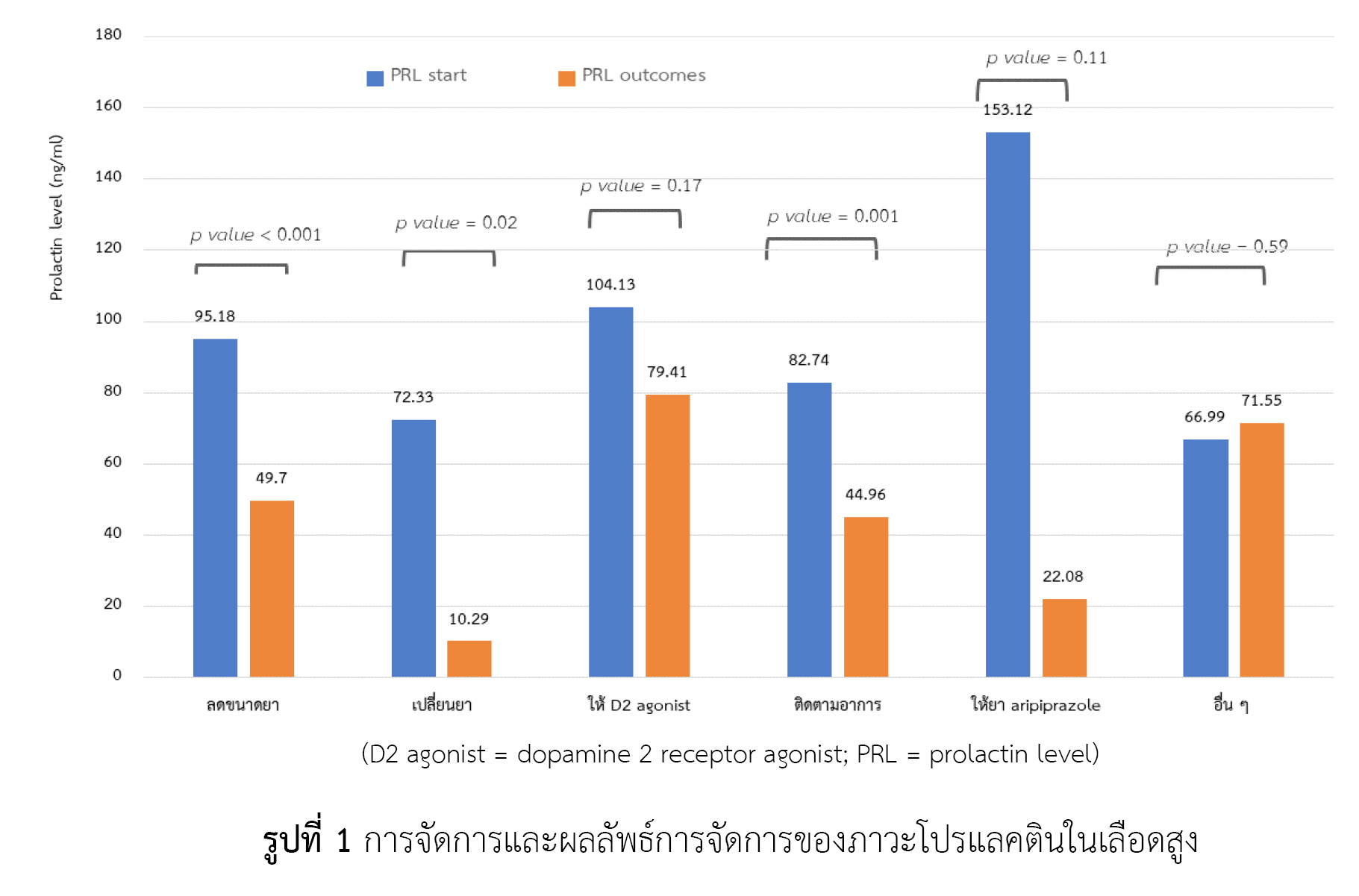
Results: In total, 127 patients were enrolled and 109 patients had hyperprolactinemia (85.83%). The most common hyperprolactinemia symptom was menstrual irregularities, which was found in 84 patients (77.06%). High average blood prolactin level was found in patients who received amisulpride, paliperidone and combination of typical and atypical antipsychotics, consecutively. The strategies for managing of hyperprolactinemia was decreasing the dose of causing drug (p-value < 0.001), switching to prolactin-sparing antipsychotic (p-value = 0.02) and using the same dose together with monitoring (p-value = 0.001)
Conclusions: Antipsychotics can cause hyperprolactinemia in psychiatric patients. The most common presenting symptom was menstrual irregularities. Many strategies for management of hyperprolactinemia can significantly lower blood prolactin level. Guidance for monitoring and management of hyperprolactinemia in psychiatric patients should be developed and implement.
References
Madhusoodanan S, Parida S, Jimenez C. Hyperprolactinemia associated with psychotropics--a review. Hum Psychopharmacol. 2010;25(4):281-97.
Fitzgerald P, Dinan TG. Prolactin and dopamine: What is the connection? A review article. J Psychopharmacol. 2008;22(2 Suppl):12-9.
Tewksbury A, Olander A. Management of antipsychotic-induced hyperprolactinemia. Ment Health Clin. 2016;6(4):185-90.
Bushe C, Shaw M, Peveler RC. A review of the association between antipsychotic use and hyperprolactinaemia. J Psychopharmacol. 2008;22(2 Suppl):46-55.
Byerly M, Suppes T, Tran QV, Baker RA. Clinical implications of antipsychotic-induced hyperprolactinemia in patients with schizophrenia spectrum or bipolar spectrum disorders: recent developments and current perspectives. J Clin Psychopharmacol. 2007;27(6):639-61.
Holt RI, Peveler RC. Antipsychotics and hyperprolactinaemia: mechanisms, consequences and management. Clin Endocrinol (Oxf). 2011;74(2):141-7.
Peuskens J, Pani L, Detraux J, De Hert M. The effects of novel and newly approved antipsychotics on serum prolactin levels: a comprehensive review. CNS Drugs. 2014;28(5):421-53.
Grigg J, Worsley R, Thew C, Gurvich C, Thomas N, Kulkarni J. Antipsychotic-induced hyperprolactinemia: synthesis of world-wide guidelines and integrated recommendations for assessment, management and future research. Psychopharmacology (Berl). 2017;234(22):3279-97.
Rusgis MM, Alabbasi AY, Nelson LA. Guidance on the treatment of antipsychotic-induced hyperprolactinemia when switching the antipsychotic is not an option. Am J Health Syst Pharm. 2021;78(10):862-71.
Dehelean L, Romosan AM, Papava I, Bredicean CA, Dumitrascu V, Ursoniu S, et al. Prolactin response to antipsychotics: an inpatient study. PLoS One. 2020;15(2):e0228648. doi: 10.1371/journal.pone.0228648.
Alosaimi FD, Fallata EO, Abalhassan M, Alhabbad A, Alzain N, Alhaddad B, et al. Prevalence and risk factors of hyperprolactinemia among patients with various psychiatric diagnoses and medications. Int J Psychiatry Clin Pract. 2018;22(4):274-81.
Walters J, Jones I. Clinical questions and uncertainty--prolactin measurement in patients with schizophrenia and bipolar disorder. J Psychopharmacol. 2008;22(2 Suppl):82-9.
Kelly DL, Conley RR. A randomized double-blind 12-week study of quetiapine, risperidone or fluphenazine on sexual functioning in people with schizophrenia. Psychoneuroendocrinology. 2006;31(3):340-6.
Roke Y, Buitelaar JK, Boot AM, Tenback D, van Harten PN. Risk of hyperprolactinemia and sexual side effects in males 10-20 years old diagnosed with autism spectrum disorders or disruptive behavior disorder and treated with risperidone. J Child Adolesc Psychopharmacol. 2012;22(6):432-9.
Bargiota SI, Bonotis KS, Messinis IE, Angelopoulos NV. The effects of antipsychotics on prolactin levels and women's menstruation. Schizophr Res Treatment. 2013;2013:502697. doi: 10.1155/2013/502697.
Glocker C, Grohmann R, Engel R, Seifert J, Bleich S, Stübner S, et al. Galactorrhea during antipsychotic treatment: results from AMSP, a drug surveillance program, between 1993 and 2015. Eur Arch Psychiatry Clin Neurosci. 2021;271(8):1425-35.
Rettenbacher MA, Hofer A, Ebenbichler C, Baumgartner S, Edlinger M, Engl J, et al. Prolactin levels and sexual adverse effects in patients with schizophrenia during antipsychotic treatment. J Clin Psychopharmacol. 2010;30(6):711-5.
Redman B, Kitchen C, Johnson KW, Bezwada P, Kelly DL. Levels of prolactin and testosterone and associated sexual dysfunction and breast abnormalities in men with schizophrenia treated with antipsychotic medications. J Psychiatr Res. 2021;143:50-3.
Kopecek M, Bares M, Svarc J, Dockery C, Horácek J. Hyperprolactinemia after low dose of amisulpride. Neuro Endocrinol Lett. 2004;25(6):419-22.
Skopek M, Manoj P. Hyperprolactinaemia during treatment with paliperidone. Australas Psychiatry. 2010;18(3):261-3.
Kearns AE, Goff DC, Hayden DL, Daniels GH. Risperidone-associated hyperprolactinemia. Endocr Pract. 2000;6(6):425-9.
Stojkovic M, Radmanovic B, Jovanovic M, Janjic V, Muric N, Ristic DI. Risperidone induced hyperprolactinemia: from basic to clinical studies. Front Psychiatry. 2022;13:874705. doi: 10.3389/fpsyt.2022.874705.
Gupta S, Lakshmanan DAM, Khastgir U, Nair R. Management of antipsychotic-induced hyperprolactinaemia. BJPsych Advances. 2017;23(4):278-86.
Labad J, Montalvo I, González-Rodríguez A, García-Rizo C, Crespo-Facorro B, Monreal JA, et al. Pharmacological treatment strategies for lowering prolactin in people with a psychotic disorder and hyperprolactinaemia: a systematic review and meta-analysis. Schizophr Res. 2020;222:88-96.
Navy H, Gardner K. Strategies for managing medication-induced hyperprolactinemia. Current Psychiatry. 2018;17(3):42-7.
Downloads
Published
How to Cite
Issue
Section
License
Copyright (c) 2022 Association of Hospital Pharmacy (Thailand)

This work is licensed under a Creative Commons Attribution-NonCommercial-NoDerivatives 4.0 International License.
บทความในวารสารเภสัชกรรมโรงพยาบาลเผยแพร่ภายใต้เงื่อนไขของสัญญาอนุญาตครีเอทีฟคอมมอนส์ในรูปแบบที่ต้องอ้างอิงแหล่งที่มา - ห้ามใช้เพื่อการค้า - ห้ามแก้ไขดัดแปลง เวอร์ชั่น 4.0 (CC BY-NC-ND 4.0) สามารถแจกจ่ายและนำบทความไปใช้ประโยชน์เพื่อการศึกษาได้แต่ต้องระบุการอ้างอิงถึงบทความจากเว็บไซต์วารสารเภสัชกรรมโรงพยาบาล ไม่สามารถนำบทความไปใช้เพื่อการพาณิชย์ใด ๆ เว้นแต่ได้รับอนุญาตจากบรรณาธิการวารสารเภสัชกรรมโรงพยาบาล และกรณีมีการนำบทความไปเรียบเรียงใหม่ เปลี่ยนแปลงเนื้อหา หรือเสริมเติมแต่งเนื้อหาของบทความ ท่านไม่สามารถนำบทความที่ปรับแต่งไปเผยแพร่ได้ในทุกกรณี
ข้อความที่ปรากฏในบทความในวารสารเป็นความคิดเห็นส่วนตัวของผู้แต่งแต่ละท่านไม่เกี่ยวข้องกับสมาคมเภสัชกรรมโรงพยาบาล (ประเทศไทย) และบุคลากรในสมาคมฯ แต่อย่างใด ความรับผิดชอบองค์ประกอบทั้งหมดของบทความแต่ละเรื่องเป็นของผู้แต่งแต่ละท่าน หากมีความผิดพลาดใด ๆ ผู้แต่งแต่ละท่านจะรับผิดชอบบทความของตนเอง ตลอดจนความรับผิดชอบด้านเนื้อหาและการตรวจร่างบทความเป็นของผู้แต่ง ไม่เกี่ยวข้องกับกองบรรณาธิการ


.png)

