Effectiveness of Development of Medication Errors Reporting System in Middle Size Hospital
Keywords:
medication error reports, medication errors reporting system, accuracy of medication error reportsAbstract
Background: The appropriate medication error reporting system can promote the accuracy of reports.
Objectives: To evaluate the effectiveness of the medication error reporting system after a renovation at the 50th Anniversary Mahavajiralongkorn Hospital.
Method: This action research compared the accuracy rate of medication error reports between a pre-renovative system between October 2019 and May 2020 and a post-renovative system between February 2021 and May 2021. The data was analyzed by descriptive statistics and compared the accuracy rate between pre- and post-renovation by inferential statistics independent Chi-squared test.
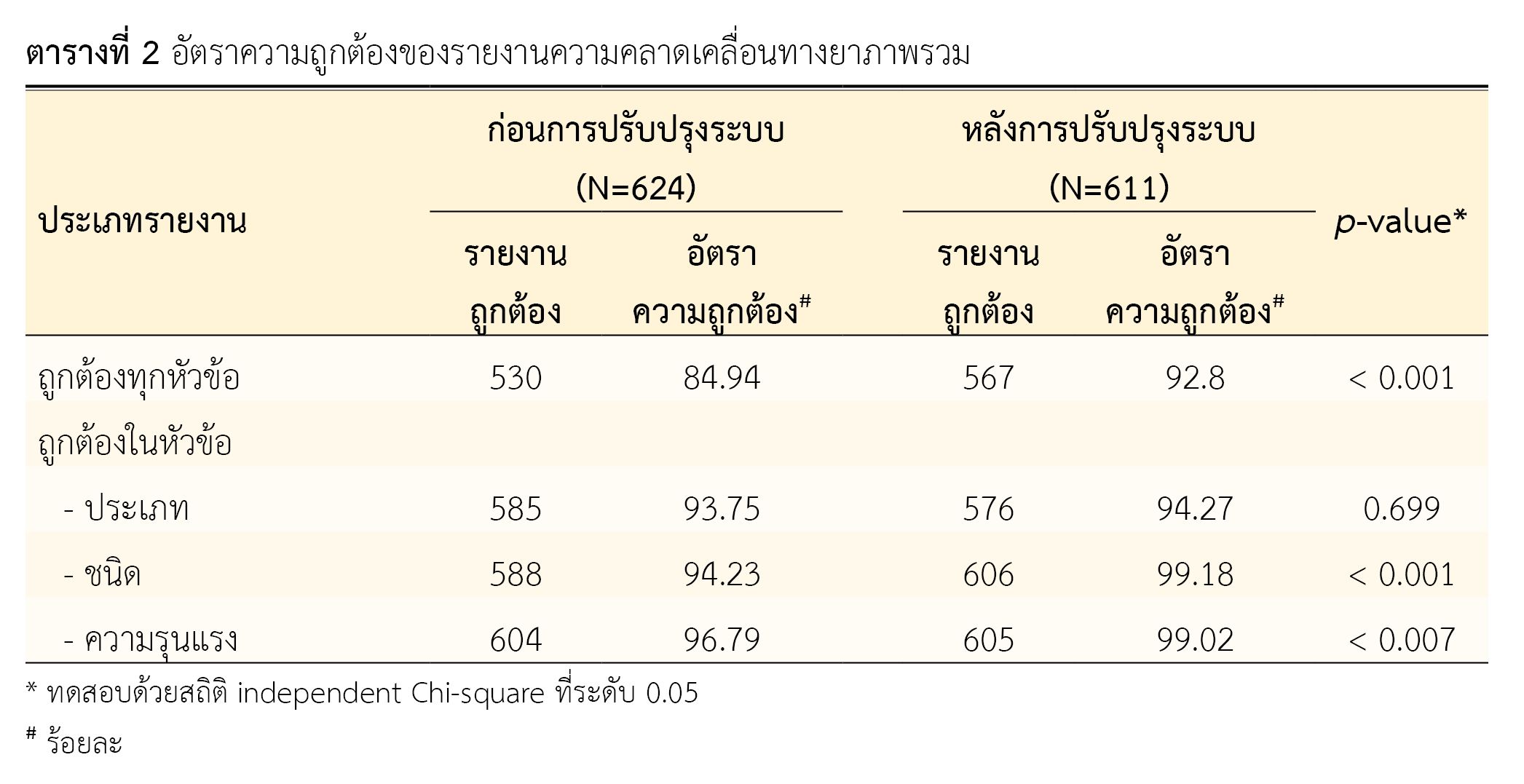
Results: The medication error reports during pre- and post-renovation were 624 and 611, respectively. Of these, the accuracy rate of medication error reporting increased from 84.94% to 92.80% (p-value < 0.001). The accuracy rate was further classified by domain of report and found to be increased in the domain of “types” (94.23% to 99.18%; p-value < 0.001), and “severity” (96.79% to 99.02%; p-value < 0.007). Whereas the “subject” domain had no significant difference (93.75% to 94.27%; p-value = 0.699). The accuracy rate of report by pharmacist was increased from 92.98% to 98.79% (p-value < 0.001), while this rate declined from 71.96% to 66.66% (p-value = 0.308) in the report by nurse but it was not statistically significant. Moreover, the accuracy rate of report after renovation of the system was higher during the office hours when compared with the out of office hours (93.79% vs. 86.25%; p-value = 0.015)
Conclusion: The renovation of medication error reporting system at the 50th Anniversary Mahavajiralongkorn Hospital can help in increasing the accuracy rate of report.
References
จันทร์จารึก รัตนเดชสกุล, ภาสกร รัตนเดชสกุล. ความคลาดเคลื่อนทางยา (medication error) กับการใช้ประโยชน์ในระบบจัดการด้านยา [อินเทอร์เน็ต]. นนทบุรี: ศูนย์การศึกษาต่อเนื่องทางเภสัชศาสตร์ สภาเภสัชกรรม; 2560 [สืบค้นเมื่อ 24 ส.ค. 2562]. สืบค้นจาก: https://ccpe.pharmacycouncil.org/index.php?option=article_detail&subpage=article_detail&id=303
Rodziewicz TL, Houseman B, Hipskind JE. Medical error reduction and prevention. In: StatPearls [Internet]. Treasure Island (FL): StatPearls Publishing; 2022 [cited 2022 Aug 24]. Available from: https://www.ncbi.nlm.nih.gov/books/NBK499956/
เรวดี ศิรินคร. ประสบการณ์การเยี่ยมสำรวจเรื่องการบริหารยา. ใน: ธิดา นิงสานนท์, ปรีชา มนทกานติกุล, สุวัฒนา จุฬาวัฒนทล, บรรณาธิการ. การบริหารยาเพื่อความปลอดภัยของผู้ป่วย. พิมพ์ครั้งที่ 3. กรุงเทพฯ: สมาคมเภสัชกรรมโรงพยาบาล (ประเทศไทย); 2554. หน้า 27-32.
ปัญญฉัตร ซอสุขไพบูลย์. ระบบรายงานความคลาดเคลื่อนทางยาจากโปรแกรมคอมพิวเตอร์ที่พัฒนาขึ้นในโรงพยาบาลขนาดใหญ่แห่งหนึ่ง. วารสารเภสัชกรรมไทย [อินเทอร์เน็ต]. 2555 [สืบค้นเมื่อ 10 ต.ค. 2564];4(1):3-16. สืบค้นจาก: https://he01.tci-thaijo.org/index.php/TJPP/article/view/169294
เพียงเพ็ญ ชนาเทพาพร. การพัฒนาโปรแกรมเพื่อรายงานผลความคลาดเคลื่อนการสั่งใช้ยาของโรงพยาบาลศรีนครินทร์. ศรีนครินทร์เวชสาร [อินเทอร์เน็ต]. 2562 [สืบค้นเมื่อ 29 มิถุนายน 2563];34(3):261-70. สืบค้นจาก: http://thaidj.org/index.php/SMNJ/article/view/6494.
Sharma SK, Mudgal SK, Thakur K, Gaur R. How to calculate sample size for observational and experimental nursing research studies? Natl J Physiol Pharm Pharmacol. 2020;10(1):1-8. doi: 10.5455/njppp.2020.10.0930717102019.
Alshaikh M, Mayet A, Aljadhey H. Medication error reporting in a university teaching hospital in Saudi Arabia. J Patient Saf. 2013;9(3):145-9. doi: 10.1097/PTS.0b013e3182845044.
เปรมวดี ศิริวิวัฒนานนท์, มณีรัตน์ รัตนามหัทธนะ. ความตั้งใจที่จะรายงานและเหตุผลที่ไม่รายงานความคลาดเคลื่อนทางยาของบุคลากรทางการแพทย์: กรณีศึกษาโรงพยาบาลประจำจังหวัดแห่งหนึ่งในประเทศไทย. วารสารเภสัชศาสตร์อีสาน. 2556;9(3):43-52. doi: 10.14456/ijps.2013.19.
Rutledge DN, Retrosi T, Ostrowski G. Barriers to medication error reporting among hospital nurses. J Clin Nurs. 2018;27(9-10):1941-9. doi: 10.1111/jocn.14335.
Kim KS, Kwon SH, Kim JA, Cho S. Nurses' perceptions of medication errors and their contributing factors in South Korea. J Nurs Manag. 2011;19(3):346-53. doi: 10.1111/j.1365-2834.2011.01249.x.
Kim J, An K, Kim MK, Yoon SH. Nurses' perception of error reporting and patient safety culture in Korea. West J Nurs Res. 2007;29(7):827-44. doi: 10.1177/0193945906297370.
Aseeri M, Banasser G, Baduhduh O, Baksh S, Ghalibi N. Evaluation of medication error incident reports at a tertiary care hospital. Pharmacy (Basel). 2020;8(2):69. doi: 10.3390/pharmacy8020069.
Nguyen HT, Nguyen TD, van den Heuvel ER, Haaijer-Ruskamp FM, Taxis K. Medication errors in vietnamese hospitals: prevalence, potential outcome and associated factors. PLoS One. 2015;10(9):e0138284. doi: 10.1371/journal.pone.0138284.
Zeraatchi A, Talebian MT, Nejati A, Dashti-Khavidaki S. Frequency and types of the medication errors in an academic emergency department in Iran: the emergent need for clinical pharmacy services in emergency departments. J Res Pharm Pract. 2013;2(3):118-22. doi: 10.4103/2279-042X.122384.
Downloads
Published
How to Cite
Issue
Section
License
Copyright (c) 2023 Association of Hospital Pharmacy (Thailand)

This work is licensed under a Creative Commons Attribution-NonCommercial-NoDerivatives 4.0 International License.
บทความในวารสารเภสัชกรรมโรงพยาบาลเผยแพร่ภายใต้เงื่อนไขของสัญญาอนุญาตครีเอทีฟคอมมอนส์ในรูปแบบที่ต้องอ้างอิงแหล่งที่มา - ห้ามใช้เพื่อการค้า - ห้ามแก้ไขดัดแปลง เวอร์ชั่น 4.0 (CC BY-NC-ND 4.0) สามารถแจกจ่ายและนำบทความไปใช้ประโยชน์เพื่อการศึกษาได้แต่ต้องระบุการอ้างอิงถึงบทความจากเว็บไซต์วารสารเภสัชกรรมโรงพยาบาล ไม่สามารถนำบทความไปใช้เพื่อการพาณิชย์ใด ๆ เว้นแต่ได้รับอนุญาตจากบรรณาธิการวารสารเภสัชกรรมโรงพยาบาล และกรณีมีการนำบทความไปเรียบเรียงใหม่ เปลี่ยนแปลงเนื้อหา หรือเสริมเติมแต่งเนื้อหาของบทความ ท่านไม่สามารถนำบทความที่ปรับแต่งไปเผยแพร่ได้ในทุกกรณี
ข้อความที่ปรากฏในบทความในวารสารเป็นความคิดเห็นส่วนตัวของผู้แต่งแต่ละท่านไม่เกี่ยวข้องกับสมาคมเภสัชกรรมโรงพยาบาล (ประเทศไทย) และบุคลากรในสมาคมฯ แต่อย่างใด ความรับผิดชอบองค์ประกอบทั้งหมดของบทความแต่ละเรื่องเป็นของผู้แต่งแต่ละท่าน หากมีความผิดพลาดใด ๆ ผู้แต่งแต่ละท่านจะรับผิดชอบบทความของตนเอง ตลอดจนความรับผิดชอบด้านเนื้อหาและการตรวจร่างบทความเป็นของผู้แต่ง ไม่เกี่ยวข้องกับกองบรรณาธิการ


.png)

