
Drug Compliance and Adverse Reactions of Favipiravir in Patients with Mild Coronavirus Disease 2019 in Self-Isolation System
Keywords:
favipiravir, self-isolation, telepharmacy, coronavirus disease 2019Abstract
Background: Favipiravir is an antiviral drug used in Thailand to treat coronavirus disease 2019. Since it is a new drug with complicated administration regimen, monitoring of patients receiving this drug is required.
Objective: This study monitored drug compliance and assessed adverse drug reactions of favipiravir.
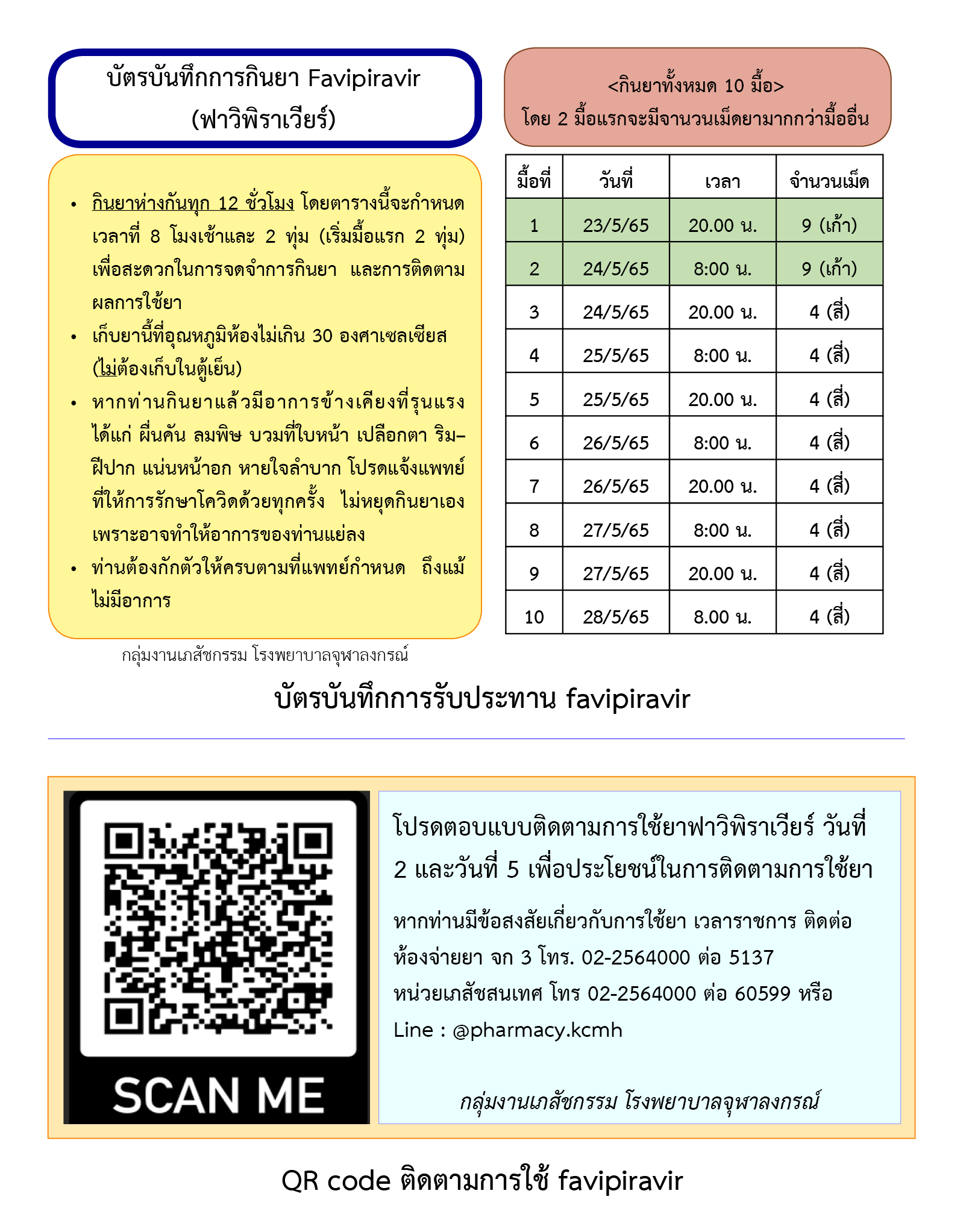
Method: This descriptive study was conducted retrospectively in patients infected with coronavirus disease 2019 who received favipiravir and participated in the self-isolation program. Medication record card and QR code for the Google Form (G-form) questionnaire were given to patients. The pharmacy department’s LINE contact was also added to patients’ contact list. Patient monitoring employed combined method of G-form questionnaire and telepharmacy to collect information from patients, while patients’ basic information, vaccination record, and underlying disease were provided by the hospital’s database.
Result: Out of 410 eligible patients, 56 were excluded due to loss of follow-up, leaving 354 patients. The mean age was 36.9 years with standard derivation of 16.1 years. The 215 patients (60.7%) were female. Patients who fell under the 608-group comprised of 24 patients (6.8%) of age 60 years or older, 10 patients (2.8%) with chronic respiratory diseases, 3 patients (0.9%) with cardiovascular disease, 70 patients (19.8%) with obesity (BMI >30 kg/m2), 2 patients (0.6%) with cancer, and 10 patients (2.8%) with diabetes. Patient monitoring found that 308 patients (87%) had good drug compliance, while 46 patients (13%) had poor compliance. The most common adverse effects reported were nausea (20 cases, 5.6%), anorexia (20 cases, 5.6%), and diarrhea (19 cases, 5.4%). Four patients developed rash that required drug discontinuation.
Conclusion: The combined method of adherence monitoring is an effective tool that enables quick and appropriate assessment and management of adverse effects.
References
คณะทำงานด้านการรักษาพยาบาลและการป้องกันการติดเชื้อในโรงพยาบาล กรมการแพทย์ กระทรวงสาธารณสุข ร่วมกับ คณาจารย์ผู้เชี่ยวชาญ จากคณะแพทยศาสตร์ มหาวิทยาลัยต่าง ๆ (คณะกรรมการกำกับดูแลรักษาโควิด-19). แนวทางเวชปฏิบัติ การวินิจฉัย ดูแลรักษา และป้องกันการติดเชื้อในโรงพยาบาล กรณีโรคติดเชื้อไวรัสโคโรนา 2019 (COVID-19) สำหรับแพทย์และบุคลากรสาธารณสุข ฉบับปรับปรุง วันที่ 22 มีนาคม 2565 [อินเทอร์เน็ต]. นนทบุรี: กรมการแพทย์; 2565 [สืบค้นเมื่อ 30 เม.ย. 2565]. สืบค้นจาก: https://covid19.dms.go.th/Content/Select_Landding_page?contentId=164
Mohiuddin AK. Patient compliance: fact of fiction?. Innov Pharm. 2020;11(1):10.24926/iip.v11i1.3941. doi:10.24926/iip.v11i1.3941.
สภาเภสัชกรรม. ประกาศสภาเภสัชกรรม ที่ 56/2563 เรื่อง การกำหนดมาตรฐานและขั้นตอนการ ให้บริการเภสัชกรรมทางไกล (Telepharmacy) ประกาศ ณ วันที่ 2 มิถุนายน พ.ศ. 2563 [อินเทอร์เน็ต]. นนทบุรี: สภาเภสัชกรรม; 2563 [สืบค้นเมื่อ 30 เม.ย. 2565]. สืบค้นจาก: https://www.pharmacycouncil.org/index.php?option=content_detail&menuid=68&itemid=1846&catid=0
Wang D, Liu Y, Zeng F, Shi C, Cheng F, Han Y, et al. Evaluation of the role and usefulness of clinical pharmacists at the Fangcang Hospital during COVID-19 outbreak. Int J Clin Pract. 2021;75(8):e14271. doi: 10.1111/ijcp.14271.
Ibrahim OM, Ibrahim RM, Abdel-Qader DH, Al Meslamani AZ, Al Mazrouei N. Evaluation of telepharmacy services in light of COVID-19. Telemed JE Health. 2021;27(6):649-56. doi: 10.1089/tmj.2020.0283.
Surapat B, Sungkanuparph S, Kirdlarp S, Lekpittaya N, Chunnguleum K. Role of clinical pharmacists in telemonitoring for patients with coronavirus disease 2019 (COVID-19). J Clin Pharm Ther. 2021;46(1):236–9. doi: 10.1111/jcpt.13293.
Ibrahim OM, Ibrahim RM, Al Meslamani AZ, Al Mazrouei N. Role of telepharmacy in pharmacist counselling to coronavirus disease 2019 patients and medication dispensing errors. J Telemed Telecare. 2023;29(1):18-27. doi: 10.1177/1357633X20964347.
Perez M, Masse M, Deldicque A, Beuscart JB, De Groote P, Desbordes J, et al. Analysis of clinical pharmacist interventions in the COVID-19 units of a French university hospital. Eur J Hosp Pharm. 2022;29(e1):e30-5. doi: 10.1136/ejhpharm-2020-002542.
Baldoni S, Amenta F, Ricci G. Telepharmacy services: present status and future perspectives: a review. Medicina (Kaunas). 2019;55(7):327. doi: 10.3390/medicina55070327.
สำนักงานปลัดกระทรวงสาธารณสุข. คณะทำงานพัฒนาระบบบริการงานเภสัชกรรมปฐมภูมิ. แนวทางการพัฒนาระบบงานเภสัชกรรมปฐมภูมิของเภสัชกรครอบครัว (Family Pharmacist) สำนักงานปลัดกระทรวงสาธารณสุข ปีงบประมาณ พ.ศ. 2565-2567 [อินเทอร์เน็ต]. นนทบุรี: กองบริหารการสาธารณสุข สำนักงานปลัดกระทรวงสาธารณสุข; 2565 [สืบค้นเมื่อ 30 เม.ย. 2565]. สืบค้นจาก: https://dmsic.moph.go.th/index/detail/8895
กฤษฏิ์ วัฒนธรรม, ธีรพล ทิพย์พยอม, อัลจนา เฟื่องจันทร์. รูปแบบกิจกรรม และผลลัพธ์การให้บริการเภสัชกรรมทางไกล: บทความปริทัศน์. วารสารเภสัชศาสตร์อีสาน. 2564;17(3):1-15. doi: 10.14456/ijps.2021.13.
Strand LM, Morley PC, Cipolle RJ, Ramsey R, Lamsam GD. Drug related problems: their structure and function. DICP. 1990;24(11):1093-7. doi: 10.1177/106002809002401114.
Cipolle RJ, Strand LM, Morley PC. Pharmaceutical care practice: the patient-centered approach to medication management. New York: McGraw-Hill Professional; 2012.
Taisho Toyama Pharmaceutical Co Ltd. Avigan (favipiravir) tablets 200 mg [Internet]. Tokyo: Taisho Toyama Pharmaceutical Co Ltd.; 2017 [cited 2021 Jan 5]. Available from: https://www.cdc.gov.tw/Uploads/9401abe5-274f-4090-a67e-70d76d9d425c.pdf
Ergür FÖ, Yıldız M, Şener MU, Kavurgacı S, Ozturk A. Adverse effects associated with favipiravir in patients with COVID-19 pneumonia: a retrospective study. Sao Paulo Med J. 2022;140(3):372-7. doi: 10.1590/1516-3180.2021.0489.R1.13082021.
Hung DT, Ghula S, Aziz JMA, Makram AM, Tawfik GM, Abozaid AAF, et al. The efficacy and adverse effects of favipiravir on patients with COVID-19: a systemic review and meta-analysis of published clinical trials and observational studies. Int J Infect Dis. 2022;120:217-27. doi: 10.1016/j.ijid.2022.04.035.
Sungsana W, Nakaranurack C, Weeraphon B, Charoenwaiyachet W, Chanprasert S, Torvorapanit P, et al. Telepharmacy during home isolation: drug-related problems and pharmaceutical care in COVID-19 patients receiving antiviral therapy in Thailand. J Pharm Policy Pract. 2023;16(1):29. doi: 10.1186/s40545-023-00538-z.
Li H, Peng YY, Lu JP. Investigation and analysis of 108 cases of home isolated patients with mild COVID-19. Disaster Med Public Health Prep. 2021;15(6):e8–11. doi: 10.1017/dmp.2020.296.
Downloads
Published
How to Cite
Issue
Section
License
Copyright (c) 2023 Association of Hospital Pharmacy (Thailand)

This work is licensed under a Creative Commons Attribution-NonCommercial-NoDerivatives 4.0 International License.
บทความในวารสารเภสัชกรรมโรงพยาบาลเผยแพร่ภายใต้เงื่อนไขของสัญญาอนุญาตครีเอทีฟคอมมอนส์ในรูปแบบที่ต้องอ้างอิงแหล่งที่มา - ห้ามใช้เพื่อการค้า - ห้ามแก้ไขดัดแปลง เวอร์ชั่น 4.0 (CC BY-NC-ND 4.0) สามารถแจกจ่ายและนำบทความไปใช้ประโยชน์เพื่อการศึกษาได้แต่ต้องระบุการอ้างอิงถึงบทความจากเว็บไซต์วารสารเภสัชกรรมโรงพยาบาล ไม่สามารถนำบทความไปใช้เพื่อการพาณิชย์ใด ๆ เว้นแต่ได้รับอนุญาตจากบรรณาธิการวารสารเภสัชกรรมโรงพยาบาล และกรณีมีการนำบทความไปเรียบเรียงใหม่ เปลี่ยนแปลงเนื้อหา หรือเสริมเติมแต่งเนื้อหาของบทความ ท่านไม่สามารถนำบทความที่ปรับแต่งไปเผยแพร่ได้ในทุกกรณี
ข้อความที่ปรากฏในบทความในวารสารเป็นความคิดเห็นส่วนตัวของผู้แต่งแต่ละท่านไม่เกี่ยวข้องกับสมาคมเภสัชกรรมโรงพยาบาล (ประเทศไทย) และบุคลากรในสมาคมฯ แต่อย่างใด ความรับผิดชอบองค์ประกอบทั้งหมดของบทความแต่ละเรื่องเป็นของผู้แต่งแต่ละท่าน หากมีความผิดพลาดใด ๆ ผู้แต่งแต่ละท่านจะรับผิดชอบบทความของตนเอง ตลอดจนความรับผิดชอบด้านเนื้อหาและการตรวจร่างบทความเป็นของผู้แต่ง ไม่เกี่ยวข้องกับกองบรรณาธิการ


.png)

