
Colchicine-induced Peripheral Neuropathy in Heart Transplant Patient with Chronic Kidney Disease: A Case Study
Keywords:
adverse drug reaction of colchicine, colchicine, drug interactions between tacrolimus and colchicine, heart transplant, peripheral neuropathyAbstract
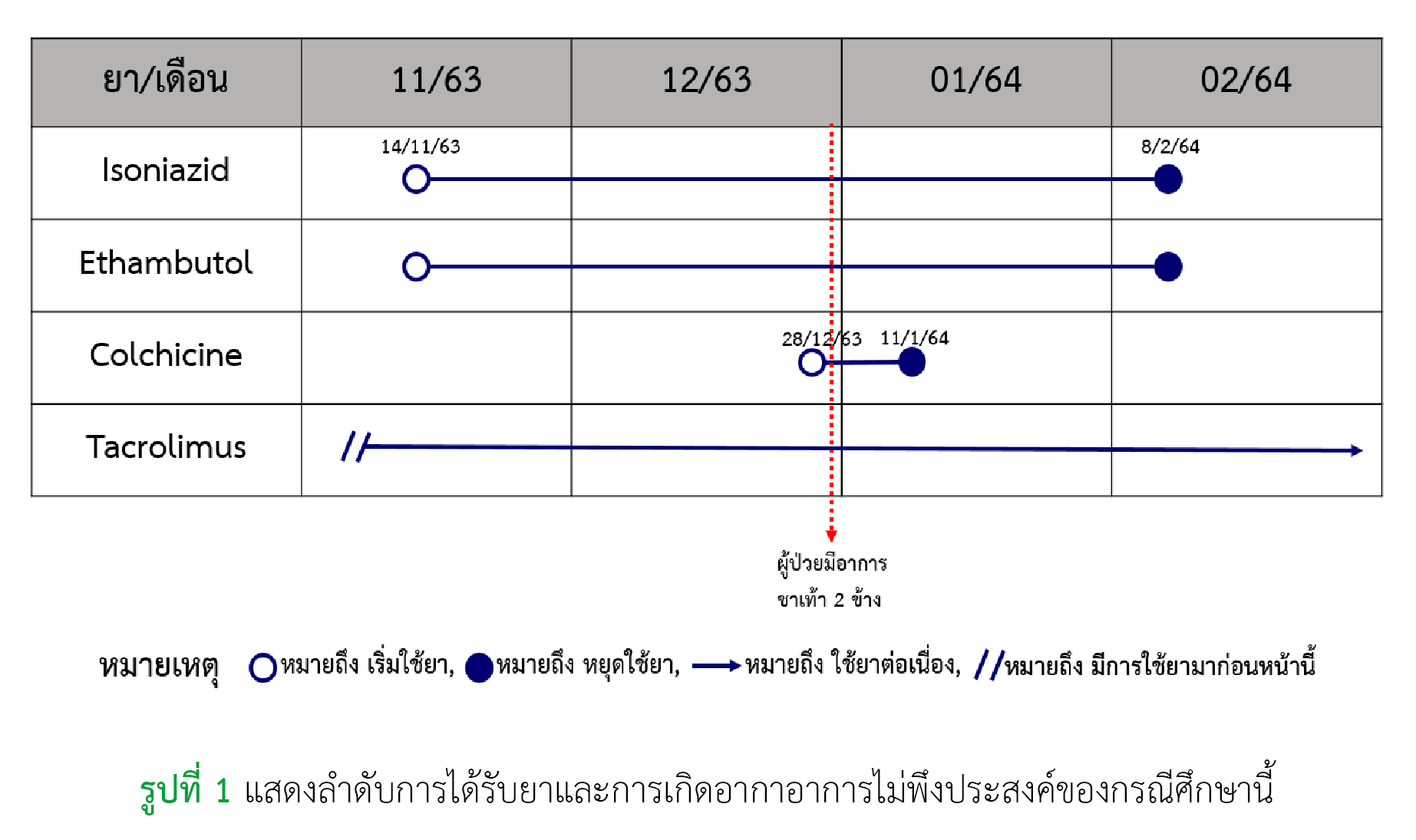
Colchicine is a drug with narrow therapeutic range. It is metabolized by the CYP3A4 enzyme. Thus, it should be used cautiously to avoid drug interactions and the dose should be adjusted in accordance with renal function. The most commonly side effects are diarrhea, abdominal pain, nausea, and vomiting. The side effects, rarely found but severe, include bone marrow suppression, myopathy, and peripheral neuropathy. This case study presents a 46-year-old Thai male patient with a post-heart transplant, gout, and chronic kidney disease. He received colchicine 1.2 mg/day, and two days later he felt numbness in both feet and had diarrhea. The dose was then reduced to 0.6 mg/day, but numbness was increased all the way to hips. He was diagnosed with neuropathy from colchicine. After stopping the drug, his symptoms were improved. It was analyzed that kidney disease and drug interactions between tacrolimus and colchicine were the important risk factors that led patient have a too high blood level of colchicine which caused the adverse reactions of colchicine. Therefore, pharmacists should have caution to use colchicine and recommend appropriate dosage adjustments, especially for organ transplant patients receiving immunosuppressive drugs who also have chronic kidney disease.
References
Ferron GM, Rochdi M, Jusko WJ, Scherrmann JM. Oral absorption characteristics and pharmacokinetics of colchicine in healthy volunteers after single and multiple doses. J Clin Pharmacol. 1996;36(10):874-83. doi: 10.1002/j.1552-4604.1996.tb04753.x.
Angelidis C, Kotsialou Z, Kossyvakis C, Vrettou AR, Zacharoulis A, Kolokathis F, et al. Colchicine pharmacokinetics and mechanism of action. Curr Pharm Des. 2018;24(6):659-63. doi: 10.2174/1381612824666180123110042.
สมาคมรูมาติสซั่มแห่งประเทศไทย. แนวทางเวชปฏิบัติการดูแลรักษาโรคเกาต์ (Guideline for management of gout) [อินเทอร์เน็ต]. กรุงเทพมหานคร: สมาคมรูมาติสซั่มแห่งประเทศไทย; 2555 [สืบค้นเมื่อ 15 พ.ย. 2564]. สืบค้นจาก: https://thairheumatology.org/phocadownload/70/Guideline_004_2.pdf
Eleftheriou G, Bacis G, Fiocchi R, Sebastiano R. Colchicine-induced toxicity in a heart transplant patient with chronic renal failure. Clin Toxicol (Phila). 2008;46(9):827-30. doi: 10.1080/15563650701779703.
Amanova A, Kendi Celebi Z, Bakar F, Caglayan MG, Keven K. Colchicine levels in chronic kidney diseases and kidney transplant recipients using tacrolimus. Clin Transplant. 2014;28(10):1177-83. doi: 10.1111/ctr.12448.
Link LH, Bindels A, Brasse BP, Intven FA, Grouls R, Roos A. Severe colchicine intoxication; always lethal? Neth J Crit Care [Internet]. 2014 [cited 2021 Nov 15];18:20-3. Available from: https://www.researchgate.net/publication/264464326_Severe_colchicine_intoxication_always_lethal
Visser NA, Notermans NC, Linssen RSN, van den Berg LH, Vrancken AF. Incidence of polyneuropathy in Utrecht, the Netherlands. Neurology. 2015;84(3):259-64. doi: 10.1212/WNL.0000000000001160.
Hanewinckel R, Drenthen J, van Oijen M, Hofman A, van Doorn PA, Ikram MA. Prevalence of polyneuropathy in the general middle-aged and elderly population. Neurology. 2016;87(18):1892-8. doi: 10.1212/WNL.0000000000003293.
Hanewinckel R, van Oijen M, Ikram MA, van Doorn PA. The epidemiology and risk factors of chronic polyneuropathy. Eur J Epidemiol. 2016;31(1):5-20. doi: 10.1007/s10654-015-0094-6.
Hughes RA. Peripheral neuropathy. BMJ. 2002;324(7335):466-9. doi: 10.1136/bmj.324.7335.466.
Jones MR, Urits I, Wolf J, Corrigan D, Colburn L, Peterson E, et al. Drug-induced peripheral neuropathy: a narrative review. Curr Clin Pharmacol. 2020;15(1):38-48. doi: 10.2174/1574884714666190121154813.
Castelli G, Desai KM, Cantone RE. Peripheral neuropathy: evaluation and differential diagnosis. Am Fam Physician. 2020;102(12):732-9. PMID: 33320513.
Vilholm OJ, Christensen AA, Zedan AH, Itani M. Drug-induced peripheral neuropathy. Basic Clin Pharmacol Toxicol. 2014;115(2):185-92. doi: 10.1111/bcpt.12261.
Mandel W. Pyridoxine and the isoniazid-induced neuropathy. Dis Chest. 1959;36:293-6. doi: 10.1378/chest.36.3.293.
กรมควบคุมโรค. กองวัณโรค. คำแนะนำเรื่องการวินิจฉัยและรักษาการติดเชื้อวัณโรคระยะแฝง [อินเทอร์เน็ต]. นนทบุรี: กองวัณโรค กรมควบคุมโรค กระทรวงสาธารณสุข; 2562 [สืบค้นเมื่อ 15 พ.ย.2564]. สืบค้นจาก: https://www.tbthailand.org/download/Manual/คำเเนะนำเรื่องการวินิจฉัยเเละรักษาการติดเชื้อวัณโรคระยะแฝง.pdf
Shoskes A, Wilson R. Neurologic complications of kidney transplantation. Transl Androl Urol. 2019;8(2):164-72. doi: 10.21037/tau.2018.08.11.
McEwan T, Bhambra J, Liew DF, Robinson PC. Systematic review of colchicine neuromyopathy: risk factors, duration and resolution. Semin Arthritis Rheum. 2023;58:152150. doi: 10.1016/j.semarthrit.2022.152150.
Lai IC, Cheng CY, Chen HH, Chen WY, Chen PY. Colchicine myoneuropathy in chronic renal failure patients with gout. Nephrology (Carlton). 2006;11(2):147-50. doi: 10.1111/j.1440-1797.2006.00542.x.
Dupont P, Hunt I, Goldberg L, Warrens A. Colchicine myoneuropathy in a renal transplant patient. Transpl Int. 2002;15(7):374-6. doi: 10.1007/s00147-002-0426-9.
Wluka AE, Ryan PF, Miller AM, Richardson M, Bergin PJ, Page JL, et al. Post-cardiac transplantation gout: incidence of therapeutic complications. J Heart Lung Transplant. 2000;19(10):951-6. doi: 10.1016/s1053-2498(00)00175-3.
Downloads
Published
How to Cite
Issue
Section
License
Copyright (c) 2023 Association of Hospital Pharmacy (Thailand)

This work is licensed under a Creative Commons Attribution-NonCommercial-NoDerivatives 4.0 International License.
บทความในวารสารเภสัชกรรมโรงพยาบาลเผยแพร่ภายใต้เงื่อนไขของสัญญาอนุญาตครีเอทีฟคอมมอนส์ในรูปแบบที่ต้องอ้างอิงแหล่งที่มา - ห้ามใช้เพื่อการค้า - ห้ามแก้ไขดัดแปลง เวอร์ชั่น 4.0 (CC BY-NC-ND 4.0) สามารถแจกจ่ายและนำบทความไปใช้ประโยชน์เพื่อการศึกษาได้แต่ต้องระบุการอ้างอิงถึงบทความจากเว็บไซต์วารสารเภสัชกรรมโรงพยาบาล ไม่สามารถนำบทความไปใช้เพื่อการพาณิชย์ใด ๆ เว้นแต่ได้รับอนุญาตจากบรรณาธิการวารสารเภสัชกรรมโรงพยาบาล และกรณีมีการนำบทความไปเรียบเรียงใหม่ เปลี่ยนแปลงเนื้อหา หรือเสริมเติมแต่งเนื้อหาของบทความ ท่านไม่สามารถนำบทความที่ปรับแต่งไปเผยแพร่ได้ในทุกกรณี
ข้อความที่ปรากฏในบทความในวารสารเป็นความคิดเห็นส่วนตัวของผู้แต่งแต่ละท่านไม่เกี่ยวข้องกับสมาคมเภสัชกรรมโรงพยาบาล (ประเทศไทย) และบุคลากรในสมาคมฯ แต่อย่างใด ความรับผิดชอบองค์ประกอบทั้งหมดของบทความแต่ละเรื่องเป็นของผู้แต่งแต่ละท่าน หากมีความผิดพลาดใด ๆ ผู้แต่งแต่ละท่านจะรับผิดชอบบทความของตนเอง ตลอดจนความรับผิดชอบด้านเนื้อหาและการตรวจร่างบทความเป็นของผู้แต่ง ไม่เกี่ยวข้องกับกองบรรณาธิการ


.png)

