
Rezafungin: ทางเลือกใหม่สำหรับรักษาการติดเชื้อแคนดิดาในกระแสเลือดและการติดเชื้อแคนดิดาแบบรุกราน
คำสำคัญ:
rezafungin, การติดเชื้อราแคนดิดาในกระแสเลือด, การติดเชื้อราแคนดิดาแบบรุกรานบทคัดย่อ
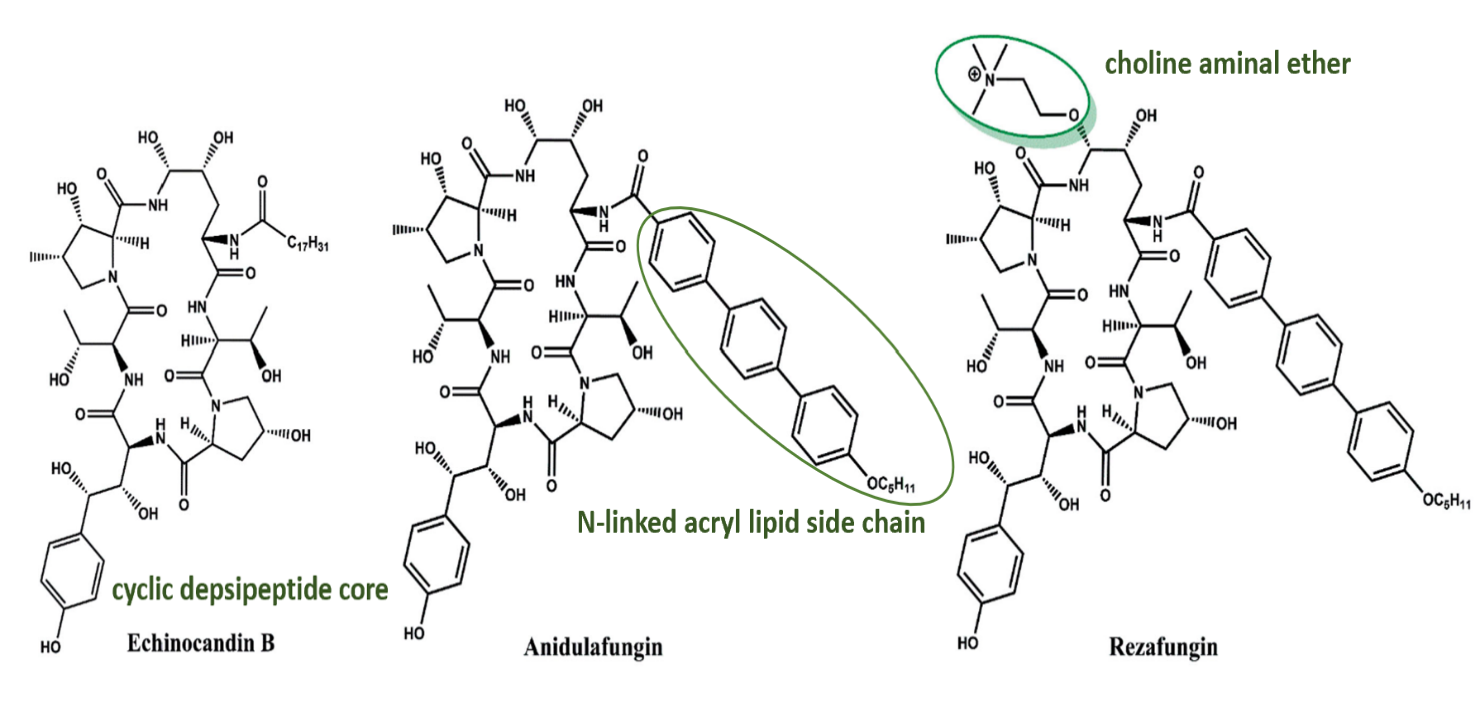
Rezafungin เป็นยาในกลุ่ม echinocandins รุ่นที่สอง ถัดจากยา anidulafungin, micafungin และ caspofungin กลไกการออกฤทธิ์ของยาคือไปยับยั้ง 1,3-β-D-glucan synthase โดย rezafungin เป็นยาในรูปแบบฉีดเข้าทางหลอดเลือดดำ สัปดาห์ละ 1 ครั้ง และยาได้รับการขึ้นทะเบียนโดยองค์การอาหารและยาแห่งประเทศสหรัฐอเมริกาในวันที่ 22 มีนาคม ค.ศ. 2023 สำหรับการรักษาการติดเชื้อแคนดิดาในกระแสเลือดและการติดเชื้อแคนดิดาแบบรุกรานในผู้ป่วยที่มีอายุมากกว่าหรือเท่ากับ 18 ปี ซึ่งมีข้อจำกัดในการใช้ยาหรือไม่มีทางเลือกในการรักษาอื่นแล้ว นอกจากนั้นยายังถูกพัฒนาขึ้นเพื่อใช้ป้องกันการติดเชื้อราในกระแสเลือดและผู้เปลี่ยนถ่ายไขกระดูกด้วย จากการทบทวนวรรณกรรมอย่างเป็นระบบพบว่า ยามีค่าครึ่งชีวิตยาวทำให้สามารถให้ยาสัปดาห์ละ 1 ครั้งได้ นอกจากนี้ rezafungin ยังมีความเป็นพิษต่อตับน้อยกว่ายาในกลุ่ม echinocandin รุ่นแรก ทำให้มีความปลอดภัยในการใช้ยามากขึ้น
เอกสารอ้างอิง
McCarty TP, White CM, Pappas PG. Candidemia and Invasive Candidiasis. Infect Dis Clin North Am. 2021;35(2):389-413. doi: 10.1016/j.idc.2021.03.007.
de Oliveira Santos GC, Vasconcelos CC, Lopes AJO, de Sousa Cartágenes MDS, Filho AKDB, do Nascimento FRF, et al. Candida infections and therapeutic strategies: mechanisms of action for traditional and alternative agents. Front Microbiol. 2018;9:1351. doi: 10.3389/fmicb.2018.01351.
European Medicines Agency (EMA). Public summary of opinion on orphan designation: rezafungin acetate for the treatment of invasive candidiasis. EU designation No. EU/3/20/2385 [Internet]. Amsterdam: EMA; 2021 [cited 2023 Jul 18]. Available from: https://www.ema.europa.eu/en/documents/orphan-designation/eu/3/20/2385-public-summary-opinion-orphan-designation-rezafungin-acetate-treatment-invasive-candidiasis_en.pdf
Pappas PG, Kauffman CA, Andes DR, Clancy CJ, Marr KA, Ostrosky-Zeichner L, et al. Clinical practice guideline for the management of candidiasis: 2016 update by the Infectious Diseases Society of America. Clin Infect Dis. 2016;62(4):e1-50. doi: 10.1093/cid/civ933.
Tan BH, Chakrabarti A, Li RY, Patel AK, Watcharananan SP, Liu Z, et al. Incidence and species distribution of candidaemia in Asia: a laboratory-based surveillance study. Clin Microbiol Infect. 2015;21(10):946-53. doi: 10.1016/j.cmi.2015.06.010.
Syed YY. Rezafungin: first approval. Drugs. 2023;83(9):833-40. doi: 10.1007/s40265-023-01891-8.
Melinta Therapeutics LLC. REZZAYO™ (rezafungin for injection), for intravenous use [Internet]. Lincolnshire (IL): Melinta Therapeutics LLC; 2023. [cited 2023 Jul 18]. Available from: https://www.rezzayo.com/wp-content/pdfs/REZZAYO%20(rezafungin%20for%20injection)%20Package%20Insert.pdf
Szymanski M, Chmielewska S, Czyzewska U, Malinowska M, Tylicki A. Echinocandins - structure, mechanism of action and use in antifungal therapy. J Enzyme Inhib Med Chem. 2022;37(1):876-94. doi: 10.1080/14756366.2022.2050224.
Zhao Y, Perlin DS. Review of the novel echinocandin antifungal rezafungin: animal studies and clinical data. J Fungi (Basel). 2020;6(4):192. doi: 10.3390/jof6040192.
McKeny PT, Nessel TA, Zito PM. Antifungal antibiotics. In: StatPearls [Internet]. Treasure Island (FL): StatPearls Publishing; 2023 [cited 2023 Jul 18]. Available from: https://www.ncbi.nlm.nih.gov/books/NBK538168/
Robbins N, Wright GD, Cowen LE. Antifungal drugs: the current armamentarium and development of new agents. Microbiol Spectr. 2016;4(5). doi: 10.1128/microbiolspec.FUNK-0002-2016.
Merative Corporation. DRUGDEX [data on the internet]. Ann Arbor (MI): Micromedex, Merative Corporation; 2023 [cited 2024 May 10]. Available from: https://www.micromedexsolutions.com/micromedex2/librarian/CS/C56967/ND_PR/evidencexpert/ND_P/evidencexpert/ (Subscription required)
Lepak AJ, Andes DR. Antifungal pharmacokinetics and pharmacodynamics. Cold Spring Harb Perspect Med. 2014;5(5):a019653. doi: 10.1101/cshperspect.a019653.
Bellmann R, Smuszkiewicz P. Pharmacokinetics of antifungal drugs: practical implications for optimized treatment of patients. Infection. 2017;45(6):737-79. doi: 10.1007/s15010-017-1042-z.
Thompson GR 3rd, Soriano A, Skoutelis A, Vazquez JA, Honore PM, Horcajada JP, et al. Rezafungin versus caspofungin in a phase 2, randomized, double-blind study for the treatment of candidemia and invasive candidiasis: the STRIVE trial. Clin Infect Dis. 2021;73(11):e3647-55. doi: 10.1093/cid/ciaa1380.
Thompson GR 3rd, Soriano A, Cornely OA, Kullberg BJ, Kollef M, Vazquez J, et al. Rezafungin versus caspofungin for treatment of candidaemia and invasive candidiasis (ReSTORE): a multicentre, double-blind, double-dummy, randomised phase 3 trial. Lancet. 2023;401(10370):49-59. doi: 10.1016/S0140-6736(22)02324-8.
Thompson GR 3rd, Soriano A, Honore PM, Bassetti M, Cornely OA, Kollef M, et al. Efficacy and safety of rezafungin and caspofungin in candidaemia and invasive candidiasis: pooled data from two prospective randomised controlled trials. Lancet Infect Dis. 2024;24(3):319-28. doi: 10.1016/S1473-3099(23)00551-0.
ดาวน์โหลด
เผยแพร่แล้ว
รูปแบบการอ้างอิง
ฉบับ
ประเภทบทความ
สัญญาอนุญาต
ลิขสิทธิ์ (c) 2024 สมาคมเภสัชกรรมโรงพยาบาล(ประเทศไทย)

อนุญาตภายใต้เงื่อนไข Creative Commons Attribution-NonCommercial-NoDerivatives 4.0 International License.
บทความในวารสารเภสัชกรรมโรงพยาบาลเผยแพร่ภายใต้เงื่อนไขของสัญญาอนุญาตครีเอทีฟคอมมอนส์ในรูปแบบที่ต้องอ้างอิงแหล่งที่มา - ห้ามใช้เพื่อการค้า - ห้ามแก้ไขดัดแปลง เวอร์ชั่น 4.0 (CC BY-NC-ND 4.0) สามารถแจกจ่ายและนำบทความไปใช้ประโยชน์เพื่อการศึกษาได้แต่ต้องระบุการอ้างอิงถึงบทความจากเว็บไซต์วารสารเภสัชกรรมโรงพยาบาล ไม่สามารถนำบทความไปใช้เพื่อการพาณิชย์ใด ๆ เว้นแต่ได้รับอนุญาตจากบรรณาธิการวารสารเภสัชกรรมโรงพยาบาล และกรณีมีการนำบทความไปเรียบเรียงใหม่ เปลี่ยนแปลงเนื้อหา หรือเสริมเติมแต่งเนื้อหาของบทความ ท่านไม่สามารถนำบทความที่ปรับแต่งไปเผยแพร่ได้ในทุกกรณี
ข้อความที่ปรากฏในบทความในวารสารเป็นความคิดเห็นส่วนตัวของผู้แต่งแต่ละท่านไม่เกี่ยวข้องกับสมาคมเภสัชกรรมโรงพยาบาล (ประเทศไทย) และบุคลากรในสมาคมฯ แต่อย่างใด ความรับผิดชอบองค์ประกอบทั้งหมดของบทความแต่ละเรื่องเป็นของผู้แต่งแต่ละท่าน หากมีความผิดพลาดใด ๆ ผู้แต่งแต่ละท่านจะรับผิดชอบบทความของตนเอง ตลอดจนความรับผิดชอบด้านเนื้อหาและการตรวจร่างบทความเป็นของผู้แต่ง ไม่เกี่ยวข้องกับกองบรรณาธิการ

.png)

