
Asciminib: A New Approach for Chronic Myeloid Leukemia
Keywords:
asciminib, ABL1 kinase inhibitor, chronic myeloid leukemiaAbstract
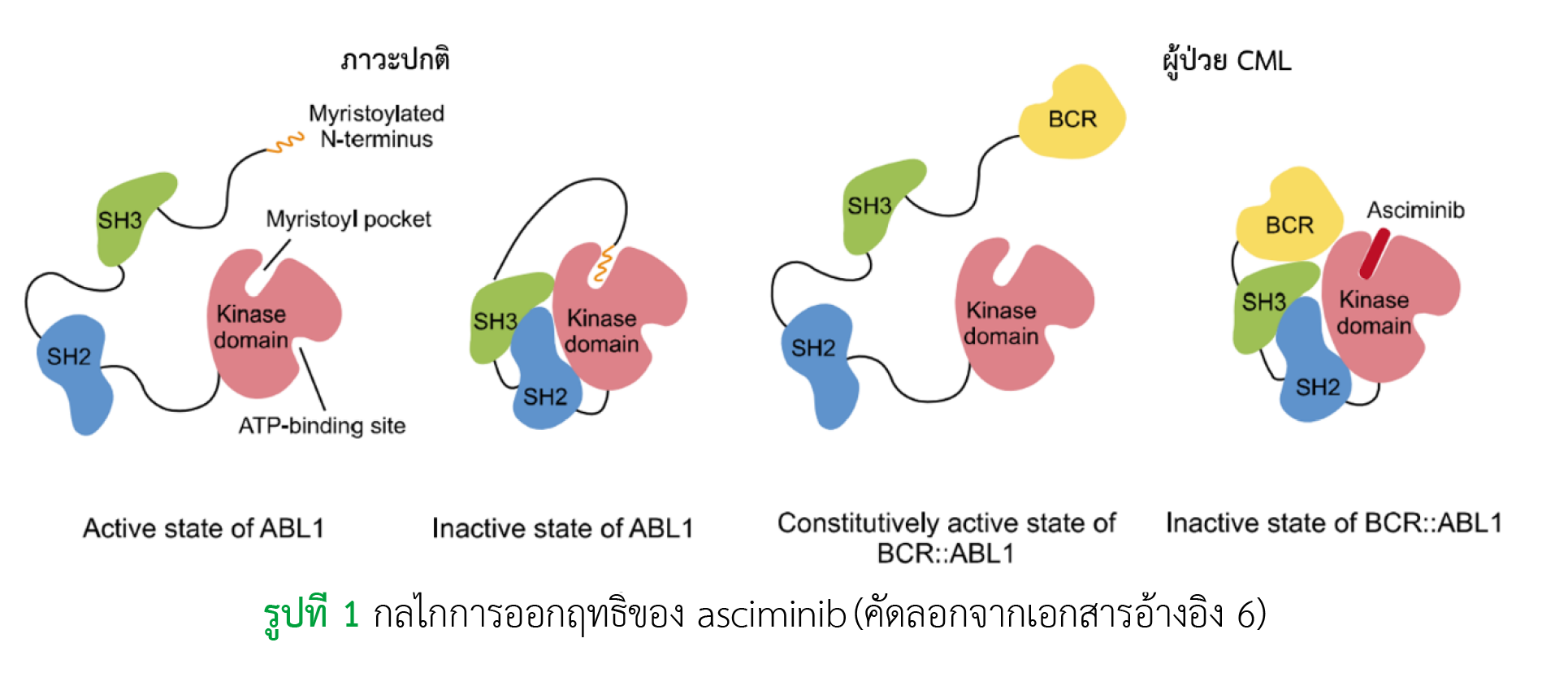
Asciminib is the first ABL1 kinase inhibitor being registered by the US Food and Drug Administration on October 29, 2021, for the treatment of chronic myeloid leukemia in the chronic phase. This treatment is intended for patients who have previously been treated with at least two other tyrosine kinase inhibitors, as well as patients who exhibit the T315I mutation. Mechanism of action is inhibiting the ABL1 kinase through its binding to the myristoyl pocket. Both in vitro and animal studies have demonstrated the drug effectiveness against the wild-type BCR-ABL1 protein and various mutated proteins, including the T315I mutation. Systematic review show that the drug is well-tolerated by patients and has a high safety profile. The most commonly reported adverse events include upper respiratory tract infections, musculoskeletal pain, fatigue, nausea, rash, and diarrhea. Additionally, there are increases in levels of triglyceride, creatine kinase, alanine aminotransferase, lipase, and amylase, as well as decreases in levels of hemoglobin, platelet count, and the number of neutrophils.
References
แสงสุรีย์ จูฑา, อุดมศักดิ์ บุญวรเศรษฐ์, ธีรยา พัววิไล, ต้นตนัย นำเบญจพล, วีระศักดิ์ นาวารวงศ์, อานุภาพ เลขะกุล, และคณะ. แนวทางเวชปฏิบัติสำหรับโรคมะเร็งเม็ดเลือดขาวเรื้อรังชนิดมัยอีลอยด์ พ.ศ. 2554 [อินเทอร์เน็ต]. กรุงเทพมหานคร: สมาคมโลหิตวิทยาแห่งประเทศไทย; 2554 [สืบค้นเมื่อ 1 ก.ย. 2566]. สืบค้นจาก http://www.tsh.or.th/files_news/newsFile_20110509164226.pdf
เอกรัฐ รัฐฤทธิ์ธำรง. โรคมะเร็งเม็ดเลือดขาวชนิดเรื้อรัง [อินเทอร์เน็ต]. กรุงเทพมหานคร: สมาคมโลหิตวิทยาแห่งประเทศไทย; 2562 [สืบค้นเมื่อ 1 ก.ย. 2566]. สืบค้นจากhttp://www.tsh.or.th/Knowledge/Details/67
Hochhaus A, Baccarani M, Silver RT, Schiffer C, Apperley JF, Cervantes F, et al. European LeukemiaNet 2020 recommendations for treating chronic myeloid leukemia. Leukemia. 2020;34(4):966-84. doi: 10.1038/s41375-020-0776-2.
Hochhaus A, Saussele S, Rosti G, Mahon FX, Janssen JJWM, Hjorth-Hansen H, et al. Chronic myeloid leukaemia: ESMO clinical practice guidelines for diagnosis, treatment and follow-up. Ann Oncol. 2017;28(suppl_4):iv41-51. doi: 10.1093/annonc/mdx219.
Deininger MW, Shah NP, Altman JK, Berman E, Bhatia R, Bhatnagar B, et al. Chronic myeloid leukemia, version 2.2021, NCCN clinical practice guidelines in oncology. J Natl Compr Canc Netw. 2020;18(10):1385-415. doi: 10.6004/jnccn.2020.0047.
Choi EJ. Asciminib: the first-in-class allosteric inhibitor of BCR::ABL1 kinase. Blood Res. 2023;58(S1):S29-36. doi: 10.5045/br.2023.2023017.
สำนักงานหลักประกันสุขภาพแห่งชาติ สำนักสนับสนุนคุณภาพและมาตรฐานหน่วยบริการ. คู่มือแนวทางการรักษาโรคมะเร็งโลหิตวิทยาในผู้ใหญ่ พ.ศ. 2561 เพื่อขอรับค่าบริการสาธารณสุข ในระบบหลักประกันสุขภาพแห่งชาติ [อินเทอร์เน็ต]. กรุงเทพมหานคร: สำนักงานหลักประกันสุขภาพแห่งชาติ; 2561 [สืบค้นเมื่อ 1 ก.ย. 2566]. สืบค้นจาก https://www.nhso.go.th/storage/files/shares/PDF/Protocol_UC02.pdf
Novartis Pharmaceuticals Corporation. SCEMBLIX® (asciminib) tablets, for oral use [Internet]. East Hanover (New Jersey): Novartis Pharmaceuticals Corporation; 2021 [cited 2023 Sep 1]. Available from: https://www.novartis.com/us-en/sites/novartis_us/files/scemblix.pdf
Hughes TP, Mauro MJ, Cortes JE, Minami H, Rea D, DeAngelo DJ, et al. Asciminib in chronic myeloid leukemia after ABL kinase inhibitor failure. N Engl J Med. 2019;381(24):2315-26. doi: 10.1056/NEJMoa1902328.
Baccarani M, Deininger MW, Rosti G, Hochhaus A, Soverini S, Apperley JF, et al. European LeukemiaNet recommendations for the management of chronic myeloid leukemia: 2013. Blood. 2013;122(6):872-84. doi: 10.1182/blood-2013-05-501569.
Réa D, Mauro MJ, Boquimpani C, Minami Y, Lomaia E, Voloshin S, et al. A phase 3, open-label, randomized study of asciminib, a STAMP inhibitor, vs bosutinib in CML after 2 or more prior TKIs. Blood. 2021;138(21):2031-41. doi: 10.1182/blood.2020009984.
Mauro MJ, Minami Y, Rea D, Hochhaus A, Lomaia E, Voloshin S, et al. Efficacy and safety results from ascembl, a multicenter, open-label, phase 3 study of asciminib, a first-in-class STAMP inhibitor, vs bosutinib in patients with chronic myeloid leukemia in chronic phase after ≥2 prior tyrosine kinase inhibitors: update after 48 weeks. Blood. 2021;138(Supplement 1):310. doi: 10.1182/blood-2021-152561.
Pérez-Lamas L, Luna A, Boque C, Xicoy B, Giraldo P, Pérez López R, et al. Toxicity of asciminib in real clinical practice: analysis of side effects and cross-toxicity with tyrosine kinase inhibitors. Cancers (Basel). 2023;15(4):1045. doi: 10.3390/cancers15041045.
Wylie AA, Schoepfer J, Jahnke W, Cowan-Jacob SW, Loo A, Furet P, et al. The allosteric inhibitor ABL001 enables dual targeting of BCR-ABL1. Nature. 2017;543(7647):733-7. doi: 10.1038/nature21702.
Eide CA, Zabriskie MS, Savage Stevens SL, Antelope O, Vellore NA, Than H, et al. Combining the allosteric inhibitor asciminib with ponatinib suppresses emergence of and restores efficacy against highly resistant BCR-ABL1 mutants. Cancer Cell. 2019;36(4):431–43:e5. doi: 10.1016/j.ccell.2019.08.004.
Downloads
Published
How to Cite
Issue
Section
License
Copyright (c) 2024 Association of Hospital Pharmacy (Thailand)

This work is licensed under a Creative Commons Attribution-NonCommercial-NoDerivatives 4.0 International License.
บทความในวารสารเภสัชกรรมโรงพยาบาลเผยแพร่ภายใต้เงื่อนไขของสัญญาอนุญาตครีเอทีฟคอมมอนส์ในรูปแบบที่ต้องอ้างอิงแหล่งที่มา - ห้ามใช้เพื่อการค้า - ห้ามแก้ไขดัดแปลง เวอร์ชั่น 4.0 (CC BY-NC-ND 4.0) สามารถแจกจ่ายและนำบทความไปใช้ประโยชน์เพื่อการศึกษาได้แต่ต้องระบุการอ้างอิงถึงบทความจากเว็บไซต์วารสารเภสัชกรรมโรงพยาบาล ไม่สามารถนำบทความไปใช้เพื่อการพาณิชย์ใด ๆ เว้นแต่ได้รับอนุญาตจากบรรณาธิการวารสารเภสัชกรรมโรงพยาบาล และกรณีมีการนำบทความไปเรียบเรียงใหม่ เปลี่ยนแปลงเนื้อหา หรือเสริมเติมแต่งเนื้อหาของบทความ ท่านไม่สามารถนำบทความที่ปรับแต่งไปเผยแพร่ได้ในทุกกรณี
ข้อความที่ปรากฏในบทความในวารสารเป็นความคิดเห็นส่วนตัวของผู้แต่งแต่ละท่านไม่เกี่ยวข้องกับสมาคมเภสัชกรรมโรงพยาบาล (ประเทศไทย) และบุคลากรในสมาคมฯ แต่อย่างใด ความรับผิดชอบองค์ประกอบทั้งหมดของบทความแต่ละเรื่องเป็นของผู้แต่งแต่ละท่าน หากมีความผิดพลาดใด ๆ ผู้แต่งแต่ละท่านจะรับผิดชอบบทความของตนเอง ตลอดจนความรับผิดชอบด้านเนื้อหาและการตรวจร่างบทความเป็นของผู้แต่ง ไม่เกี่ยวข้องกับกองบรรณาธิการ


.png)

