Evaluation of Counseling from Pharmacist to Liver Transplant Patients
Keywords:
drug-related problems, liver transplantation, pharmacist counseling, medication reconciliation, patient safetyAbstract
Background: The prescribed immunosuppressants for organ transplant patients were adjusted according to blood level. Other drugs were also adjusted. These patients frequently have polypharmacy, which leads to increased risk for drug-related problems (DRPs).
Objectives: This study aimed to determine DRPs detected during counseling to organ transplant patients by pharmacist at pre-doctor visit comparing to counseling at pre- and post- doctor visit.
Method: A retrospective, observational study was performed in the Liver Transplant Clinic from January 1, 2021 to December 31, 2022. In 2021, pharmacists counseled patients at pre-doctor visit (pre-counseling) but in 2022, pharmacists counseled twice at pre- and post- doctor visit (pre- and post-counseling). Pharmacists identified DRPs using the PCNE Classification Version 9.1 and DRPs were grouped into preventable DRPs and non-preventable DRPs.
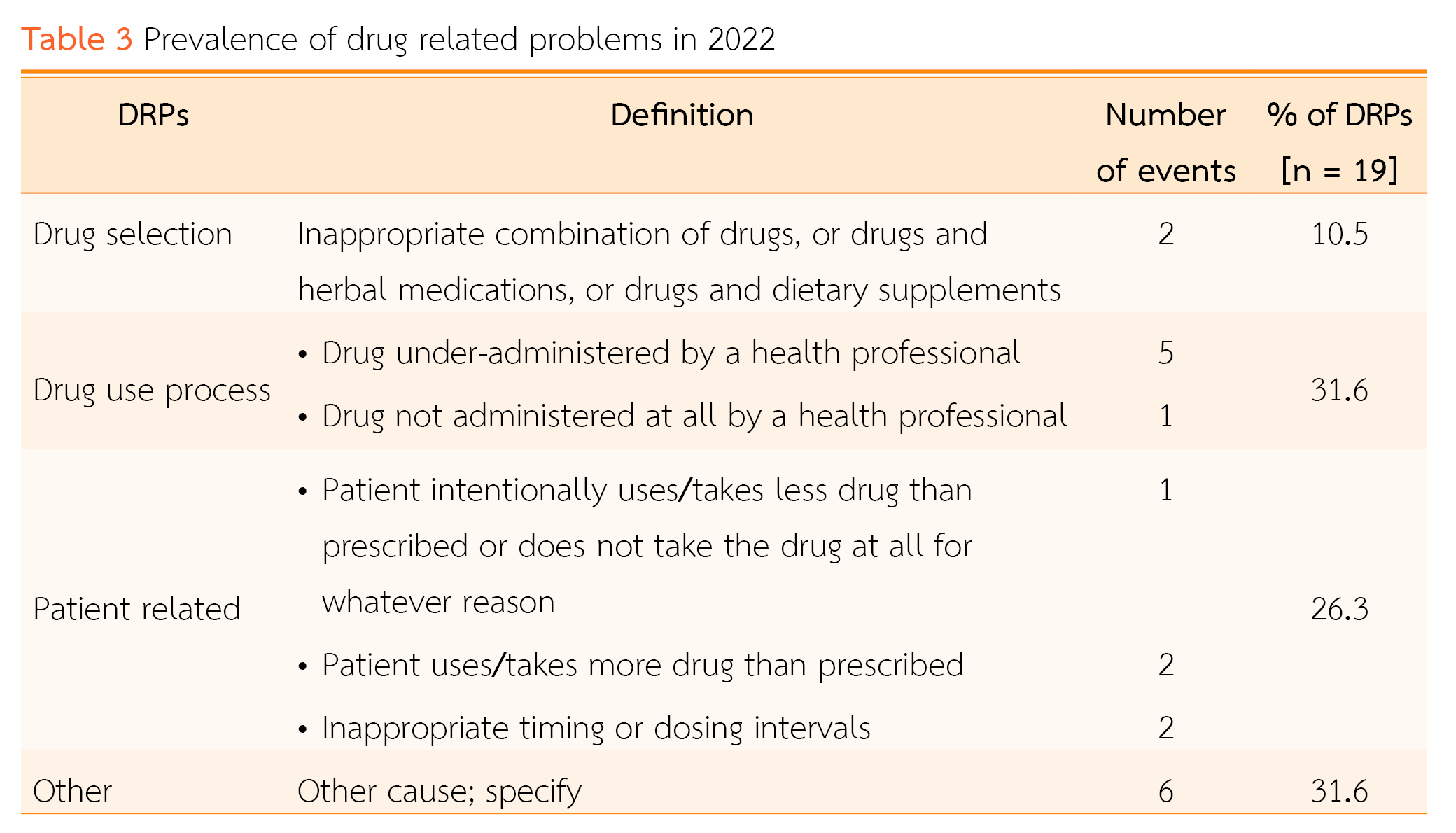
Results: In 2021, 15 DRPs were found from 240 pre-counseling. Four categories of DRPs were identified: patient-related problems (11, 73.3%), adverse drug effects (2, 13.3%), drug-use process problems (1, 6.7%), and drug selection problems (1, 6.7%). Thirteen (86.7%) of those were classified as preventable DRPs. In 2022, 19 DRPs were found from 314 pre- and post-counseling. Four categories of DRPs were identified: drug-use process problems (6, 31.6%), adverse drug effects (6, 31.6%), patient-related problems (5, 26.3%), and drug selection problems (2, 10.5%). Thirteen (68.4%) of those were classified as preventable DRPs.
Conclusion: The results of the study indicate that pre- and post- counseling from pharmacists can significantly reduce patient-related problems, and tend to decrease non-adherence when compared with pre- counseling alone.
References
ศูนย์รับบริจาคอวัยวะสภากาชาดไทย. รายงานประจำปี พ.ศ. 2565 [อินเทอร์เน็ต]. กรุงเทพมหานคร: ศูนย์รับบริจาคอวัยวะสภากาชาดไทย; 2565 [สืบค้นเมื่อ 5 ต.ค. 2566]. สืบค้นจาก: https://www.organdonate.in.th/assets/files/odc2565.pdf
Mulder MB, Doga B, Borgsteede SD, van den Burg AM, Metselaar HJ, den Hoed CM, et al. Evaluation of medication-related problems in liver transplant recipients with and without an outpatient medication consultation by a clinical pharmacist: a cohort study. Int J Clin Pharm. 2022;44(5):1114-22. doi: 10.1007/s11096-022-01423-6.
O'Carroll RE, McGregor LM, Swanson V, Masterton G, Hayes PC. Adherence to medication after liver transplantation in Scotland: a pilot study. Liver Transpl. 2006;12(12):1862-8. doi: 10.1002/lt.20828.
Stemer G, Lemmens-Gruber R. Clinical pharmacy services and solid organ transplantation: a literature review. Pharm World Sci. 2010;32(1):7-18. doi: 10.1007/s11096-009-9351-7.
Pharmaceutical Care Network Europe (PCNE). Classification for drug related problems: the PCNE classification V 9.1 [Internet]. n.p.: Pharmaceutical Care Network Europe Association; 2020 [cited Aug 2, 2022].Available from: https://www.pcne.org/upload/files/417_PCNE_classification_V9-1_final.pdf
Mulder MB, Borgsteede SD, Darwish Murad S, Landman CS, Metselaar HJ, Hunfeld NGM. Medication-related problems in liver transplant recipients in the outpatient setting: a Dutch cohort study. Front Pharmacol. 2021;12:637090. doi: 10.3389/fphar.2021.637090.
Flamme-Obry F, Belaiche S, Hazzan M, Ramdan N, Noël C, Odou P, et al. Clinical pharmacist and medication reconciliation in kidney transplantation. Nephrol Ther. 2018;14(2):91-8. doi: 10.1016/j.nephro.2017.04.004.
Downloads
Published
How to Cite
Issue
Section
License
Copyright (c) 2024 Association of Hospital Pharmacy (Thailand)

This work is licensed under a Creative Commons Attribution-NonCommercial-NoDerivatives 4.0 International License.
บทความในวารสารเภสัชกรรมโรงพยาบาลเผยแพร่ภายใต้เงื่อนไขของสัญญาอนุญาตครีเอทีฟคอมมอนส์ในรูปแบบที่ต้องอ้างอิงแหล่งที่มา - ห้ามใช้เพื่อการค้า - ห้ามแก้ไขดัดแปลง เวอร์ชั่น 4.0 (CC BY-NC-ND 4.0) สามารถแจกจ่ายและนำบทความไปใช้ประโยชน์เพื่อการศึกษาได้แต่ต้องระบุการอ้างอิงถึงบทความจากเว็บไซต์วารสารเภสัชกรรมโรงพยาบาล ไม่สามารถนำบทความไปใช้เพื่อการพาณิชย์ใด ๆ เว้นแต่ได้รับอนุญาตจากบรรณาธิการวารสารเภสัชกรรมโรงพยาบาล และกรณีมีการนำบทความไปเรียบเรียงใหม่ เปลี่ยนแปลงเนื้อหา หรือเสริมเติมแต่งเนื้อหาของบทความ ท่านไม่สามารถนำบทความที่ปรับแต่งไปเผยแพร่ได้ในทุกกรณี
ข้อความที่ปรากฏในบทความในวารสารเป็นความคิดเห็นส่วนตัวของผู้แต่งแต่ละท่านไม่เกี่ยวข้องกับสมาคมเภสัชกรรมโรงพยาบาล (ประเทศไทย) และบุคลากรในสมาคมฯ แต่อย่างใด ความรับผิดชอบองค์ประกอบทั้งหมดของบทความแต่ละเรื่องเป็นของผู้แต่งแต่ละท่าน หากมีความผิดพลาดใด ๆ ผู้แต่งแต่ละท่านจะรับผิดชอบบทความของตนเอง ตลอดจนความรับผิดชอบด้านเนื้อหาและการตรวจร่างบทความเป็นของผู้แต่ง ไม่เกี่ยวข้องกับกองบรรณาธิการ

.png)

