A Comparison of the Efficacy of Initial Warfarin Dosing Using a Calculation-Based Dosing Versus the Standard Physician-Prescribed Dosing
Abstract
Background: The initial dose of warfarin has traditionally ranged from 0.5 to 5 milligrams per day, with varying times for the INR to reach the therapeutic range. Utilizing a formula-calculated dosing to determine the initial dose of warfarin may increase the likelihood of achieving a therapeutic INR more effectively.
Objectives: To compare the efficacy of initial warfarin dosing using a formula-calculated dosing versus standard physician-prescribed dosing.
Methods: A retrospective study was conducted at a general hospital with 400 beds in Prachuapkhirikhan province. Data of patients who started warfarin during October 17, 2022 and March 29, 2024, with targeting an INR range of 2.0 - 3.0 were collected. In addition, patients must receive continued treatment and at least one INR must be followed-up within 7-90 days after starting warfarin.
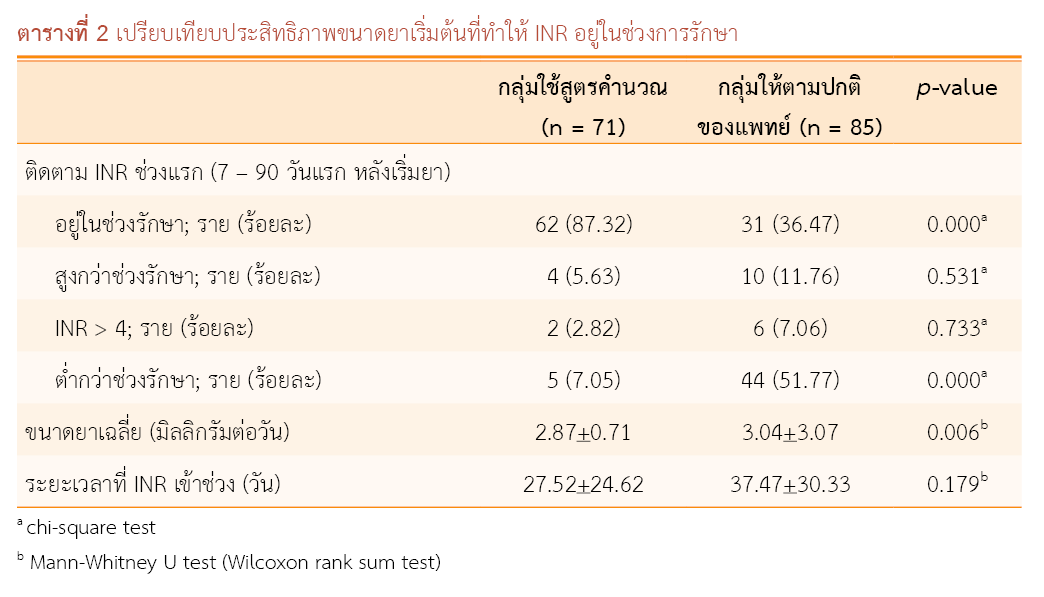
Results: The study included 156 patients with an average age of 64.30±15.4 years, 85 of whom were female (54.49%). Atrial fibrillation, was indicated in 101 patients (64.74%). They then were divided into two groups: 85 patients (54.49%) received standard physician-prescribed dosing, and 71 patients (45.51%) received the formula-calculated dosing. The latter group had 62 times (87.32%) of achieving the therapeutic INR range, compared to 31 times (36.47%) in the standard physician-prescribed dosing group, the difference was statistically significant (p-value < 0.001).
Conclusion: Initial warfarin dosing using a formula-calculated dosing resulted in a higher percentage of patients achieving the target INR range compared to standard physician-prescribed dosing.
References
สมาคมแพทย์โรคหัวใจแห่งประเทศไทย. แนวทางการรักษาผู้ป่วยด้วยยาต้านการแข็งตัวของเลือดชนิดรับประทาน พ.ศ. 2553 [อินเทอร์เน็ต]. กรุงเทพมหานคร: สมาคมแพทย์โรคหัวใจแห่งประเทศไทยในพระบรมราชูปถัมภ์; 2553 [สืบค้นเมื่อ 1 เม.ย. 2567]. สืบค้นจาก: http://www.thaiheart.org/images/column_1292154183/warfarin_Guideline%281%29.pdf
สุภารัตน์ วัฒนสมบัติ. ยาต้านการแข็งตัวของเลือด. ไทยไภษัชยนิพนธ์. 2553;5(1):87–98. doi: 10.69598/tbps.5.1.87-98.
Ansell J, Hirsh J, Hylek E, Jacobson A, Crowther M, Palareti G. Pharmacology and management of the vitamin K antagonists: American College of Chest Physicians Evidence-Based Clinical Practice Guidelines (8th Edition). Chest. 2008;133(6 SUPPL. 6):160S-98S. doi: 10.1378/chest.08-0670.
กองบริหารการสาธารณสุข. แนวทางการจัดการด้านยาตาม service plan สาขาโรคหัวใจและไต [อินเทอร์เน็ต].นนทบุรี: กองบริหารการสาธารณสุข สำนักงานปลัดกระทรวงสาธารณสุข; 2563 [สืบค้นเมื่อ 1 เม.ย. 2567]. หน้า 5–18. สืบค้นจาก: https://dmsic.moph.go.th/index/detail/8490
Pongbangli N, Phrommintikul A, Wongcharoen W. Simplified warfarin dosing formula to guide the initiating dose in Thai patients. J Med Assoc Thai [Internet]. 2019 [cited 2024 May 2];102(9):957-61. Available from: http://www.jmatonline.com/view.php?id=2253
สกนวรรณ พวงหอม, มาศชุดา สุวรรณธัย. ขนาดยาวาร์ฟารินเริ่มต้นที่เหมาะสม และปัจจัยที่มีผลต่อขนาดยาวาร์ฟารินเริ่มต้นที่ทำให้ค่าไอเอ็นอาร์อยู่ในช่วงเป้าหมาย. วารสารเภสัชกรรมโรงพยาบาล [อินเทอร์เน็ต]. 2567 [สืบค้นเมื่อ 4 พ.ค. 2567];34(1):1-11. สืบค้นจาก: https://he02.tci-thaijo.org/index.php/TJHP/article/view/265495
Gao W, Zhang Z, Guan Z, Chen W, Li Z. Developing Chinese race-specific warfarin dose prediction algorithms. Int J Clin Pharm. 2023;45(3):731-8. doi: 10.1007/s11096-023-01565-1.
สิระ ชวรัศมิ์, ชนัชชา อุปฮาด. ปัจจัยที่มีผลต่อค่า INR ของผู้ใช้ยาวาร์ฟาริน โรงพยาบาลเบญจลักษณ์เฉลิมพระเกียรติ 80 พรรษา. วารสารอนามัยสิ่งแวดล้อมและสุขภาพชุมชน [อินเทอร์เนต]. 2565 [สืบค้นเมื่อ 2 มิ.ย. 2567];7(1):137-46. สืบค้นจาก: https://he03.tci-thaijo.org/index.php/ech/article/view/519
กรรณิกา เหมือนจันทร์แจ่ม. ขนาดยาวาร์ฟารินที่เหมาะสมและปัจจัยทางคลินิกที่มีผลต่อขนาดยาวาร์ฟารินในขนาดคงที่ ที่โรงพยาบาลราชบุรี. วารสารหัวหินสุขใจไกลกังวล [อินเทอร์เนต]. 2563 [สืบค้นเมื่อ 2 มิ.ย. 2567];5(1):18-29. สืบค้นจาก: https://he01.tci-thaijo.org/index.php/hhsk/article/view/240517
กิตติศักดิ์ พนมพงศ์, พัชริยา โทนหงษา. ปัจจัยทำนายขนาดยาวาร์ฟารินและปัจจัยที่มีความสัมพันธ์กับระดับไอเอ็นอาร์ของผู้ป่วย ที่ได้รับยาวาร์ฟาริน โรงพยาบาลหนองพอก จังหวัดร้อยเอ็ด. วารสารวิจัยและพัฒนานวัตกรรมทางสุขภาพ [อินเทอร์เนต]. 2564 [สืบค้นเมื่อ 2 มิ.ย. 2567];2(3):109-20. สืบค้นจาก: https://he01.tci-thaijo.org/index.php/jrhi/article/view/252824
Yang W, Ma J, Hu W, Dai H, Xu H. Associated factors and safety of the rapidly achieving first therapeutic target of warfarin in hospitalized patients: a retrospective cohort study. Int J Clin Pharm. 2022;44(4):939-46. doi: 10.1007/s11096-022-01404-9.
Alamri AM, Almogbel YS, Salazar M, Putney K, Bayat M. Comparison of initial warfarin dosing in hospitalised patients considered sensitive to warfarin: low-dose versus standard-dose strategy. J Pharm Pract Res. 2020;50(1):71-4. doi: 10.1002/jppr.1541.
นาตยา หวังนิรัติศัย, สกนธ์ สุภากุล, ภูขวัญ อรุณมานะกุล. ผลของการบริบาลทางเภสัชกรรมในผู้ป่วยที่ได้รับยาวาร์ฟาริน ของคลินิกวาร์ฟาริน โรงพยาบาลสวรรค์ประชารักษ์. วารสารเภสัชกรรมไทย [อินเทอร์เน็ต]. 2561 [สืบค้นเมื่อ 6 พ.ค. 2567];10(1):120-8. สืบค้นจาก: https://he01.tci-thaijo.org/index.php/TJPP/article/view/171018
ศุภกร อ่อนงาม. ผลลัพธ์ของการบริบาลทางเภสัชกรรมกรรมในผู้ป่วยที่ได้รับยาวาร์ฟารินขณะพักรักษาตัวในโรงพยาบาลชุมชน. วารสารเภสัชกรรมไทย [อินเทอร์เน็ต]. 2560 [สืบค้นเมื่อ 6 พ.ค. 2567];9(2):433-46. สืบค้นจาก: https://he01.tci-thaijo.org/index.php/TJPP/article/view/170897
Downloads
Published
How to Cite
Issue
Section
License
Copyright (c) 2025 Association of Hospital Pharmacy (Thailand)

This work is licensed under a Creative Commons Attribution-NonCommercial-NoDerivatives 4.0 International License.
บทความในวารสารเภสัชกรรมโรงพยาบาลเผยแพร่ภายใต้เงื่อนไขของสัญญาอนุญาตครีเอทีฟคอมมอนส์ในรูปแบบที่ต้องอ้างอิงแหล่งที่มา - ห้ามใช้เพื่อการค้า - ห้ามแก้ไขดัดแปลง เวอร์ชั่น 4.0 (CC BY-NC-ND 4.0) สามารถแจกจ่ายและนำบทความไปใช้ประโยชน์เพื่อการศึกษาได้แต่ต้องระบุการอ้างอิงถึงบทความจากเว็บไซต์วารสารเภสัชกรรมโรงพยาบาล ไม่สามารถนำบทความไปใช้เพื่อการพาณิชย์ใด ๆ เว้นแต่ได้รับอนุญาตจากบรรณาธิการวารสารเภสัชกรรมโรงพยาบาล และกรณีมีการนำบทความไปเรียบเรียงใหม่ เปลี่ยนแปลงเนื้อหา หรือเสริมเติมแต่งเนื้อหาของบทความ ท่านไม่สามารถนำบทความที่ปรับแต่งไปเผยแพร่ได้ในทุกกรณี
ข้อความที่ปรากฏในบทความในวารสารเป็นความคิดเห็นส่วนตัวของผู้แต่งแต่ละท่านไม่เกี่ยวข้องกับสมาคมเภสัชกรรมโรงพยาบาล (ประเทศไทย) และบุคลากรในสมาคมฯ แต่อย่างใด ความรับผิดชอบองค์ประกอบทั้งหมดของบทความแต่ละเรื่องเป็นของผู้แต่งแต่ละท่าน หากมีความผิดพลาดใด ๆ ผู้แต่งแต่ละท่านจะรับผิดชอบบทความของตนเอง ตลอดจนความรับผิดชอบด้านเนื้อหาและการตรวจร่างบทความเป็นของผู้แต่ง ไม่เกี่ยวข้องกับกองบรรณาธิการ


.png)

