
Outcome of The Developing of Unit Dose System for Continued Drug by Using an Automated Drug Dispenser in Inpatient Wards
Keywords:
automatic dispenser, medication error, unit dose systemAbstract
Background: Lampang Hospital changed its drug distribution system for continued drug orders in inpatient wards to an automated unit-dose drug dispenser in February 2021. The new system was implemented due to higher dispensing errors than the target in the previous one-day drug distribution method. The incidence of drug administration errors was also approaching the quality assurance target limits.
Objectives: The study aims to evaluate the outcomes following the use of the automated unit-dose drug dispenser, focusing on the incidence of drug dispensing errors, drug administration errors, and stakeholder satisfaction.
Methods: The study employs a mixed-methods approach, using a retrospective descriptive design. It includes an analysis of the duration of drug dispensing, the percentage of medications dispensed within the target time, the incidence of drug dispensing and administration errors, and a survey on the satisfaction of nurses and staff in the inpatient pharmacy department.
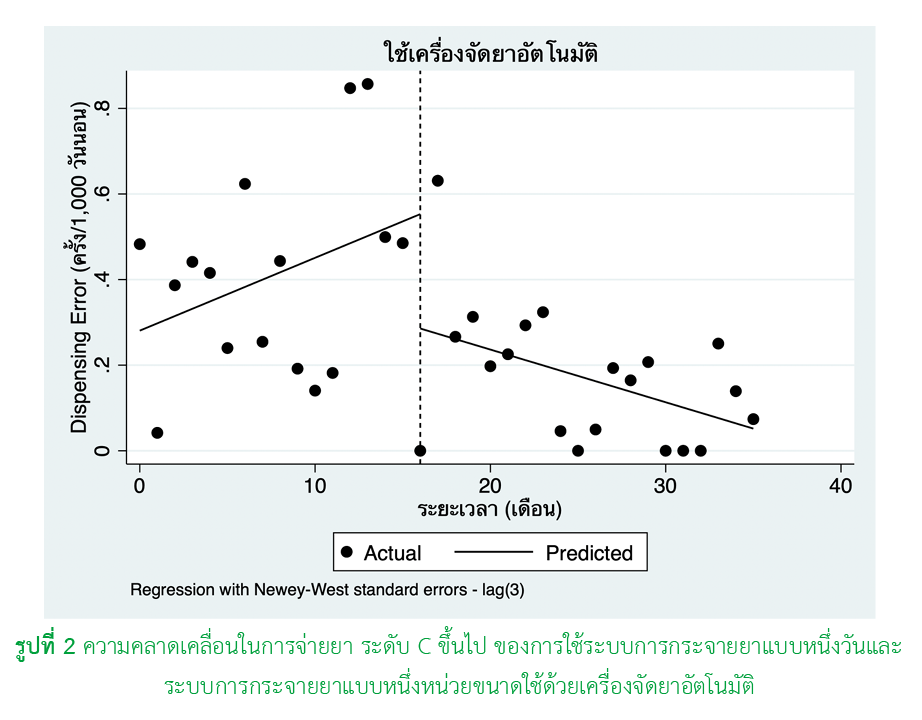
Results: Dispensing errors of severity level C and above decreased significantly (p-value = 0.004). However, administration errors increased, though not significantly (p-value = 0.732). The duration of drug dispensing lengthened (p-value = 0.003), and the completion rate of continued drug dispensing within the set time decreased (p-value = 0.006). Nurses were highly satisfied with the reduction of their workload in tablet administration. Pharmacy support staff expressed greater satisfaction with the system than pharmacy technicians and pharmacists.
Conclusion: The automated unit-dose drug dispenser for inpatients reduced drug dispensing errors but increased drug administration errors of severity level C and above. Additionally, the system increased the time required for dispensing tasks. Nevertheless, both pharmacy and nursing staff reported high overall satisfaction with the system.
References
งานศูนย์ข้อมูลและสถิติ โรงพยาบาลลำปาง. รายงานประจำปีโรงพยาบาลลำปาง 2563 [อินเทอร์เน็ต]. ลำปาง: โรงพยาบาลลำปาง; 2563 [สืบค้นเมื่อ 15 ส.ค. 2567]. สืบค้นได้จาก: http://www.lph.go.th/inforlpng/images/report/2563.pdf
ธิดา นิงสานนท์ และคณะ. กรอบงานพื้นฐานระบบยา [อินเทอร์เน็ต]. นนทบุรี: สถาบันรับรองคุณภาพสถานพยาบาล (สรพ.); 2563 [สืบค้นเมื่อ 15 ส.ค. 2567]. สืบค้นได้จาก: https://backend.ha.or.th/fileupload/DOCUMENT/00514/72647587-6d96-428e-8de6-9f9c3fd88776.pdf
วนิดา พุ่มไพศาลชัย, ศุภรัตน์ แสงเอื้ออังกูร, โสภิณ ชัยวุฒิ. ระบบการจ่ายยาแบบหนึ่งหน่วย (unit dose system). วารสารสุขภาพจิตแห่งประเทศไทย [อินเทอร์เน็ต]. 2545 [สืบค้นเมื่อ 31 ส.ค. 2567];10(1):49-54. สืบค้นได้จาก: https://he01.tci-thaijo.org/index.php/jmht/article/view/247102
Hänninen K, Ahtiainen HK, Suvikas-Peltonen EM, Tötterman AM. Automated unit dose dispensing systems producing individually packaged and labelled drugs for inpatients: a systematic review. Eur J Hosp Pharm. 2023;30(3):127-35. doi: 10.1136/ejhpharm-2021-003002.
National Coordinating Council for Medication Error Reporting and Prevention (NCC MERP). Index for categorizing medication errors [Internet]. n.p.: NCC MERP; 2022 [Cited 2024 Aug 31]. Available form: https://www.nccmerp.org/types-medication-errors
ศศิธร ลีลาสิริวิลาส. ความคลาดเคลื่อนในการใช้ยาเปรียบเทียบระหว่างระบบการกระจายยาแบบหนึ่งหน่วยการใช้และแบบหนึ่งวันการใช้ในโรงพยาบาลสุราษฏร์ธานี [วิทยานิพนธ์เภสัชศาสตรมหาบัณฑิต]. สงขลา: มหาวิทยาลัยสงขลานครินทร์; 2548.
เพียงเพ็ญ ชนาเทพาพร. ประสิทธิภาพและความปลอดภัยของระบบการจ่ายยาด้วยเครื่องจัดยาอัตโนมัติและอิเล็กทรอนิกส์จัดมือในผู้ป่วยในที่โรงพยาบาลศรีนครินทร์. ศรีนครินทร์เวชสาร [อินเทอร์เน็ต]. 2563 [สืบค้นเมื่อ 31 ส.ค. 2567];35(3):311-19. สืบค้นจาก: https://thaidj.org/index.php/smnj/article/view/9127
Sutra C, Vitale G, Pagès A, Shen PH ,Wu TT, Lin WL, et al. Automated unit-dose dispensing system: data collections and analysis of nonconformities over a 13-month period in Toulouse hospital. Pharm Hosp Clin [Internet]. 2016 [cited 2024 Jul 2];51(2):164–71. Available from: https://documentation.ehesp.fr/index.php?lvl=notice_display&id=314993
Darwesh BM, Machudo SY, John S. The experience of using an automated dispensing system to improve medication safety and management at King Abdul Aziz University Hospital. J Pharm Pract Community Med. 2017;3(3):114-9. doi: 10.5530/jppcm.2017.3.26.
อุกฤษฏ หมั่นภักดี. ความคิดเห็นบุคลากรทางการแพทยตอประสิทธิภาพระบบจัดยาอัตโนมัติของโรงพยาบาลรัฐในภาคตะวันออก [วิทยานิพนธ์ปริญญาบริหารธุรกิจมหาบัณฑิต]. กรุงเทพมหานคร: สาขาวิชาบริหารธุรกิจ มหาวิทยาลัยราชภัฏธนบุรี; 2560.
James KL, Barlow D, McArtney R, Hiom S, Roberts D, Whittlesea C. Incidence, type and causes of dispensing errors: a review of the literature. Int J Pharm Pract. 2009;17(1):9–30. doi: 10.1211/ijpp.17.1.0004.
Noparatayaporn P, Sakulbumrungsil R, Thaweethamcharoen T, Sangseenil W. Comparison on human resource requirement between manual and automated dispensing systems. Value Health Reg Issues. 2017:12:107-11. doi: 10.1016/j.vhri.2017.03.007.
Tu HN, Shan TH, Wu YC, Shen PH, Wu TY, Lin WL, et al. Reducing medication errors by adopting automatic dispensing cabinets in critical care units. J Med Syst. 2023;47(1):52. doi: 10.1007/s10916-023-01953-0.
Downloads
Published
How to Cite
Issue
Section
License
Copyright (c) 2025 Association of Hospital Pharmacy (Thailand)

This work is licensed under a Creative Commons Attribution-NonCommercial-NoDerivatives 4.0 International License.
บทความในวารสารเภสัชกรรมโรงพยาบาลเผยแพร่ภายใต้เงื่อนไขของสัญญาอนุญาตครีเอทีฟคอมมอนส์ในรูปแบบที่ต้องอ้างอิงแหล่งที่มา - ห้ามใช้เพื่อการค้า - ห้ามแก้ไขดัดแปลง เวอร์ชั่น 4.0 (CC BY-NC-ND 4.0) สามารถแจกจ่ายและนำบทความไปใช้ประโยชน์เพื่อการศึกษาได้แต่ต้องระบุการอ้างอิงถึงบทความจากเว็บไซต์วารสารเภสัชกรรมโรงพยาบาล ไม่สามารถนำบทความไปใช้เพื่อการพาณิชย์ใด ๆ เว้นแต่ได้รับอนุญาตจากบรรณาธิการวารสารเภสัชกรรมโรงพยาบาล และกรณีมีการนำบทความไปเรียบเรียงใหม่ เปลี่ยนแปลงเนื้อหา หรือเสริมเติมแต่งเนื้อหาของบทความ ท่านไม่สามารถนำบทความที่ปรับแต่งไปเผยแพร่ได้ในทุกกรณี
ข้อความที่ปรากฏในบทความในวารสารเป็นความคิดเห็นส่วนตัวของผู้แต่งแต่ละท่านไม่เกี่ยวข้องกับสมาคมเภสัชกรรมโรงพยาบาล (ประเทศไทย) และบุคลากรในสมาคมฯ แต่อย่างใด ความรับผิดชอบองค์ประกอบทั้งหมดของบทความแต่ละเรื่องเป็นของผู้แต่งแต่ละท่าน หากมีความผิดพลาดใด ๆ ผู้แต่งแต่ละท่านจะรับผิดชอบบทความของตนเอง ตลอดจนความรับผิดชอบด้านเนื้อหาและการตรวจร่างบทความเป็นของผู้แต่ง ไม่เกี่ยวข้องกับกองบรรณาธิการ


.png)

