
ยาที่ใช้รักษาโรคกระดูกพรุน
คำสำคัญ:
โรคกระดูกพรุน, ยาต้านการสลายกระดูก, ยากระตุ้นการสร้างกระดูก, กระดูกหักจากกระดูกพรุนบทคัดย่อ
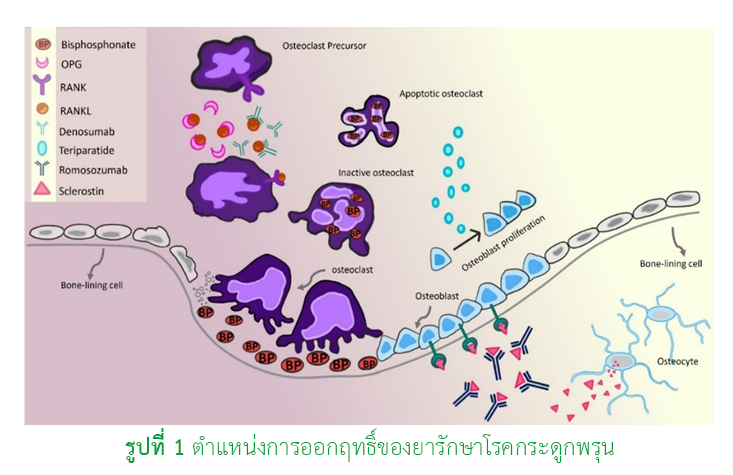
โรคกระดูกพรุนเป็นปัญหาสำคัญทางสาธารณสุข เกิดจากความผิดปกติของการเมแทบอลิซึมของ bone remodeling ทำให้มีการลดลงของความหนาแน่นของกระดูก เพิ่มความเสี่ยงของการเกิดกระดูกหักได้ โดยเฉพาะในผู้สูงอายุ ยาที่ใช้รักษาโรคกระดูกพรุนจึงเป็นยาที่ออกฤทธิ์โดยการลดการทำงานของ osteoclast เพื่อลดการสลายกระดูกและกระตุ้นการสร้างกระดูกโดย osteoblast ทั้งนี้การเลือกใช้ยาเพื่อรักษากระดูกพรุนนั้นให้พิจารณาตามความเสี่ยงของการเกิดกระดูกหัก ร่วมกับค่าความหนาแน่นของมวลกระดูก ตามคำแนะนำเวชปฏิบัติ การดูแลรักษาโรคกระดูกพรุน ของมูลนิธิโรคกระดูกพรุนแห่งประเทศไทย พ.ศ. 2564 ได้แนะนำให้ใช้ยาต้านการสลายกระดูกกลุ่ม bisphosphonates ในผู้ที่มีความเสี่ยงสูงต่อการเกิดกระดูกหักเป็นอันดับแรก แต่หากไม่สามารถใช้ยากลุ่ม bisphosphonates ได้ จึงจะพิจารณาใช้ denosumab สำหรับผู้ที่มีความเสี่ยงสูงมากต่อการเกิดกระดูกหัก ให้รักษาแบบต่อเนื่องด้วยยาที่มีฤทธิ์กระตุ้นการสร้างกระดูก ได้แก่ teriparatide หรือ romosozumab ตามด้วยยาต้านการสลายกระดูกกลุ่ม bisphosphonates หรือ denosumab อย่างไรก็ตาม ควรพิจารณาข้อบ่งใช้ อาการไม่พึงประสงค์ ข้อควรระวัง และข้อห้ามใช้ในการใช้ยาแต่ละชนิด ตลอดจนความร่วมมือในการใช้ยาของผู้ป่วยร่วมด้วยเสมอ
เอกสารอ้างอิง
NIH Consensus Development Panel on Osteoporosis Prevention, Diagnosis, and Therapy. Osteoporosis prevention, diagnosis, and therapy. JAMA. 2001;285(6):785–95. doi:10.1001/jama.285.6.785.
Langdahl BL. Overview of treatment approaches to osteoporosis. Br J Pharmacol. 2021;178(9):1891-906. doi: 10.1111/bph.15024.
Barnsley J, Buckland G, Chan PE, Ong A, Ramos AS, Baxter M, et al. Pathophysiology and treatment of osteoporosis: challenges for clinical practice in older people. Aging Clin Exp Res. 2021;33(4):759-73. doi: 10.1007/s40520-021-01817-y.
Kanis JA. Assessment of fracture risk and its application to screening for postmenopausal osteoporosis: synopsis of a WHO report. Osteoporos Int. 1994;4(6):368-81. doi: 10.1007/BF01622200.
Kanis JA, Johnell O, De Laet C, Johansson H, Oden A, Delmas P, et al. A meta-analysis of previous fracture and subsequent fracture risk. Bone. 2004;35(2):375-82. doi: 10.1016/j.bone.2004.03.024.
มูลนิธิโรคกระดูกพรุนแห่งประเทศไทย. คำแนะนำเวชปฏิบัติการดูแลรักษาโรคกระดูกพรุน พ.ศ. 2564. กรุงเทพมหานคร: มูลนิธิโรคกระดูกพรุนแห่งประเทศไทย; 2565.
University of Sheffield. Fracture risk assessment tool [Internet]. Sheffield: University of Sheffield; 2019 [cited 2024 Oct 11]. Available from: https://frax.shef.ac.uk/frax/tool.aspx?country=57
IOF. Calcium patient factsheet [Internet]. Nyon: International Osteoporosis Foundation (IOF); 2019 [cited 2025 Mar 31]. Available from: https://www.osteoporosis.foundation/system/files/eh/2019-12/Patient_calcium-factsheet.pdf
Boucher BJ. The problems of vitamin D insufficiency in older people. Aging Dis. 2012;3(4):313-29. PMID: 23185713.
Schwinghammer TL. Chapter 3. Osteoporosis. In: Schwinghammer TL, DiPiro JT, Ellingrod VL, DiPiro CV, editors. Pharmacotherapy handbook. 11th ed [Internet]. n.p.: McGraw Hill.; 2021. [cited 2023 Jul 14]. Available from: https://accesspharmacy.mhmedical.com/content.aspx?bookid=3012§ionid=253433831
Weaver CM, Alexander DD, Boushey CJ, Dawson-Hughes B, Lappe JM, LeBoff MS, et al. Calcium plus vitamin D supplementation and risk of fractures: an updated meta-analysis from the National Osteoporosis Foundation. Osteoporos Int. 2016;27(1):367-76. doi: 10.1007/s00198-015-3386-5.
Miller PD, Jamal SA, Evenepoel P, Eastell R, Boonen S. Renal safety in patients treated with bisphosphonates for osteoporosis: a review. J Bone Miner Res. 2013;28(10):2049-59. doi: 10.1002/jbmr.2058.
Wang M, Wu YF, Girgis CM. Bisphosphonate drug holidays: evidence from clinical trials and real-world studies. JBMR Plus. 2022;6(6):e10629. doi: 10.1002/jbm4.10629.
Amgen Inc. PROLIA® (denosumab) injection, for subcutaneous use [Internet]. n.p.: U.S. Food and Drug Administration; 2022 [cited 2023 Jul 23]. Available from: https://www.accessdata.fda.gov/drugsatfda_docs/label/2023/125320Orig1s211lbl.pdf
Tsourdi E, Yu EW, Jan de Beur SM, Drake MT. Vaccination for coronavirus disease 2019 (COVID-19) and relationship to osteoporosis care: current evidence and suggested approaches. J Bone Miner Res. 2021;36(6):1042-7. doi: 10.1002/jbmr.4304.
Hodsman AB, Bauer DC, Dempster DW, Dian L, Hanley DA, Harris ST, et al. Parathyroid hormone and teriparatide for the treatment of osteoporosis: a review of the evidence and suggested guidelines for its use. Endocr Rev. 2005;26(5):688-703. doi: 10.1210/er.2004-0006.
Amgen. Evenity® [Package insert]. Bangkok: Amgen (Thailand) Ltd.; 2020.
Organon. Fosamax® Plus [Package insert]. Bangkok: Organon (Thailand) Ltd.; 2023.
Zuellig pharma. Actonel® [Package insert]. Bangkok: Zuellig pharma Ltd.; 2019.
DKSH. Bonviva® [Package insert]. Bangkok: DKSH (Thailand) Ltd; 2019.
Genentech (USA) Inc. BONIVA® (ibandronate sodium) injection, for intravenous use [Internet]. n.p.: U.S. Food and Drug Administration; 2022 [cited 2023 Jul 23]. Available from: https://www.accessdata.fda.gov/drugsatfda_docs/label/2022/021858Orig1s023lbl.pdf
Alvogen. Aclasta® [Package insert]. Bangkok: Alvogen (Thailand) Ltd; 2018.
Lilly (USA) Llc. FORTEO® (teriparatide) injection, for subcutaneous use [Internet]. n.p.: U.S. Food and Drug Administration; 2021[cited 2023 Jul 23]. Available from: https://www.accessdata.fda.gov/drugsatfda_docs/label/2021/021318Orig1s056lbl.pdf
Vaisman-Mentesh A, Gutierrez-Gonzalez M, DeKosky BJ, Wine Y. The molecular mechanisms that underlie the immune biology of anti-drug antibody formation following treatment with monoclonal antibodies. Front Immunol. 2020;11:1951. doi: 10.3389/fimmu.2020.01951.
ดาวน์โหลด
เผยแพร่แล้ว
รูปแบบการอ้างอิง
ฉบับ
ประเภทบทความ
สัญญาอนุญาต
ลิขสิทธิ์ (c) 2025 สมาคมเภสัชกรรมโรงพยาบาล(ประเทศไทย)

อนุญาตภายใต้เงื่อนไข Creative Commons Attribution-NonCommercial-NoDerivatives 4.0 International License.
บทความในวารสารเภสัชกรรมโรงพยาบาลเผยแพร่ภายใต้เงื่อนไขของสัญญาอนุญาตครีเอทีฟคอมมอนส์ในรูปแบบที่ต้องอ้างอิงแหล่งที่มา - ห้ามใช้เพื่อการค้า - ห้ามแก้ไขดัดแปลง เวอร์ชั่น 4.0 (CC BY-NC-ND 4.0) สามารถแจกจ่ายและนำบทความไปใช้ประโยชน์เพื่อการศึกษาได้แต่ต้องระบุการอ้างอิงถึงบทความจากเว็บไซต์วารสารเภสัชกรรมโรงพยาบาล ไม่สามารถนำบทความไปใช้เพื่อการพาณิชย์ใด ๆ เว้นแต่ได้รับอนุญาตจากบรรณาธิการวารสารเภสัชกรรมโรงพยาบาล และกรณีมีการนำบทความไปเรียบเรียงใหม่ เปลี่ยนแปลงเนื้อหา หรือเสริมเติมแต่งเนื้อหาของบทความ ท่านไม่สามารถนำบทความที่ปรับแต่งไปเผยแพร่ได้ในทุกกรณี
ข้อความที่ปรากฏในบทความในวารสารเป็นความคิดเห็นส่วนตัวของผู้แต่งแต่ละท่านไม่เกี่ยวข้องกับสมาคมเภสัชกรรมโรงพยาบาล (ประเทศไทย) และบุคลากรในสมาคมฯ แต่อย่างใด ความรับผิดชอบองค์ประกอบทั้งหมดของบทความแต่ละเรื่องเป็นของผู้แต่งแต่ละท่าน หากมีความผิดพลาดใด ๆ ผู้แต่งแต่ละท่านจะรับผิดชอบบทความของตนเอง ตลอดจนความรับผิดชอบด้านเนื้อหาและการตรวจร่างบทความเป็นของผู้แต่ง ไม่เกี่ยวข้องกับกองบรรณาธิการ


.png)

