Evaluation of Rational Use of Antibiotics for Acute Diarrhea in a University Hospital
Keywords:
rational drug use, rational drug use of antibiotics, diarrhea, acute diarrheaAbstract
Background: The Ministry of Public Health has set a benchmark for the use of antibiotics in acute diarrhea as an indicator of rational drug use, aiming for a usage rate of no more than 20%. Maharaj Nakorn Chiang Mai Hospital has not previously assessed the appropriateness of antibiotic use in this patient population.
Objectives: To study the patterns and appropriateness of antibiotic prescribing for acute diarrhea patients based on Thailand's rational drug use guidelines.
Methods: This retrospective descriptive study focused on patients aged 15-59 years diagnosed with acute diarrhea who were prescribed antibiotics at the outpatient department in 2021. Data were analyzed using descriptive statistics.
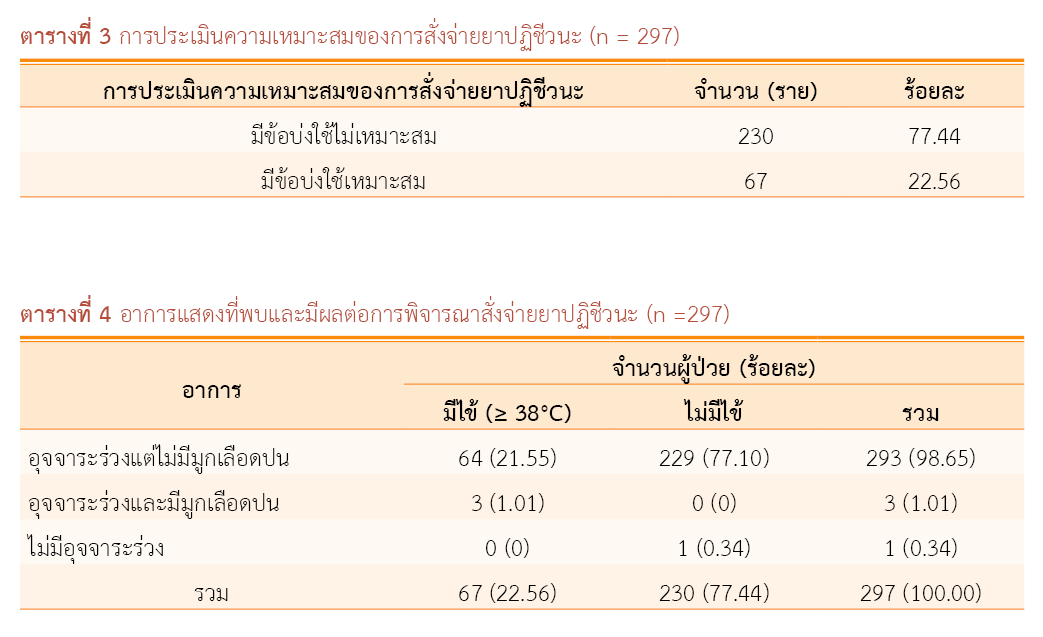
Results: Appropriateness assessment was performed in 290 patients and 77.44% of patients had no indication for antibiotics. The most frequently prescribed antibiotic was norfloxacin 400 mg twice daily for 5 days (50.84%).
Conclusion: Over 77% of acute diarrhea patients were not indicated for antibiotic therapy according to rational drug use guidelines. Excessive antibiotic use may lead to antibiotic resistance and unnecessary healthcare costs.
References
World Health Organization. Promoting rational use of medicines: core components. [Internet]. n.p.: World Health Organization; 2023 [cited 2023 Oct 31]. Available from: https://www.who.int/activities/promoting-rational-use-of-medicines
Friedman ND, Temkin E, Carmeli Y. The negative impact of antibiotic resistance. Clin Microbiol Infect. 2016;22(5):416-22. doi: 10.1016/j.cmi.2015.12.002.
Naylor NR, Atun R, Zhu N, Kulasabanathan K, Silva S, Chatterjee A, et al. Estimating the burden of antimicrobial resistance: a systematic literature review. Antimicrob Resist Infect Control. 2018;7:28. doi: 10.1186/s13756-018-0336-y.
กรมควบคุมโรค กระทรวงสาธารณสุข ร่วมกับสมาคมแพทย์โรคระบบทางเดินอาหารแห่งประเทศไทย. แนวทางการดูแลรักษาผู้ป่วยโรคอุจจาระร่วงเฉียบพลันในผู้ใหญ่. พิมพ์ครั้งที่ 2 [อินเทอร์เน็ต]. กรุงเทพมหานคร: สมาคมแพทย์โรคระบบทางเดินอาหารแห่งประเทศไทย; 2546 [สืบค้นเมื่อ 3 พ.ย. 2566]. สืบค้นจาก: https://www.gastrothai.net/th/guideline-detail.php?content_id=33
คณะอนุกรรมการส่งเสริมการใช้ยาอย่างสมเหตุผล. คู่มือการดำเนินงานโครงการโรงพยาบาลส่งเสริมการใช้ยาอย่างสมเหตุผล (rational drug use hospital manual) [อินเทอร์เน็ต]. นนทบุรี: กองนโยบายแห่งชาติด้านยา สำนักงานคณะกรรมการอาหารและยา กระทรวงสาธารณสุข; 2558 [สืบค้นเมื่อ 3 พ.ย. 2566]. หน้า 89-90. สืบค้นจาก: https://ndp.fda.moph.go.th/rational-drug-use/rdu-manual/
อดิศักดิ์ วงค์ใน. การสั่งจ่ายยาปฏิชีวนะในผู้ป่วยโรคอุจจาระร่วงเฉียบพลันที่โรงพยาบาลสมเด็จพระยุพราชปัว จังหวัดน่าน. วารสารวิจัยระบบสาธารณสุข [อินเทอร์เน็ต]. 2554 [สืบค้นเมื่อ 10 พ.ย. 2566];5(2):181-6. สืบค้นจาก: https://kb.hsri.or.th/dspace/handle/11228/3247?show=full &locale- attribute=th
ดุสิตา ตู้ประกาย. การใช้ยาปฏิชีวนะอย่างเหมาะสมสำหรับโรคอุจจาระร่วงเฉียบพลันในผู้ป่วยนอกศูนย์สุขภาพชุมชนในเขตเมืองของโรงพยาบาลลำปาง. พุทธชินราชเวชสาร [อินเทอร์เน็ต]. 2562 [สืบค้นเมื่อ 10 พ.ย. 2566];36(3):274-81. สืบค้นจาก: https://he01.tci-thaijo.org/index.php/BMJ/article/view/243487
Downloads
Published
How to Cite
Issue
Section
License
Copyright (c) 2025 Association of Hospital Pharmacy (Thailand)

This work is licensed under a Creative Commons Attribution-NonCommercial-NoDerivatives 4.0 International License.
บทความในวารสารเภสัชกรรมโรงพยาบาลเผยแพร่ภายใต้เงื่อนไขของสัญญาอนุญาตครีเอทีฟคอมมอนส์ในรูปแบบที่ต้องอ้างอิงแหล่งที่มา - ห้ามใช้เพื่อการค้า - ห้ามแก้ไขดัดแปลง เวอร์ชั่น 4.0 (CC BY-NC-ND 4.0) สามารถแจกจ่ายและนำบทความไปใช้ประโยชน์เพื่อการศึกษาได้แต่ต้องระบุการอ้างอิงถึงบทความจากเว็บไซต์วารสารเภสัชกรรมโรงพยาบาล ไม่สามารถนำบทความไปใช้เพื่อการพาณิชย์ใด ๆ เว้นแต่ได้รับอนุญาตจากบรรณาธิการวารสารเภสัชกรรมโรงพยาบาล และกรณีมีการนำบทความไปเรียบเรียงใหม่ เปลี่ยนแปลงเนื้อหา หรือเสริมเติมแต่งเนื้อหาของบทความ ท่านไม่สามารถนำบทความที่ปรับแต่งไปเผยแพร่ได้ในทุกกรณี
ข้อความที่ปรากฏในบทความในวารสารเป็นความคิดเห็นส่วนตัวของผู้แต่งแต่ละท่านไม่เกี่ยวข้องกับสมาคมเภสัชกรรมโรงพยาบาล (ประเทศไทย) และบุคลากรในสมาคมฯ แต่อย่างใด ความรับผิดชอบองค์ประกอบทั้งหมดของบทความแต่ละเรื่องเป็นของผู้แต่งแต่ละท่าน หากมีความผิดพลาดใด ๆ ผู้แต่งแต่ละท่านจะรับผิดชอบบทความของตนเอง ตลอดจนความรับผิดชอบด้านเนื้อหาและการตรวจร่างบทความเป็นของผู้แต่ง ไม่เกี่ยวข้องกับกองบรรณาธิการ

.png)

