Outcomes of Pharmacy Automation System Development for Outpatient Services at Maharat Nakhon Ratchasima Hospital
Keywords:
pharmacy automation system, medication errors, medication safetyAbstract
Background: Pharmacy automation systems are widely accepted for their capacity to reduce medication errors; nevertheless, errors continue to be observed in the automation systems currently implemented in the hospital. The research team has further developed the dispensing system to enhance medication safety.
Objective: To evaluate the outcomes of developing dispensing system using pharmacy automation in terms of medication errors and drug waiting time.
Methods: This quasi-experimental study compared data before and after system development. The study population comprised all outpatient prescriptions serviced before system development (October 1, 2021 – May 31, 2023) and after system development (October 1, 2023 – September 30, 2024). The developed system utilized barcode/QR code technology on medication packages to verify accuracy. If the data (type, strength, dosage form, and quantity) matched the medication information recorded in the hospital information system, the medication label would be automatically printed. Descriptive data were analyzed using percentages and means. Proportion comparisons were performed using two-proportion Z-test.
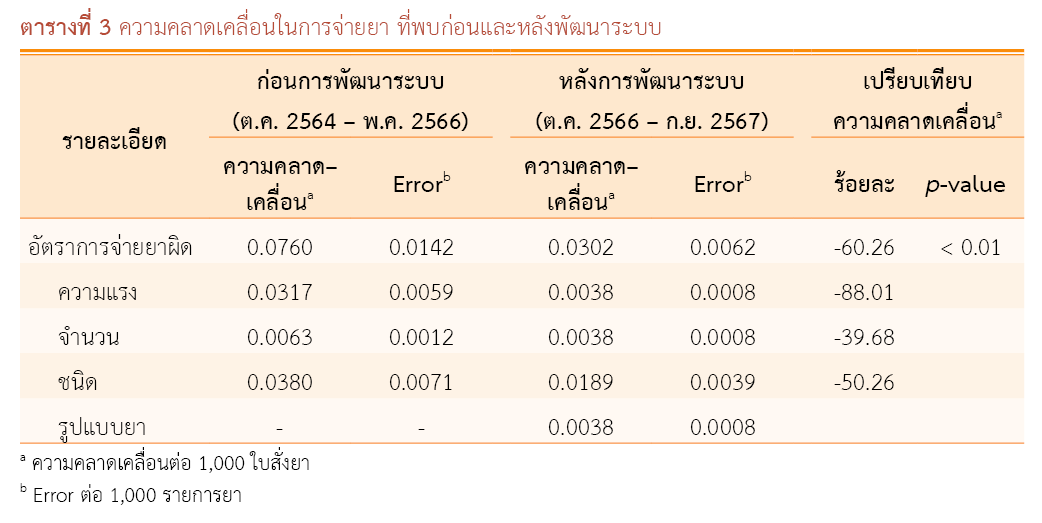
Results: After system development, medication errors during preparation process decreased from 28.50 to 18.17 per 1,000 prescriptions, representing a 36.25% reduction (p-value < 0.001). In the medication checking process, errors decreased from 4.23 to 3.37 per 1,000 prescriptions, representing a 20.21% reduction (p-value < 0.001). Dispensing errors rate decreased from 0.0760 to 0.0302 per 1,000 prescriptions, representing a 60.26% reduction (p-value < 0.01). However, the average drug waiting time increased from 29.15 minutes to 35.16 minutes.
Conclusion: The developed system resulted in statistically significant reductions in medication errors across all stages: preparation process, checking process and dispensing process. However, drug waiting time increased resulted from increased number of prescriptions and lower process resources.
References
ปัญญาภรณ์ เกตุคร้าม, กรแก้ว จันทภาษา. ความคิดเห็นของเภสัชกรเกี่ยวกับประโยชน์ของหุ่นยนต์จัดยาอัตโนมัติ. วารสารไทยเภสัชศาสตร์และวิทยาการสุขภาพ [อินเทอร์เน็ต]. 2565 [สืบค้นเมื่อ 10 ส.ค. 2566];17(3):226-34. สืบค้นจาก: https://ejournals.swu.ac.th/index.php/pharm/article/view/14725
สถาบันรับรองคุณภาพสถานพยาบาล (องค์การมหาชน). เป้าหมายความปลอดภัยของผู้ป่วยของประเทศไทย พ.ศ. 2561 (Patient safety goals: SIMPLE Thailand 2018) [อินเทอร์เน็ต]. นนทบุรี: สถาบันรับรองคุณภาพสถานพยาบาล (องค์การมหาชน); 2561 [สืบค้นเมื่อ 10 ส.ค. 2566]. สืบค้นจาก: https://www.ha.or.th/TH/Posts/สาระ-องค์ความรู้/details/172#
Sriboonruang P, Rattanamahattana M. Barcode scanning technology to improve pre-dispensing errors. GMSMJ [Internet]. 2023 [cite 2023 Aug 1];3(1):7-12. Available from: https://he02.tci-thaijo.org/index.php/gmsmj/article/view/260455
Takase T, Masumoto N, Shibatani N, Matsuoka Y, Tanaka F, Hirabatake M, et al. Evaluating the safety and efficiency of robotic dispensing systems. J Pharm Health Care Sci. 2022;8(1):24. doi: 10.1186/s40780-022-00255-w.
เพียงเพ็ญ ชนาเทพาพร. การศึกษาความคลาดเคลื่อนการจัดยาของเครื่องจัดยาอัตโนมัติและตู้อิเล็กทรอนิกส์จัดยาแบบต่าง ๆ ในการบริการจ่ายยา ผู้ป่วยในที่โรงพยาบาลศรีนครินทร์. วารสารเภสัชศาสตร์อีสาน. 2563;16(3):39-51. doi: 10.14456/ijps.2020.16.
เพียงเพ็ญ ชนาเทพาพร. ประสิทธิภาพและความปลอดภัยของระบบการจ่ายยาด้วยเครื่องจัดยาอัตโนมัติและอิเล็กทรอนิกส์จัดมือในผู้ป่วยในที่โรงพยาบาลศรีนครินทร์. ศรีนครินทร์เวชสาร [อินเทอร์เน็ต]. 2563 [สืบค้นเมื่อ 17 มิ.ย. 2566];35(3):311-9. สืบค้นจาก: https://thaidj.org/index.php/smnj/article/view/9127
กรมสุขภาพจิต. สรุปผลการประเมินด้านการบริหารจัดการและพัฒนานวัตกรรมในการบริหารจัดการ (innovation base) ของกรมสุขภาพจิตประจำปีงบประมาณ 2562 [อินเทอร์เน็ต]. นนทบุรี: กรมสุขภาพจิต กระทรวงสาธารณสุข; 2562 [สืบค้นเมื่อ 22 เม.ย. 2566]. สืบค้นจาก: https://doc.dmh.go.th/guest/report/innovation/view.asp?id=17
Downloads
Published
How to Cite
Issue
Section
License
Copyright (c) 2026 Association of Hospital Pharmacy (Thailand)

This work is licensed under a Creative Commons Attribution-NonCommercial-NoDerivatives 4.0 International License.
บทความในวารสารเภสัชกรรมโรงพยาบาลเผยแพร่ภายใต้เงื่อนไขของสัญญาอนุญาตครีเอทีฟคอมมอนส์ในรูปแบบที่ต้องอ้างอิงแหล่งที่มา - ห้ามใช้เพื่อการค้า - ห้ามแก้ไขดัดแปลง เวอร์ชั่น 4.0 (CC BY-NC-ND 4.0) สามารถแจกจ่ายและนำบทความไปใช้ประโยชน์เพื่อการศึกษาได้แต่ต้องระบุการอ้างอิงถึงบทความจากเว็บไซต์วารสารเภสัชกรรมโรงพยาบาล ไม่สามารถนำบทความไปใช้เพื่อการพาณิชย์ใด ๆ เว้นแต่ได้รับอนุญาตจากบรรณาธิการวารสารเภสัชกรรมโรงพยาบาล และกรณีมีการนำบทความไปเรียบเรียงใหม่ เปลี่ยนแปลงเนื้อหา หรือเสริมเติมแต่งเนื้อหาของบทความ ท่านไม่สามารถนำบทความที่ปรับแต่งไปเผยแพร่ได้ในทุกกรณี
ข้อความที่ปรากฏในบทความในวารสารเป็นความคิดเห็นส่วนตัวของผู้แต่งแต่ละท่านไม่เกี่ยวข้องกับสมาคมเภสัชกรรมโรงพยาบาล (ประเทศไทย) และบุคลากรในสมาคมฯ แต่อย่างใด ความรับผิดชอบองค์ประกอบทั้งหมดของบทความแต่ละเรื่องเป็นของผู้แต่งแต่ละท่าน หากมีความผิดพลาดใด ๆ ผู้แต่งแต่ละท่านจะรับผิดชอบบทความของตนเอง ตลอดจนความรับผิดชอบด้านเนื้อหาและการตรวจร่างบทความเป็นของผู้แต่ง ไม่เกี่ยวข้องกับกองบรรณาธิการ


.png)

