
Incidence and Factors Associated with Dyslipidemia in Newly Diagnosed Type 2 Diabetes Patients: A 4-Year Follow-up Study
Keywords:
type 2 diabetes mellitus, dyslipidemia, longitudinal studyAbstract
Background: Dyslipidemia is a common comorbidity in patients with type 2 diabetes mellitus and is a significant factor leading to complications and reduced quality of life.
Objective: To determine the incidence and study the factors associated with the development of dyslipidemia in newly diagnosed type 2 diabetes mellitus (T2DM) patients.
Methods: This retrospective cohort study enrolled data from the 43-file database covering Healthcare Region 10. New onset type 2 diabetic patients (ICD10: E11X) diagnosed between 2015 and 2017 were followed for 4 years to determine the incidence of dyslipidemia (ICD10: E78X). Associated factors were analyzed using a parametric survival model. Time ratio (TR) was reported.
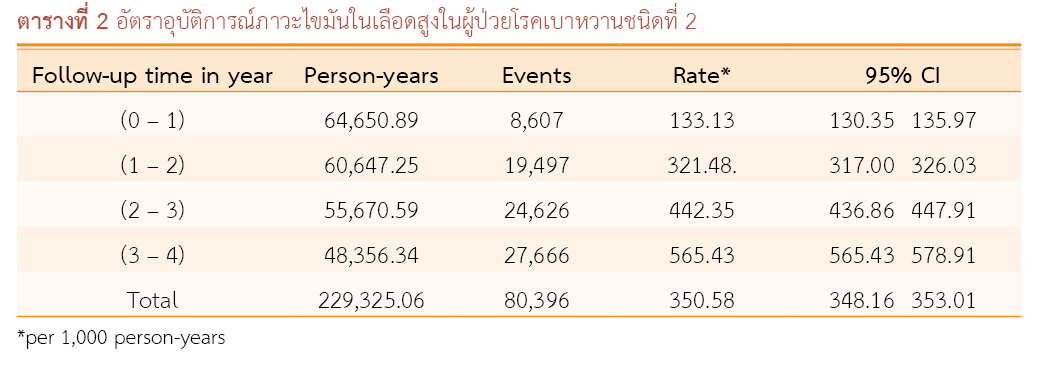
Results: Of the 80,001 newly diagnosed type 2 diabetic patients who met the inclusion criteria, 49,528 (61.91%) were female, and the mean ± SD age was 57.37 ± 12.31 years. The incidence rate of dyslipidemia was 350.58 episodes per 1,000 person-years. Factors significantly associated with the earlier development of dyslipidemia were age diagnosed with T2DM (TR = 0.918, p-value<0.001), being male (TR = 0.965, p-value<0.001), having hypertension (TR = 0.976, p-value=0.007). In contrast, current age (TR = 1.092; p-value<0.001) and a history of hypertension prior to diabetes diagnosis (TR = 1.048; p-value=0.002) were associated with a longer time to dyslipidemia.
Conclusion: Among patients with newly diagnosed T2DM, older age at diabetes diagnosis, male sex, and hypertension were associated with a shorter time to dyslipidemia, whereas current age and prior hypertension were associated with a longer time to dyslipidemia. These findings highlight the importance of systematic screening and appropriate management of dyslipidemia among high-risk T2DM patients.
References
International Diabetes Federation. Diabetes around the world in 2024 [Internet]. Brussels: The International Diabetes Federation (IDF); 2025 [cited 2025 Sep 3]. Available from: https://idf.org/about-diabetes/diabetes-facts-figures/
ระบบคลังข้อมูลด้านการแพทย์และสุขภาพ (HDC). อัตราป่วยรายใหม่ของโรคเบาหวานต่อแสนประชากรในปีงบประมาณ [อินเทอร์เน็ต]. นนทบุรี: ศูนย์เทคโนโลยีสารสนเทศและการสื่อสาร สำนักงานปลัดกระทรวงสาธารณสุข; 2568 [สืบค้นเมื่อ 23 ธ.ค. 2568]. สืบค้นจาก: https://hdc.moph.go.th/center/public/standard-report-detail/eeeab22e386d32e7f5f5ecefebce0001
อรทัย เขียวเจริญ, ชัชชน ประเสริฐวรกุล, ธันวา ขัติยศ, เฌอมาณัฎฐ์ ศรีวงค์ชัย, ทยาภา ศรีศิริอนันต์, พงษ์ลัดดา หล่ำพู่, และคณะ. ต้นทุนบริการผู้ป่วยนอกรายโรคจากข้อมูลผู้ป่วยรายบุคคลจากการศึกษาต้นทุนรายโรคระยะที่ 1. สรรพสาร สมสส. 2566;1(7):100-12. doi: 10.14456/hispa.2023.7..
Li Y, Zhao L, Yu D, Ding G. The prevalence and risk factors of dyslipidemia in different diabetic progression stages among middle-aged and elderly populations in China. PLoS One. 2018;13(10):e0205709. doi: 10.1371/journal.pone.0205709.
Li J, Nie Z, Ge Z, Shi L, Gao B, Yang Y. Prevalence of dyslipidemia, treatment rate and its control among patients with type 2 diabetes mellitus in Northwest China: a cross-sectional study. Lipids Health Dis. 2022;21(1):77. doi: 10.1186/s12944-022-01691-1.
กุลธิดา สุทธิโชติ, นรีวรรณ เขียวอิ่ม, นิธิกุล เต็มเอี่ยม. ความสัมพันธ์ของระยะการป่วยเป็นเบาหวานและการควบคุมระดับน้ำตาลต่อการเกิดภาวะจอตาผิดปกติจากเบาหวานในผู้ป่วยเบาหวานชนิดที่ 2 โรงพยาบาลศรีสะเกษ. วารสารระบบบริการปฐมภูมิและเวชศาสตร์ครอบครัว [อินเทอร์เน็ต]. 2566 [สืบค้นเมื่อ 27 ก.ย. 2568];6(1):74-86. สืบค้นจาก: https://so03.tci-thaijo.org/index.php/PCFM/article/view/259590
Euswas N, Phonnopparat N, Morasert K, Thakhampaeng P, Kaewsanit A, Mungthin M, et al. National trends in the prevalence of diabetic retinopathy among Thai patients with type 2 diabetes and its associated factors from 2014 to 2018. PLoS One. 2021;16(1):e0245801. doi: 10.1371/journal.pone.0245801.
Li Z, Yuan Y, Qi Q, Wang Q, Feng L. Relationship between dyslipidemia and diabetic retinopathy in patients with type 2 diabetes mellitus: a systematic review and meta-analysis. Syst Rev. 2023;12(1):148. doi: 10.1186/s13643-023-02321-2.
Zayed MG, Karsan W, Peto T, Saravanan P, Virgili G, Preiss D. Diabetic retinopathy and quality of Life: a systematic review and meta-analysis. JAMA Ophthalmol. 2024;142(3):199-207. doi: 10.1001/jamaophthalmol.2023.6435.
Narindrarangkura P, Bosl W, Rangsin R, Hatthachote P. Prevalence of dyslipidemia associated with complications in diabetic patients: a nationwide study in Thailand. Lipids Health Dis. 2019;18(1):90. doi: 10.1186/s12944-019-1034-3.
Li Q, Jiang Y, Song A, Li Y, Xu X, Xu R. The association between chronological age and dyslipidemia: a cross-sectional study in Chinese aged population. Clin Interv Aging. 2023;18:667-75. doi: 10.2147/cia.S406237.
Hu ZH, Connett JE, Yuan JM, Anderson KE. Role of survivor bias in pancreatic cancer case-control studies. Ann Epidemiol. 2016;26(1):50-6. doi: 10.1016/j.annepidem.2015.11.001.
MacKinnon DP, Krull JL, Lockwood CM. Equivalence of the mediation, confounding and suppression effect. Prev Sci. 2000;1(4):173-81. doi: 10.1023/a:1026595011371.
Mehta RK, Koirala P, Mallick RL, Parajuli S, Jha R. Dyslipidemia in patients with type 2 diabetes mellitus in a tertiary care centre: a descriptive cross-sectional study. J Nepal Med Assoc. 2021;59(236):305-9. doi: 10.31729/jnma.6278.
Bello-Ovosi BO, Ovosi JO, Ogunsina MA, Asuke S, Ibrahim MS. Prevalence and pattern of dyslipidemia in patients with type 2 diabetes mellitus in Zaria, Northwestern Nigeria. Pan Afr Med J. 2019;34:123. doi: 10.11604/pamj.2019.34.123.18717.
Pedersen AB, Mikkelsen EM, Cronin-Fenton D, Kristensen NR, Pham TM, Pedersen L, et al. Missing data and multiple imputation in clinical epidemiological research. Clin Epidemiol. 2017;9:157-66. doi: 10.2147/CLEP.S129785.
Rosoff DB, Davey Smith G, Mehta N, Clarke TK, Lohoff FW. Evaluating the relationship between alcohol consumption, tobacco use, and cardiovascular disease: a multivariable Mendelian randomization study. PLoS Med. 2020;17(12):e1003410. doi: 10.1371/journal.pmed.1003410.
Santos MR, Pereira A, Sousa JA, Mendonca F, Monteiro JP, Temtem M, et al. High density lipoprotein cholesterol and alcohol consumption: are they related? Eur Heart J Acute Cardiovasc Care. 2021;10(Suppl 1):zuab020.216. doi: 10.1093/ehjacc/zuab020.216.
Suzuki T, Fukui S, Shinozaki T, Asano T, Yoshida T, Aoki J, et al. Lipid profiles after changes in alcohol consumption among adults undergoing annual checkups. JAMA Netw Open. 2025;8(3):e250583. doi: 10.1001/jamanetworkopen.2025.0583.
Downloads
Published
How to Cite
Issue
Section
License
Copyright (c) 2026 Association of Hospital Pharmacy (Thailand)

This work is licensed under a Creative Commons Attribution-NonCommercial-NoDerivatives 4.0 International License.
บทความในวารสารเภสัชกรรมโรงพยาบาลเผยแพร่ภายใต้เงื่อนไขของสัญญาอนุญาตครีเอทีฟคอมมอนส์ในรูปแบบที่ต้องอ้างอิงแหล่งที่มา - ห้ามใช้เพื่อการค้า - ห้ามแก้ไขดัดแปลง เวอร์ชั่น 4.0 (CC BY-NC-ND 4.0) สามารถแจกจ่ายและนำบทความไปใช้ประโยชน์เพื่อการศึกษาได้แต่ต้องระบุการอ้างอิงถึงบทความจากเว็บไซต์วารสารเภสัชกรรมโรงพยาบาล ไม่สามารถนำบทความไปใช้เพื่อการพาณิชย์ใด ๆ เว้นแต่ได้รับอนุญาตจากบรรณาธิการวารสารเภสัชกรรมโรงพยาบาล และกรณีมีการนำบทความไปเรียบเรียงใหม่ เปลี่ยนแปลงเนื้อหา หรือเสริมเติมแต่งเนื้อหาของบทความ ท่านไม่สามารถนำบทความที่ปรับแต่งไปเผยแพร่ได้ในทุกกรณี
ข้อความที่ปรากฏในบทความในวารสารเป็นความคิดเห็นส่วนตัวของผู้แต่งแต่ละท่านไม่เกี่ยวข้องกับสมาคมเภสัชกรรมโรงพยาบาล (ประเทศไทย) และบุคลากรในสมาคมฯ แต่อย่างใด ความรับผิดชอบองค์ประกอบทั้งหมดของบทความแต่ละเรื่องเป็นของผู้แต่งแต่ละท่าน หากมีความผิดพลาดใด ๆ ผู้แต่งแต่ละท่านจะรับผิดชอบบทความของตนเอง ตลอดจนความรับผิดชอบด้านเนื้อหาและการตรวจร่างบทความเป็นของผู้แต่ง ไม่เกี่ยวข้องกับกองบรรณาธิการ


.png)

