
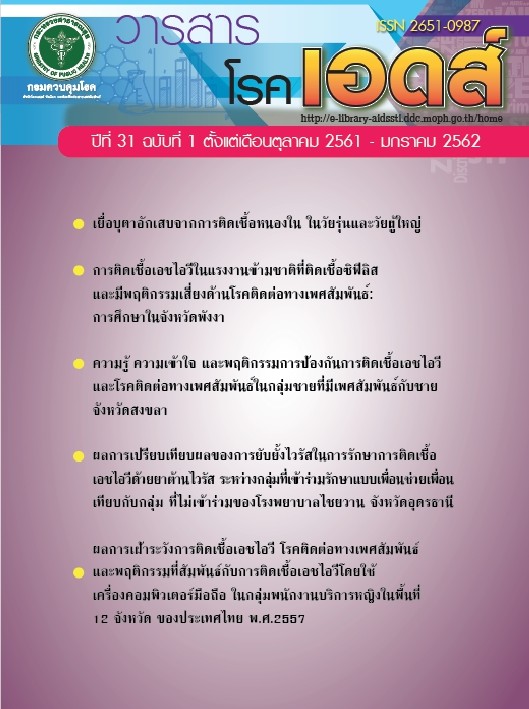
Integrated HIV/STI Biological and Behavioral Surveillance among Female Sex Workers Using Handheld Computer in 12 Provinces in Thailand: Results from a Survey in 2014
DOI:
https://doi.org/10.14456/taj.2019.5Keywords:
Surveillance system, HIV infection rate, Sexually transmitted infection rate, behavior related to HIV infection, Female sex workerAbstract
Bureau of Epidemiology, Department of Disease Control has developed an integrated HIV/sexually transmitted infction (STI) biological and behavioral surveillance (IBBS) among female sex workers (FSW) in order to collect information which can explain the relationship between HIV and sexually transmitted infections with behaviors in a more comprehensive way. The first survey was performed in 12 provinces in 2010. The second survey was repeated in 2013, using handheld computer to collect behavior data. This report aims to describe the results of the second survey. FSW in the survey were 15-49 years old. Blood and urine samples were collected to test for HIV infection and sexually transmitted infection including Neisseria gonorrhea and Chlamydia trachomatis. Subjects responded to self-administered questionnaire using handheld computer. There were 3,254 FSWs participated in the survey. Of these, 1,103 (33.9%) were direct FSW and 2,151 (66.1%) were indirect FSW. The average age was 28.7±9 years old. Aggregated rates of HIV, Neisseria gonorrhea and Chlamydia trachomatis infection were 1.9, 4.2 and 18.1% respectively. For behavior data, 58.5% of FSW knew and used to receive distributed condoms and 88.8% had experience of HIV testing during the last one year before survey. 92.1% reported using condom in their last sex act. Data on condom used in every sex act during the past month was 95.2% with regular customer, 97.0 with periodic customer, 75.9% with other men and 27.3% with husband or boyfriend. The results of the survey showed lowering trend of HIV infection in FSW comparing to the 2010 results while in Neisseria gonorrhea and Chlamydia trachomatis infections, the trends had been highly increased. This increasing trend may be the effect from low rates of condom used with other men and husband or boyfriend. It is recommended that the STI control program must be strengthened in this group of population in order to get a better outcome in controlling the diseases.Downloads
Download data is not yet available.
References
1. UNAIDS, UNICEF and WHO. Epidemiological Fact Sheets onHIV/AIDS and Sexually Transmitted Infections–Thailand,2004 update. Geneva, Switzerland and New York, USA
2. WHO South–East Asia Regional Office and Ministry of Public Health, Thailand. External Review of the HealthSec-tor Response to HIV/AIDS in Thailand, 2005. Bangkok, Thailand
3. Joint United Nations Program on HIV/AIDS. Report on the global AIDS epidemic, 2006. Geneva, Switzerland
4. Report of AIDS situation in Thailand, 2006. Bureau of Epidemiology, Disease Control department, Ministry of Public Health, 2006
5. Heckathorn DD. Respondent driven sampling: A new approach to the study of hidden populations. Social Prob-lems 1997; 44: 174–199 6. Heckathorn DD. Respondent–Driven Sampling II: Deriving Valid Population Estimates from Chain–Referral Samples of Hidden Populations. Social Problems 2002; 49: 11–34
7. ผลการเฝ้าระวังการติดเชื้อเอชไอวี โรคติดต่อทางเพศสัมพันธ์และพฤติกรรมที่สัมพันธ์กับการติดเชื้อเอชไอวี โดยใช้เครื่องคอมพิวเตอร์มือถือ ในกลุ่มพนักงานบริการหญิงในพื้นที่ 12 จังหวัด ของประเทศไทย พ.ศ. 2553, สำนักระบาดวิทยา กรมควบคุมโรค กระทรวงสาธารณสุข, โรงพิมพ์ชุมนุมสหกรณ์การเกษตรแห่งประเทศไทย, หน้า 17
8. Guidelines for repeated behavioral survey in populations at risk of HIV, Funded by The Unites States Agency for International Development (USAID) through the IMPACT Project Implemented by Family Health International, The formula for calculating sample sizes, p.47–53, 2003
9. แนวทางการดูแลรักษาผู้ติดเชื้อเอชไอวี และผู้ป่วยเอดส์ในประเทศไทย ปี พ.ศ. 2549/2550. กรมควบคุมโรค กระทรวงสาธารณสุข, โรงพิมพ์ชุมนุมสหกรณ์การเกษตรแห่งประเทศไทย, หน้า 15–17
2. WHO South–East Asia Regional Office and Ministry of Public Health, Thailand. External Review of the HealthSec-tor Response to HIV/AIDS in Thailand, 2005. Bangkok, Thailand
3. Joint United Nations Program on HIV/AIDS. Report on the global AIDS epidemic, 2006. Geneva, Switzerland
4. Report of AIDS situation in Thailand, 2006. Bureau of Epidemiology, Disease Control department, Ministry of Public Health, 2006
5. Heckathorn DD. Respondent driven sampling: A new approach to the study of hidden populations. Social Prob-lems 1997; 44: 174–199 6. Heckathorn DD. Respondent–Driven Sampling II: Deriving Valid Population Estimates from Chain–Referral Samples of Hidden Populations. Social Problems 2002; 49: 11–34
7. ผลการเฝ้าระวังการติดเชื้อเอชไอวี โรคติดต่อทางเพศสัมพันธ์และพฤติกรรมที่สัมพันธ์กับการติดเชื้อเอชไอวี โดยใช้เครื่องคอมพิวเตอร์มือถือ ในกลุ่มพนักงานบริการหญิงในพื้นที่ 12 จังหวัด ของประเทศไทย พ.ศ. 2553, สำนักระบาดวิทยา กรมควบคุมโรค กระทรวงสาธารณสุข, โรงพิมพ์ชุมนุมสหกรณ์การเกษตรแห่งประเทศไทย, หน้า 17
8. Guidelines for repeated behavioral survey in populations at risk of HIV, Funded by The Unites States Agency for International Development (USAID) through the IMPACT Project Implemented by Family Health International, The formula for calculating sample sizes, p.47–53, 2003
9. แนวทางการดูแลรักษาผู้ติดเชื้อเอชไอวี และผู้ป่วยเอดส์ในประเทศไทย ปี พ.ศ. 2549/2550. กรมควบคุมโรค กระทรวงสาธารณสุข, โรงพิมพ์ชุมนุมสหกรณ์การเกษตรแห่งประเทศไทย, หน้า 15–17
Downloads
Published
2021-09-17
How to Cite
1.
Poonkesorn S, Numvong T. Integrated HIV/STI Biological and Behavioral Surveillance among Female Sex Workers Using Handheld Computer in 12 Provinces in Thailand: Results from a Survey in 2014. Thai AIDS Journal [internet]. 2021 Sep. 17 [cited 2026 Sep. 28];31(1):40-54. available from: https://he02.tci-thaijo.org/index.php/ThaiAIDSJournal/article/view/253691
Issue
Section
Special Article

