
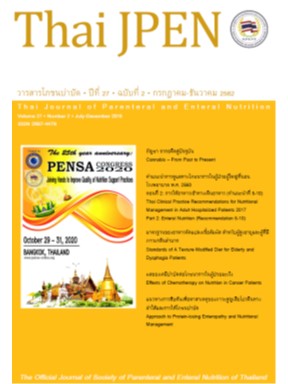
Effects of Chemotherapy on Nutrition in Cancer Patients
Keywords:
chemotherapy, adverse effect, nutrition, cancer patientAbstract
Cancer patients have high risks of malnutrition due to the cancer itself or the adverse effects of cancer treatment. Chemotherapy, particularly, has systemic effects on the body to kill cancer cells, but also affects the mucosal cells of the gastrointestinal tract, which are normal cells of the body that grow fast. It also aggravates poor diet intake or nutrient loss by causing taste/smell alteration, mucositis, nausea, vomiting, diarrhea, etc. Prolonged adverse symptoms leave the patients at risk of cancer cachexia that badly affects the quality of life. Physicians may consider postponing or stopping chemotherapy if patients have severe adverse symptoms resulting in cancer treatment failure and reduced survival rate. Appropriate nutritional advice to specific patients about their chemotherapy regimens and the possible consequences are mandatory to monitor potential problems and provide nutritional management immediately.
References
Perry MC, Doll DC, Freter CE, Hejleh TA, Ailor SK, Anderson CM, et al. Perry’s The Chemotherapy Source Book. 5th ed. Philadelphia: Wolters Kluwer; 2012:38-46.
Arends J, Baracos V, Bertz H, Bozzetti F, Calder PC, Deutz NEP, et al. ESPEN expert group recommendations for action against cancer-related malnutrition. Clin Nutr. 2017;36:1187-96.
Muscaritoli M, Lucia S, Farcomeni A, Lorusso V, Saracino V, Barone C, et al. Prevalence of malnutrition in patients at first medical oncology visit: the PreMiO study. Oncotarget. 2017; 8(45):79884-96.
จินนี่ เตโชนิมิต, ณัฏฐดา อารีเปี่ยม, ทิพวรรณ ศิริเฑียรทอง, บุษบา ตระการสง่า. ภาวะโภชนาการในผู้ป่วยมะเร็งเต้านมและลำไส้ใหญ่และไส้ตรงก่อนได้รับการรักษาด้วยยาเคมีบำบัด. วารสารโรคมะเร็ง 2561;38(1):1-10.
Caro MMM, Laviano A, Pichard C. Nutritional intervention and quality of life in adult oncology patients. Clin Nutr. 2007;26:289–301.
Muscaritoli M, Molfino A, Gioia G, Laviano A, Rossi Fanelli F. The "parallel pathway": a novel nutritional and metabolic approach to cancer patients. Intern Emerg Med. 2011;6(2):105-12.
Arends J, Bachmann P, Baracos V, Barthelemy N, Bertz H, Bozzetti F, et al. ESPEN guidelines on nutrition in cancer patients. Clin Nutr. 2017;36:11-48.
de Las Peñas R, Majem M, Perez-Altozano J, Virizuela JA, Cancer E, Diz P, et al. SEOM clinical guidelines on nutrition in cancer patients (2018). Clin Transl Oncol. 2019;21(1):87-93.
แบบคัดกรองภาวะโภชนาการ สมาคมผู้ให้อาหารทางหลอดเลือดดำและทางเดินอาหารแห่งประเทศไทย (SPENT Nutrition Screening Tool) [เข้าถึงเมื่อ 2562 กันยายน 25]; [1 หน้า]. เข้าถึงได้จาก: http://www.spent.or.th/uploads/event/แบบคัดกรองภาวะโภชนาการ%20new.pdf
Komindr S, Tangsermwong T, Janepanish P. Simplified malnutrition tool for Thai patients. Asia Pac J Clin Nutr. 2013;22:516-21.
Caillet P, Liuu E, Raynaud Simon A, Bonnefoy M, Guerin O, Berrut G, et al. Association between cachexia, chemotherapy and outcomes in older cancer patients: A systematic review. Clin Nutr. 2017;36(6):1473-82.
Custódio ID, Marinho EC, Gontijo CA, Pereira TS, Paiva CE, Maia YC. Impact of chemotherapy on diet and nutritional status of women with breast cancer: A Prospective Study. PLoS One. 2016;16:11-6.
Grant BL, Hamilton KK. Medical Nutrition Therapy for Cancer Prevention, Treatment, and Recovery. In: Mahan LK, Escott-stump S, Raymond JL, editors. Krause’s Food and the Nutrition Care Process. 13th ed. PA: Elsevier Saunders; 2012:832-56.
Peterson DE, Boers-Doets CB, Bensadoun RJ, Herrsted J. Management of oral and gastrointestinal mucosal injury: ESMO Clinical Practice Guidelines for diagnosis, treatment, and follow-up. Ann Oncol. 2015;26(suppl 5):139-51.
Sultani M, Stringer AM, Bowen JM, Gibson RJ. Anti-inflammatory cytokines: important immunoregulatory factors contributing to chemotherapy-induced gastrointestinal mucositis. Chemother Res Pract. 2012;2012:490804.
Kwon Y. Mechanism-based management for mucositis: option for treating side effects without compromising the efficacy of cancer therapy. Onco Targets Ther. 2016;9:2007-16.
Lalla RV, Bowen J, Barasch A, Elting L, Epstein J, Keefe DM, et al. MASCC/ISOO clinical practice guidelines for the management of mucositis secondary to cancer therapy. Cancer 2014;120:1453–61.
Warr DG, Street JC, Carides AD. Evaluation of risk factors predictive of nausea and vomiting with current standard-of-care antiemetic treatment: analysis of phase 3 trial of aprepitant in patients receiving adriamycin-cyclophosphamide-based chemotherapy. Support Care Cancer. 2011;19:807-13
Ettinger DS, Berger MJ, Aston J, Barbour S, Bergsbaken J, Brandit D, et al. NCCN Guideline: Antiemesis version 1.2019 [cited 2019 Jun 1]. Available from: URL: https://www.nccn.org/
Gamper E-M, Zabernigg A, Wintner LM, Giesinger JM, Oberguggenberger A, Kemmler G, et al. Coming to Your Senses: Detecting Taste and Smell Alterations in Chemotherapy Patients. A Systematic Review. J Pain Symptom Manag. 2012;44(6):880-95.
Hong JH, Omur-Ozbek P, Stanek BT, Dietrich AM, Duncan SE, Lee YW, et al. Taste and odor abnormalities in cancer patients. J Support Oncol. 2009;7:58-65.
Epstein JB, Barasch A. Taste disorders in cancer patients: pathogenesis, and approach to assessment and management. Oral Oncol. 2010;46:77-81.
Steinbach S, Hummel T, Böhner C, Berktold S, Hundt W, Kriner M, et al. Qualitative and quantitative assessment of taste and smell changes in patients undergoing chemotherapy for breast Cancer or gynecologic malignancies. J Clin Oncol. 2009;27(11):1899-905.
Steinbach S, Hundt W, Schmalfeldt B, Böhner C, Berktold S, Wolf P, et al. Effect of platinum-containing chemotherapy on olfactory, gustatory, and hearing function in ovarian cancer patients. Arch Gynecol Obstet. 2012;286(2):473-80.
Rehwaldt M, Wickham R, Purl S, Tariman J, Blendowski C, Shott S et al. Self-care strategies to cope with taste changes after chemotherapy. Oncol Nurs Forum. 2009;36:E47-56.
Bossi P, Antonuzzo A, Cherny NI, Rosengarten O, Pernot S, Trippa F, et al Diarrhoea in adult cancer patients: ESMO Clinical Practice Guidelines. Ann Oncol. 2018;4:126-42.
Meta-Analysis Group In Cancer, Le´vy E, Piedbois P, Buyse M, Pignon JP, Rougier P, et al. Toxicity of fluorouracil in patients with advanced colorectal cancer: effect of administration schedule and prognostic factors. J Clin Oncol. 1998;16:3537–41.
Yumuk PF, Aydin SZ, Dane F, Gumus M, Ekenel M, Aliustaoglu M, et al. The absence of early diarrhea with atropine premedication during irinotecan therapy in metastatic colorectal patients. Int J Colorectal Dis. 2004;19:609-10.
Stein A. Chemotherapy-induced diarrhea: pathophysiology, frequency and guideline-based management. Ther Adv Med Oncol. 2010;2:51–63.
Downloads
Published
How to Cite
Issue
Section
License
The content and information in the articles published in Thai JPEN วารสารโภชนบำบัด, are the opinions and responsibility of the authors directly. The editorial team is not obliged to agree or take any responsibility.
All articles, content, figures, etc. that have been published in Thai JPEN วารสารโภชนบำบัด are the copyright of Thai JPEN วารสารโภชนบำบัด. If any person or organization require distribution of all or any part of them, please send the request for the written permission from Thai JPEN วารสารโภชนบำบัด only.

